Chapter 6: Applications of Definite Integrals
OVERVIEW In Chapter 5 we saw that a continuous function over a closed interval has a definite integral, which is the limit of Riemann sum approximations for the function. We found a way to evaluate definite integrals using the Fundamental Theorem of Calculus. We saw that the area under a curve and the area between two curves could be defined and computed as definite integrals. In this chapter we will see some of the many additional applications of definite integrals. We will use the definite integral to define and find volumes, lengths of plane curves, and areas of surfaces of revolution. We will see how integrals are used to solve physical problems involving the work done by a force, and how they give the location of an object’s center of mass. The integral arises in these and other applications in which we can approximate a desired quantity by Riemann sums. The limit of those Riemann sums, which is the quantity we seek, is given by a definite integral.
6.1 Volumes Using Cross-Sections
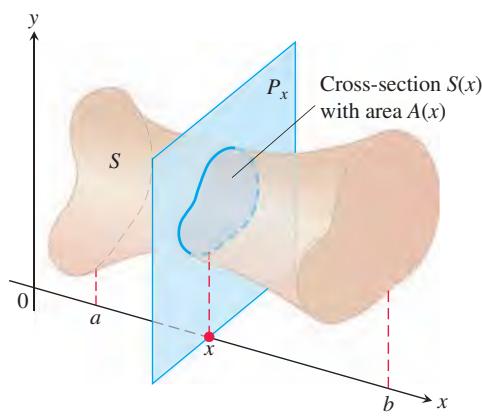
In this section we define volumes of solids by using the areas of their cross-sections. A cross-section of a solid S is the planar region formed by intersecting S with a plane (Figure 6.1). We present three different methods for obtaining the cross-sections appropriate to finding the volume of a particular solid: the method of slicing, the disk method, and the washer method.
Suppose that we want to find the volume of a solid S like the one pictured in Figure 6.1. At each point x in the interval
FIGURE 6.1 A cross-section
Before showing how this method works, we need to extend the definition of a cylinder from the usual cylinders of classical geometry (which have circular, square, or other regular bases) to cylindrical solids that have more general bases. As shown in Figure 6.2, if the cylindrical solid has a base whose area is A and its height is h, then the volume of the cylindrical solid is
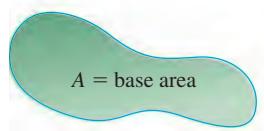
Plane region whose area we know
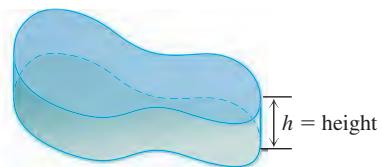
Cylindrical solid based on region Volume = base area × height = Ah
FIGURE 6.2 The volume of a cylindrical solid is equal to its base area times its height.
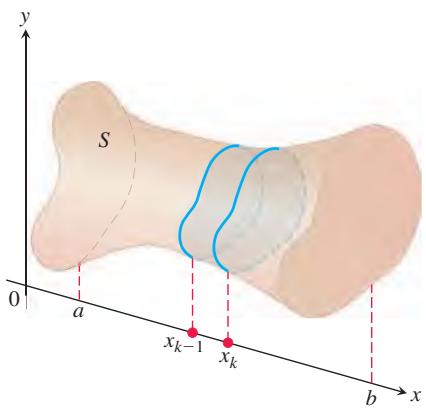
FIGURE 6.3 A typical thin slab in the solid S.
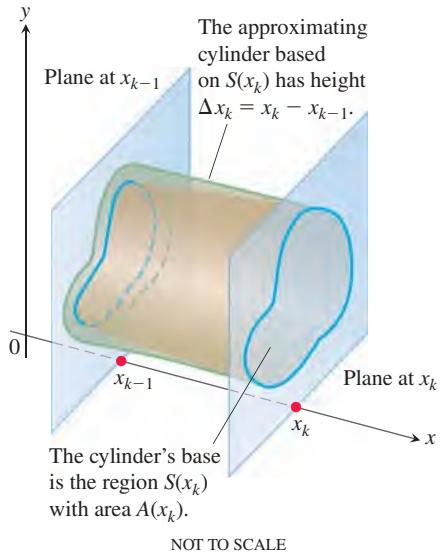
FIGURE 6.4 The solid thin slab in Figure 6.3 is shown enlarged here. It is approximated by the cylindrical solid with base
In the method of slicing, the base will be the cross-section of S that has area
Slicing by Parallel Planes
We partition
Volume of the kth slab
The volume V of the entire solid S is therefore approximated by the sum of these cylindrical volumes,
This is a Riemann sum for the function
Therefore, we define this definite integral to be the volume of the solid S.
DEFINITION The volume of a solid of integrable cross-sectional area
from x = a to x = b is the integral of A from a to b, 𝐴 ( 𝑥 ) 𝑉 = ∫ 𝑏 𝑎 𝐴 ( 𝑥 ) 𝑑 𝑥 .
This definition applies whenever
Calculating the Volume of a Solid
-
Sketch the solid and a typical cross-section.
-
Find a formula for
𝐴 ( 𝑥 ) -
Find the limits of integration.
-
Integrate
𝐴 ( 𝑥 )
EXAMPLE 1 A pyramid 3 meters high has a square base that is 3 meters on a side. The cross-section of the pyramid perpendicular to the altitude x meters down from the vertex is a square x meters on a side. Find the volume of the pyramid.
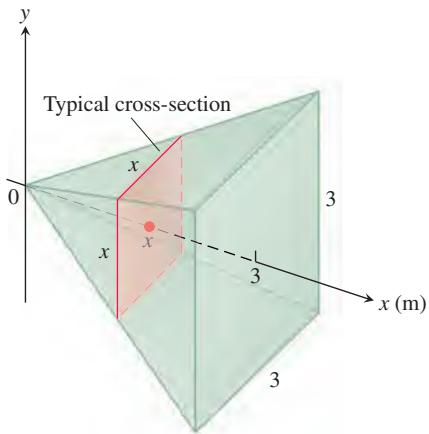
FIGURE 6.5 The cross-sections of the pyramid in Example 1 are squares.
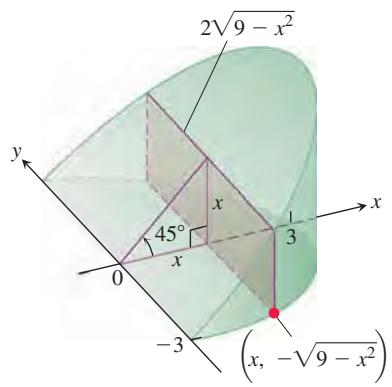
FIGURE 6.6 The wedge of Example 2, sliced perpendicular to the x-axis. The cross-sections are rectangles.
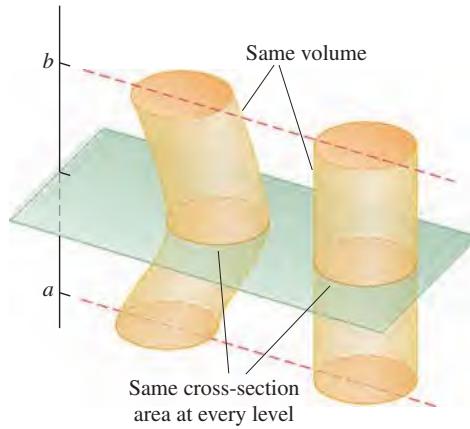
FIGURE 6.7 Cavalieri’s principle: These solids have the same volume (imagine each solid as a stack of coins).
Solution
-
A sketch. We draw the pyramid with its altitude along the
𝑥 -
A formula for
𝐴 ( 𝑥 )
-
The limits of integration. The squares lie on the planes from
𝑥 = 0 𝑥 = 3 -
Integrate to find the volume:
EXAMPLE 2 A curved wedge is cut from a circular cylinder of radius 3 by two planes. One plane is perpendicular to the axis of the cylinder. The second plane crosses the first plane at a
Solution We draw the wedge and sketch a typical cross-section perpendicular to the x-axis (Figure 6.6). The base of the wedge in the figure is the semicircle with
The rectangles run from
EXAMPLE 3 Cavalieri’s principle says that solids with equal altitudes and identical cross-sectional areas at each height have the same volume (Figure 6.7). This follows immediately from the definition of volume, because the cross-sectional area function
Solids of Revolution: The Disk Method
The solid generated by rotating (or revolving) a planar region about an axis in its plane is called a solid of revolution. To find the volume of a solid like the one shown in Figure 6.8, we first observe that the cross-sectional area
Therefore, the definition of volume gives us the following formula.
HISTORICAL BIOGRAPHY Bonaventura Cavalieri (1598–1647)
Cavalieri was born in Milan, Italy. At a young age, Cavalieri began studying geometry. Later, he studied from and worked with Galileo; the two mathematicians often corresponded through letters. Cavalieri learned the foundations of calculus and developed his ideas on the method of indivisibles, which was his major contribution to mathematics.
Volume by Disks for Rotation About the x-Axis
To know more, visit the companion Website.
This method for calculating the volume of a solid of revolution is often called the disk method because a cross-section is a circular disk of radius
EXAMPLE 4 The region between the curve
Solution We draw the region and a typical radius (Figure 6.8a) and the generated solid (Figure 6.8b). The volume is
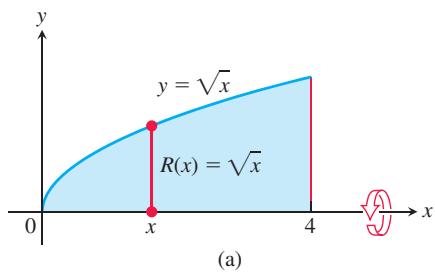
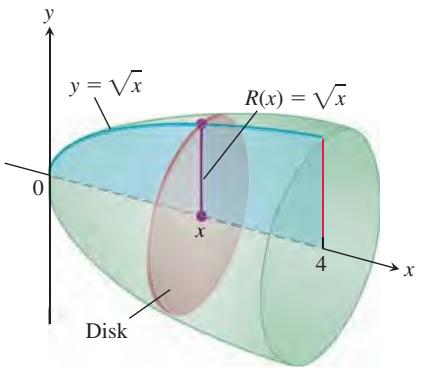
FIGURE 6.8 The region (a) and solid of revolution (b) in Example 4.
EXAMPLE 5 The circle
is rotated about the x-axis to generate a sphere. Find its volume.
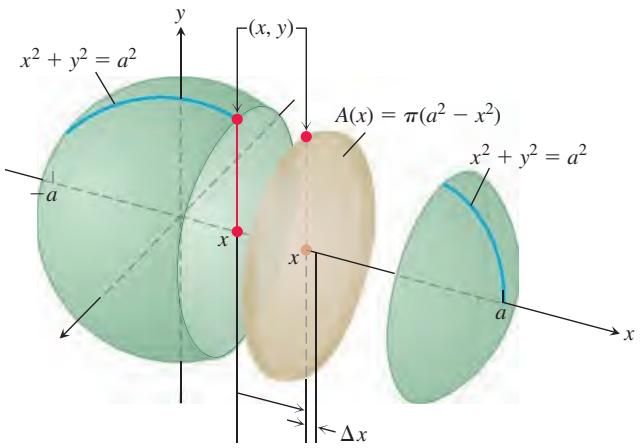
FIGURE 6.9 The sphere generated by rotating the circle
Solution We imagine the sphere cut into thin slices by planes perpendicular to the x-axis (Figure 6.9). The cross-sectional area at a typical point x between -a and a is
(b)
Therefore, the volume is
The axis of revolution in the next example is not the x-axis, but the rule for calculating the volume is the same: Integrate
EXAMPLE 6 Find the volume of the solid generated by revolving the region bounded by
Solution We draw the region and a typical radius (Figure 6.10a), and the generated solid (Figure 6.10b). The volume is
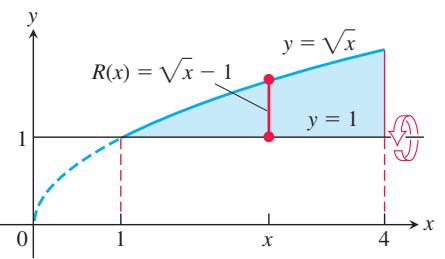
(a)
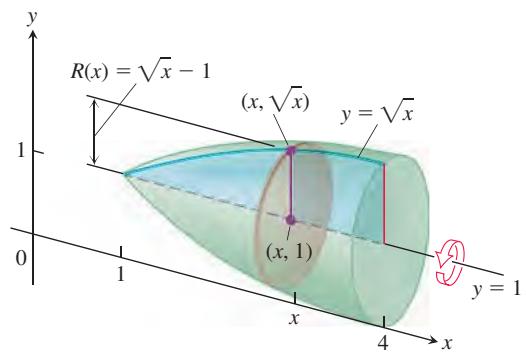
FIGURE 6.10 The region (a) and solid of revolution (b) in Example 6.
To find the volume of a solid generated by revolving a region between the y-axis and a curve
and the definition of volume gives us the following formula.
Volume by Disks for Rotation About the y-Axis
EXAMPLE 7 Find the volume of the solid generated by revolving the region between the y-axis and the curve
(a)
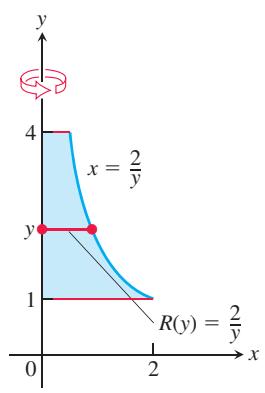
(a)
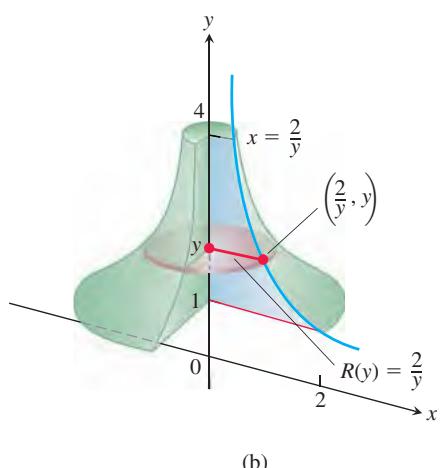
FIGURE 6.11 The region (a) and part of the solid of revolution (b) in Example 7.
Solution We draw the region and a typical radius (Figure 6.11a) and the generated solid (Figure 6.11b). The volume is
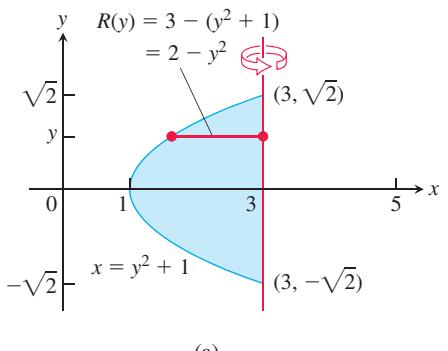
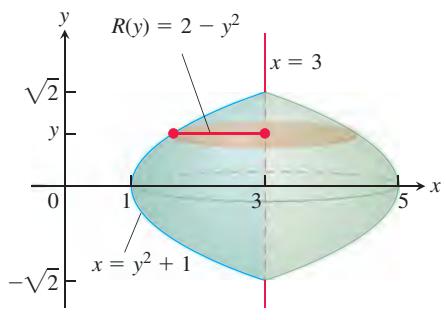
EXAMPLE 8 Find the volume of the solid generated by revolving the region between the parabola
Solution We draw the region and a typical radius (Figure 6.12a) and the generated solid (Figure 6.12b). Note that the cross-sections are perpendicular to the line x = 3 and have y-coordinates from
(b)
FIGURE 6.12 The region (a) and solid of revolution (b) in Example 8.
Solids of Revolution: The Washer Method
If the region we revolve to generate a solid does not border on or cross the axis of revolution, then the solid has a hole in it (Figure 6.13). The cross-sections perpendicular to the axis of revolution are washers (the purplish circular surface in Figure 6.13) instead of disks. The dimensions of a typical washer are
Inner radius:
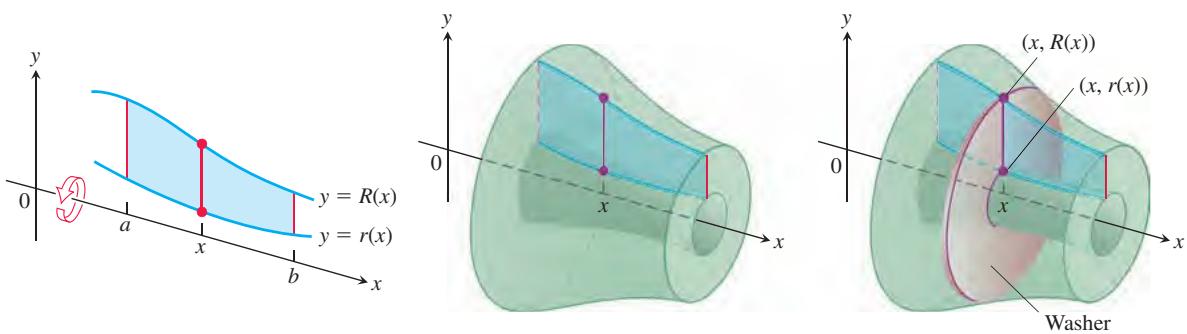
FIGURE 6.13 The cross-sections of the solid of revolution generated here are washers, not disks, so the integral
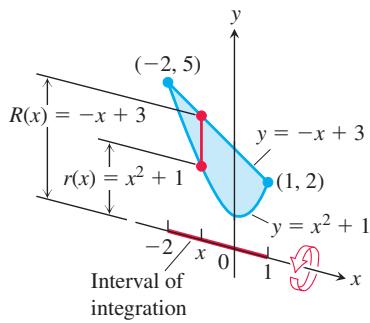
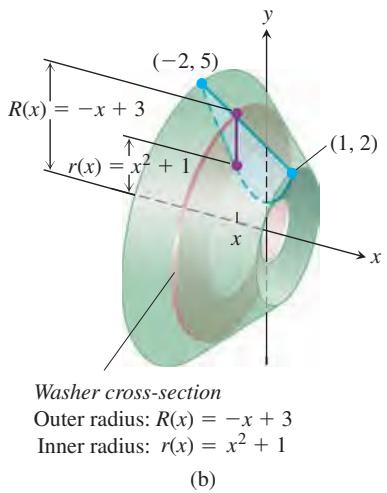
FIGURE 6.14 (a) The region in Example 9 spanned by a line segment perpendicular to the axis of revolution. (b) When the region is revolved about the x-axis, the line segment generates a washer.
The washer’s area is the area of a circle of radius
Consequently, the definition of volume in this case gives us the following formula.
Volume by Washers for Rotation About the x-Axis
This method for calculating the volume of a solid of revolution is called the washer method because a thin slab of the solid resembles a circular washer with outer radius
EXAMPLE 9 The region bounded by the curve
Solution We draw the region and sketch a line segment across it perpendicular to the axis of revolution (the red segment in Figure 6.14a). We then find the outer and inner radii of the washer that would be swept out by the line segment if it were revolved about the x-axis along with the region. These radii are the distances of the ends of the line segment from the axis of revolution (see Figure 6.14).
Outer radius:
Inner radius:
We obtain the limits of integration by finding the x-coordinates of the intersection points of the curve and line in Figure 6.14a.
The volume is
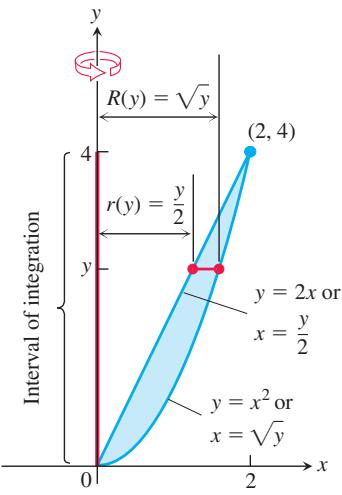
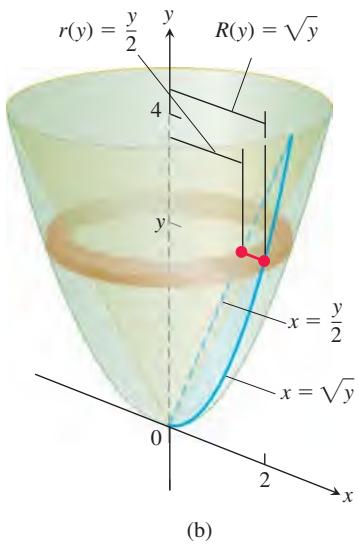
To find the volume of a solid formed by revolving a region about the y-axis, we use the same procedure as in Example 9, but integrate with respect to y instead of x. In this situation, the line segment sweeping out a typical washer is perpendicular to the y-axis (the axis of revolution), and the outer and inner radii of the washer are functions of y.
EXAMPLE 10 The region bounded by the parabola
Solution First we sketch the region and draw a line segment across it perpendicular to the axis of revolution (the y-axis). See Figure 6.15a.
The radii of the washer swept out by the line segment are
The line and parabola intersect at
Rotation around y-axis
FIGURE 6.15 (a) The region being rotated about the y-axis, the washer radii, and limits of integration in Example 10. (b) The washer swept out by the line segment in part (a).
Substitute for radii and limits of integration.
Exercises 6.1
Volumes by Slicing
Find the volumes of the solids in Exercises 1–10.
-
The solid lies between planes perpendicular to the
𝑥 𝑥 = 0 𝑥 = 4 0 ≤ 𝑥 ≤ 4 𝑦 = − √ 𝑥 𝑦 = √ 𝑥 -
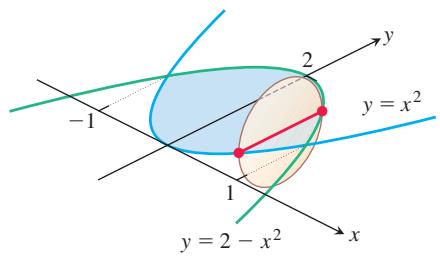
The solid lies between planes perpendicular to the x-axis at x = -1 and x = 1. The cross-sections perpendicular to the x-axis are circular disks whose diameters run from the parabola
𝑦 = 𝑥 2 𝑦 = 2 − 𝑥 2
-
The solid lies between planes perpendicular to the x-axis at x = -1 and x = 1. The cross-sections perpendicular to the x-axis between these planes are squares whose bases run from the semicircle
𝑦 = − √ 1 − 𝑥 2 𝑦 = √ 1 − 𝑥 2 -
The solid lies between planes perpendicular to the
𝑥 𝑥 = − 1 𝑥 = 1 𝑥 𝑦 = − √ 1 − 𝑥 2 𝑦 = √ 1 − 𝑥 2 -
The base of a solid is the region between the curve
𝑦 = 2 √ s i n 𝑥 [ 0 , 𝜋 ] 𝑥 𝑥
a. equilateral triangles with bases running from the x-axis to the curve as shown in the accompanying figure.
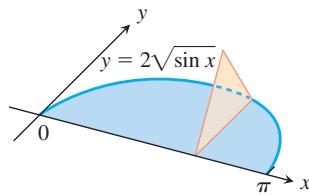
b. squares with bases running from the x-axis to the curve.
- The solid lies between planes perpendicular to the x-axis at
𝑥 = − 𝜋 / 3 𝑥 = 𝜋 / 3
a. circular disks with diameters running from the curve
b. squares whose bases run from the curve
- The base of a solid is the region bounded by the graphs of y = 3x, y = 6, and x = 0. The cross-sections perpendicular to the x-axis are
a. rectangles of height 10.
b. rectangles of perimeter 20.
- The base of a solid is the region bounded by the graphs of
𝑦 = √ 𝑥 𝑦 = 𝑥 / 2 𝑥
b. semicircles with diameters running across the base of the solid.
-
The solid lies between planes perpendicular to the y-axis at y = 0 and y = 2. The cross-sections perpendicular to the y-axis are circular disks with diameters running from the y-axis to the parabola
𝑥 = √ 5 𝑦 2 -
The base of the solid is the disk
𝑥 2 + 𝑦 2 ≤ 1 𝑦 𝑦 = − 1 𝑦 = 1
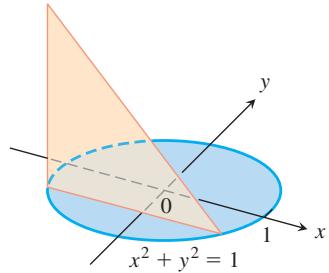
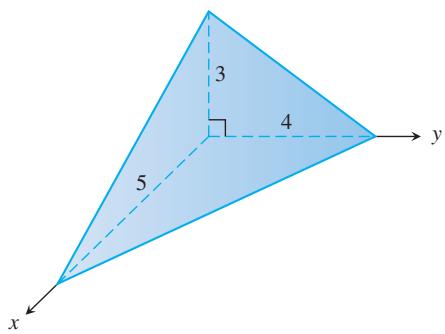
- Find the volume of the given right tetrahedron. (Hint: Consider slices perpendicular to one of the labeled edges.)
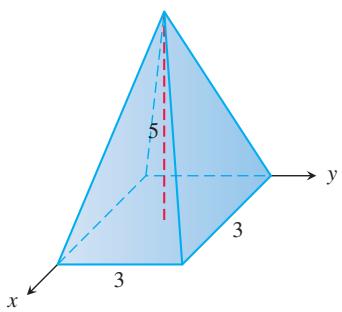
- Find the volume of the given pyramid, which has a square base of area 9 and height 5.
- A twisted solid A square of side length s lies in a plane perpendicular to a line L. One vertex of the square lies on L. As this square moves a distance h along L, the square turns one revolution about L to generate a corkscrew-like column with square cross-sections.
a. Find the volume of the column.
b. What will the volume be if the square turns twice instead of once? Give reasons for your answer.
- Cavalieri’s principle A solid lies between planes perpendicular to the
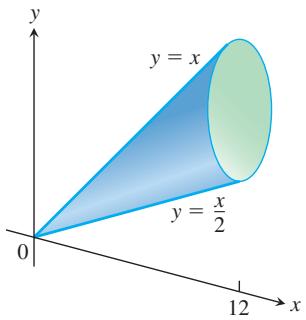
𝑥 𝑥 = 0 𝑥 = 1 2 𝑥 𝑦 = 𝑥 / 2 𝑦 = 𝑥
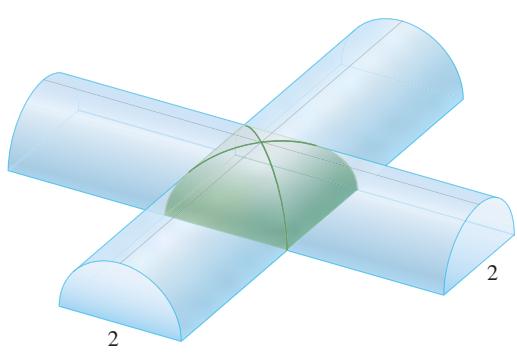
- Intersection of two half-cylinders Two half-cylinders of diameter 2 meet at a right angle in the accompanying figure. Find the volume of the solid region common to both half-cylinders. (Hint: Consider slices parallel to the base of the solid.)
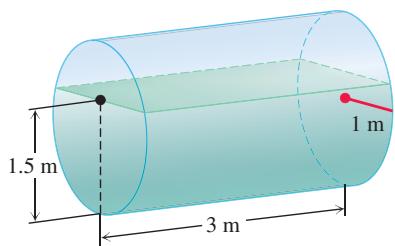
- Gasoline in a tank A gasoline tank is in the shape of a right circular cylinder (lying on its side) of length 3 m and radius 1 m. Set up an integral that represents the volume of the gas in the tank if it is filled to a depth of 1.5 m. You will learn how to compute this integral in Chapter 8 (or you may use geometry to find its value).
Volumes by the Disk Method
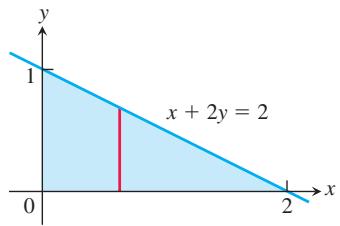
In Exercises 17–20, find the volume of the solid generated by revolving the shaded region about the given axis.
- About the
𝑥
-
About the
𝑦 -
About the y-axis
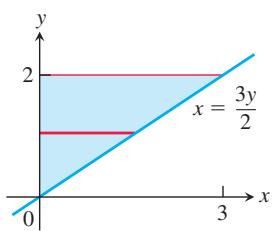
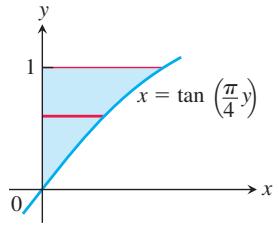
- About the x-axis
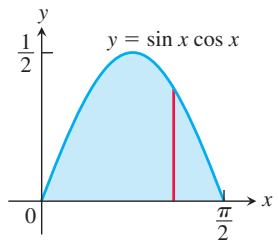
Find the volumes of the solids generated by revolving the regions bounded by the lines and curves in Exercises 21–30 about the x-axis.
-
𝑦 = 𝑥 2 𝑦 = 0 𝑥 = 2 -
𝑦 = 𝑥 3 𝑦 = 0 𝑥 = 2
-
𝑦 = √ c o s 𝑥 , 0 ≤ 𝑥 ≤ 𝜋 / 2 , 𝑦 = 0 , 𝑥 = 0 -
𝑦 = s e c 𝑥 , 𝑦 = 0 , 𝑥 = − 𝜋 / 4 , 𝑥 = 𝜋 / 4 -
𝑦 = 𝑒 − 𝑥 𝑦 = 0 𝑥 = 0 𝑥 = 1 -
The region between the curve
𝑦 = √ c o t 𝑥 𝑥 = 𝜋 / 6 𝑥 = 𝜋 / 2 -
The region between the curve
𝑦 = 1 / ( 2 √ 𝑥 ) 𝑥 𝑥 = 1 / 4 𝑥 = 4 -
𝑦 = 𝑒 𝑥 − 1 , 𝑦 = 0 , 𝑥 = 1 , 𝑥 = 3
In Exercises 31 and 32, find the volume of the solid generated by revolving the region about the given line.
-
The region in the first quadrant bounded above by the line
𝑦 = √ 2 𝑦 = s e c 𝑥 t a n 𝑥 𝑦 𝑦 = √ 2 -
The region in the first quadrant bounded above by the line y = 2, below by the curve
𝑦 = 2 s i n 𝑥 0 ≤ 𝑥 ≤ 𝜋 / 2
Find the volumes of the solids generated by revolving the regions bounded by the lines and curves in Exercises 33–38 about the y-axis.
-
The region enclosed by
𝑥 = √ 5 𝑦 2 -
The region enclosed by
𝑥 = 𝑦 3 / 2 𝑥 = 0 𝑦 = 2 -
The region enclosed by
𝑥 = √ 2 s i n 2 𝑦 0 ≤ 𝑦 ≤ 𝜋 / 2 -
The region enclosed by
𝑥 = √ c o s ( 𝜋 𝑦 / 4 ) − 2 ≤ 𝑦 ≤ 0 -
𝑥 = 2 / √ 𝑦 + 1 -
𝑥 = √ 2 𝑦 / ( 𝑦 2 + 1 ) , 𝑥 = 0 , 𝑦 = 1
Volumes by the Washer Method
Find the volumes of the solids generated by revolving the shaded regions in Exercises 39 and 40 about the indicated axes.
- The
𝑥
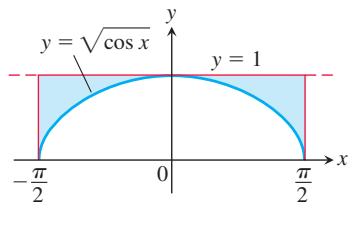
- The y-axis
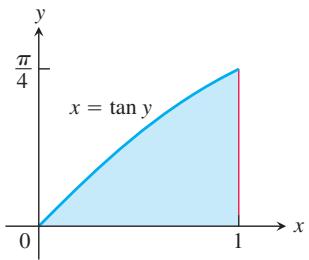
Find the volumes of the solids generated by revolving the regions bounded by the lines and curves in Exercises 41–46 about the x-axis.
-
𝑦 = 𝑥 , 𝑦 = 1 , 𝑥 = 0 -
𝑦 = 2 √ 𝑥 , 𝑦 = 2 , 𝑥 = 0 -
𝑦 = 𝑥 2 + 1 , 𝑦 = 𝑥 + 3 -
𝑦 = 4 − 𝑥 2 , 𝑦 = 2 − 𝑥 -
𝑦 = s e c 𝑥 , 𝑦 = √ 2 , − 𝜋 / 4 ≤ 𝑥 ≤ 𝜋 / 4 -
𝑦 = s e c 𝑥 , 𝑦 = t a n 𝑥 , 𝑥 = 0 , 𝑥 = 1
In Exercises 47–50, find the volume of the solid generated by revolving each region about the y-axis.
-
The region enclosed by the triangle with vertices
( 1 , 0 ) ( 2 , 1 ) ( 1 , 1 ) -
The region enclosed by the triangle with vertices
( 0 , 1 ) ( 1 , 0 ) ( 1 , 1 ) -
The region in the first quadrant bounded above by the parabola
𝑦 = 𝑥 2 -
The region in the first quadrant bounded on the left by the circle
𝑥 2 + 𝑦 2 = 3 𝑥 = √ 3 𝑦 = √ 3
In Exercises 51 and 52, find the volume of the solid generated by revolving each region about the given axis.
-
The region in the first quadrant bounded above by the curve
𝑦 = 𝑥 2 𝑥 𝑥 = 1 𝑥 = − 1 -
The region in the second quadrant bounded above by the curve
𝑦 = − 𝑥 3
Volumes of Solids of Revolution
-
Find the volume of the solid generated by revolving the region bounded by
𝑦 = √ 𝑥 𝑦 = 2 𝑥 = 0 𝑥 𝑦 𝑦 = 2 𝑥 = 4 -
Find the volume of the solid generated by revolving the triangular region bounded by the lines y = 2x, y = 0, and x = 1 about a. the line x = 1. b. the line x = 2.
-
Find the volume of the solid generated by revolving the region bounded by the parabola
𝑦 = 𝑥 2 𝑦 = 1 𝑦 = 1 𝑦 = 2 𝑦 = − 1 -
By integration, find the volume of the solid generated by revolving the triangular region with vertices
( 0 , 0 ) ( 𝑏 , 0 ) ( 0 , ℎ )
Theory and Applications
-
The volume of a torus The disk
𝑥 2 + 𝑦 2 ≤ 𝑎 2 𝑥 = 𝑏 ( 𝑏 > 𝑎 ) ∫ 𝑎 − 𝑎 √ 𝑎 2 − 𝑦 2 𝑑 𝑦 = 𝜋 𝑎 2 / 2 𝑎 -
Volume of a bowl A bowl has a shape that can be generated by revolving the graph of
𝑦 = 𝑥 2 / 2
a. Find the volume of the bowl.
b. Related rates If we fill the bowl with water at a constant rate of 3 cubic units per second, how fast will the water level in the bowl be rising when the water is 4 units deep?
- Volume of a bowl
a. A hemispherical bowl of radius a contains water to a depth h. Find the volume of water in the bowl.
b. Related rates Water runs into a sunken concrete hemispherical bowl of radius 5 m at the rate of
-
Explain how you could estimate the volume of a solid of revolution by measuring the shadow cast on a table parallel to its axis of revolution by a light shining directly above it.
-
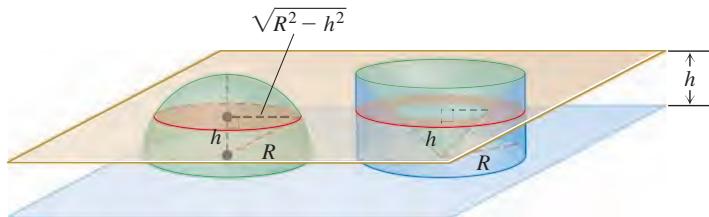
Volume of a hemisphere Derive the formula
𝑉 = ( 2 / 3 ) 𝜋 𝑅 3
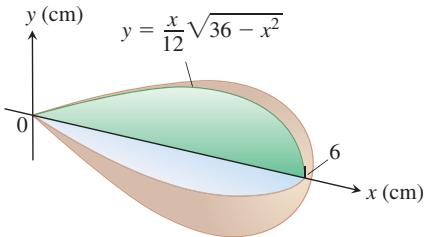
- Designing a plumb bob Having been asked to design a brass plumb bob that will weigh in the neighborhood of
1 9 0 g 8 . 5 g / c m 3
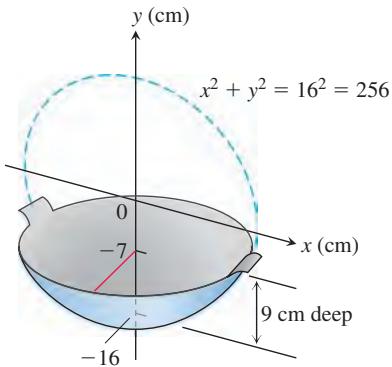
- Designing a wok You are designing a wok frying pan that will be shaped like a spherical bowl with handles. A bit of experimentation at home persuades you that you can get one that holds about 3 L if you make it 9 cm deep and give the sphere a radius of 16 cm. To be sure, you picture the wok as a solid of revolution, as shown here, and calculate its volume with an integral. To the nearest cubic centimeter, what volume do you really get? (1 L = 1000 cm
3
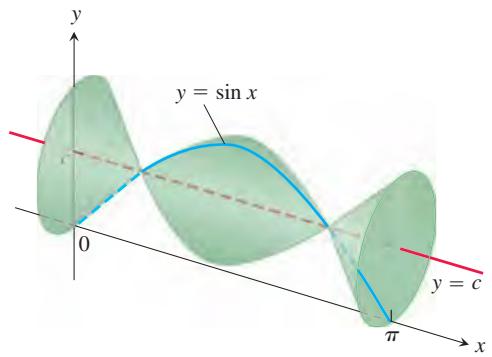
- Max-min The arch
𝑦 = s i n 𝑥 , 0 ≤ 𝑥 ≤ 𝜋 𝑦 = 𝑐 , 0 ≤ 𝑐 ≤ 1
a. Find the value of
b. What value of
T c. Graph the solid’s volume as a function of
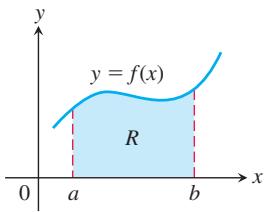
- Consider the region R bounded by the graphs of
𝑦 = 𝑓 ( 𝑥 ) > 0 4 𝜋 8 𝜋
- Consider the region R given in Exercise 65. If the volume of the solid formed by revolving R around the x-axis is
6 𝜋 1 0 𝜋
6.2 Volumes Using Cylindrical Shells
In Section 6.1 we defined the volume of a solid to be the definite integral
Slicing with Cylinders
Suppose we slice through the solid using circular cylinders of increasing radii, like cookie cutters. We slice straight down through the solid so that the axis of each cylinder is parallel to the y-axis. The vertical axis of each cylinder is always the same line, but the radii of the cylinders increase with each slice. In this way the solid is sliced up into thin cylindrical shells of constant thickness that grow outward from their common axis, like circular tree rings. Unrolling a cylindrical shell shows that its volume is approximately that of a rectangular slab with area
EXAMPLE 1 The region enclosed by the x-axis and the parabola
Solution Using the washer method from Section 6.1 would be awkward here because we would need to express the x-values of the left and right sides of the parabola in Figure 6.16a in terms of y. This is because these x-values, which describe the inner and outer radii of a typical washer, are solutions to the equation
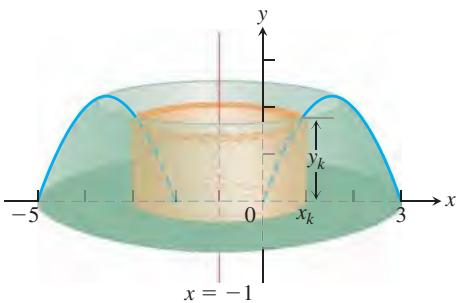
FIGURE 6.17 A cylindrical shell of height
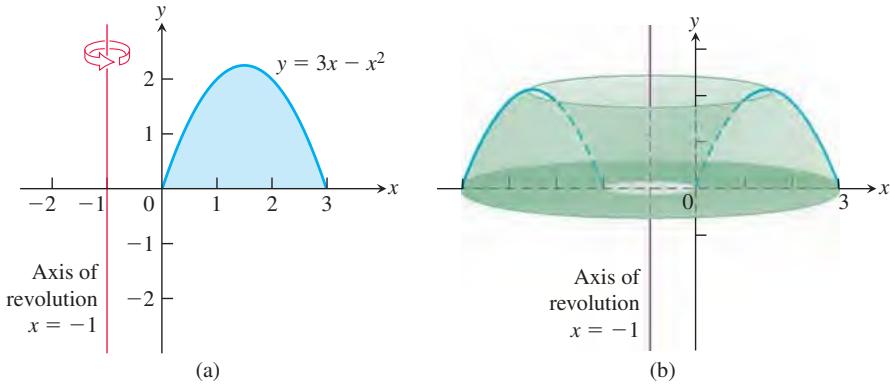
FIGURE 6.16 (a) The graph of the region in Example 1, before revolution. (b) The solid formed when the region in part (a) is revolved about the axis of revolution
Each shell sits over a subinterval
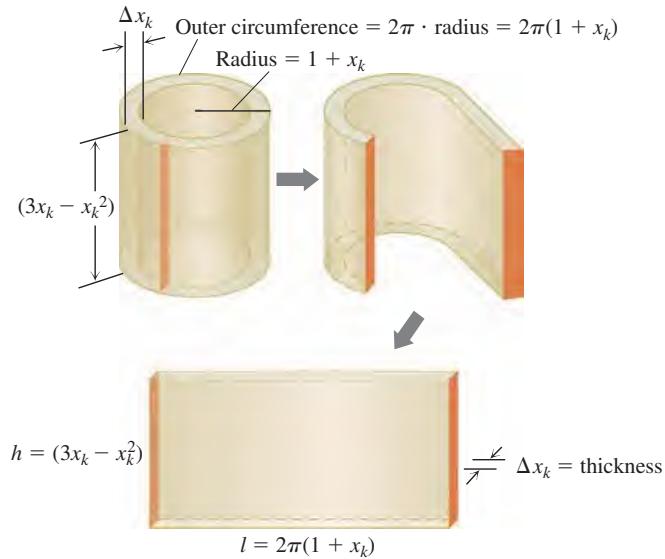
FIGURE 6.18 Cutting and unrolling a cylindrical shell gives a nearly rectangular solid (Example 1).
Summing together the volumes
Taking the limit as the thickness
We now generalize this procedure to a broader class of solids.
The Shell Method
Suppose that the region bounded by the graph of a nonnegative continuous function
Let P be a partition of the interval
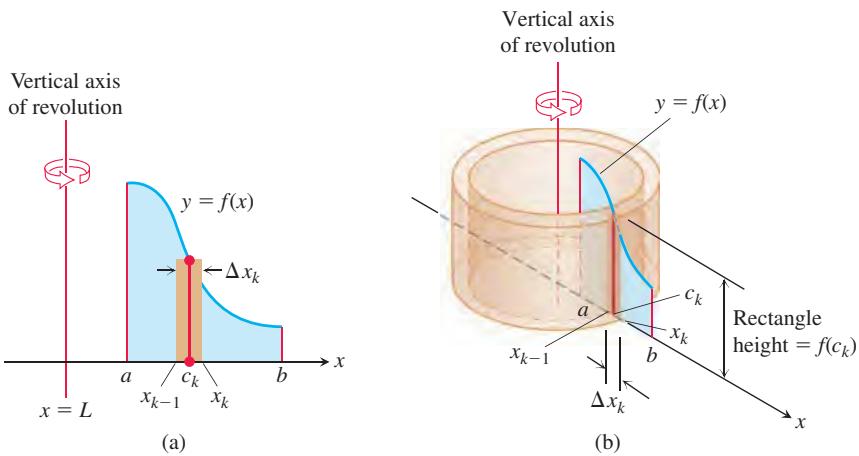
FIGURE 6.19 When the region shown in (a) is revolved about the vertical line x = L, a solid is produced which can be sliced into cylindrical shells. A typical shell is shown in (b).
The volume of a cylindrical shell of height h with inner radius r and outer radius R is
We approximate the volume of the solid S by summing the volumes of the shells swept out by the n rectangles:
The limit of this Riemann sum as each
We refer to the variable of integration, here x, as the thickness variable. To emphasize the process of the shell method, we state the general formula in terms of the shell radius and shell height. This will allow for rotations about a horizontal line y = L as well.
Shell Formula for Revolution About a Vertical Line
The volume of the solid generated by revolving the region between the x-axis and the graph of a continuous function
EXAMPLE 2 The region bounded by the curve
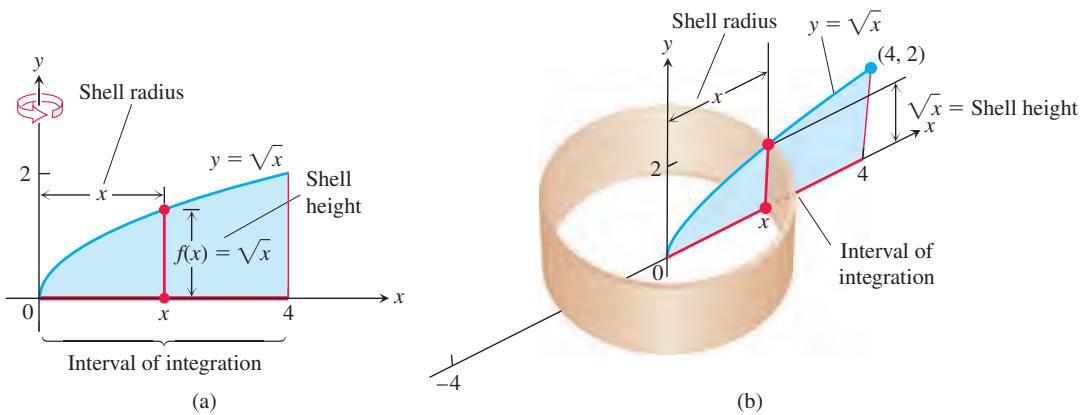
Solution Sketch the region and draw a line segment across it parallel to the axis of revolution (Figure 6.20a). Label the segment’s height (shell height) and distance from the axis of revolution (shell radius). (We drew the shell in Figure 6.20b, but you need not do that.)
FIGURE 6.20 (a) The region, shell dimensions, and interval of integration in Example 2. (b) The shell swept out by the vertical segment in part (a) with a width
The shell thickness variable is
So far, we have used vertical axes of revolution. For horizontal axes, we replace the
EXAMPLE 3 The region bounded by the curve
Solution This is the solid whose volume was found by the disk method in Example 3 of Section 6.1. Now we find its volume by the shell method. First, sketch the region and draw a line segment across it parallel to the axis of revolution (Figure 6.21a). Label the segment’s length (shell height) and distance from the axis of revolution (shell radius). (We drew the shell in Figure 6.21b, but you need not do that.)
In this case, the shell thickness variable is y, so the limits of integration for the shell formula method are a = 0 and b = 2 (along the y-axis in Figure 6.21). The volume of the solid is
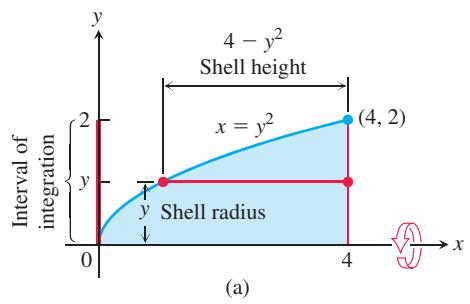
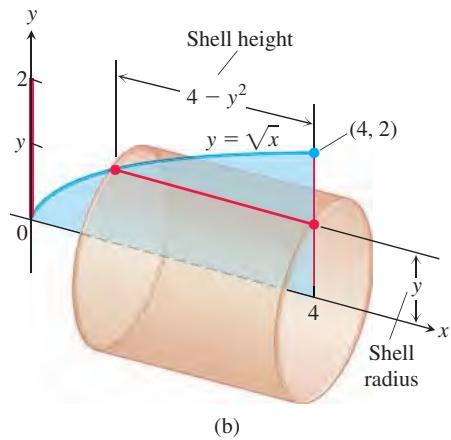
FIGURE 6.21 (a) The region, shell dimensions, and interval of integration in Example 3. (b) The shell swept out by the horizontal segment in part (a) with a width
Summary of the Shell Method
Regardless of the position of the axis of revolution (horizontal or vertical), the steps for implementing the shell method are these.
-
Draw the region and sketch a line segment across it parallel to the axis of revolution. Label the segment’s height or length (shell height) and distance from the axis of revolution (shell radius).
-
Find the limits of integration for the thickness variable.
-
Integrate the product
2 𝜋
The shell method gives the same answer as the washer method when both are used to calculate the volume of a region. We do not prove that result here, but it is illustrated in Exercises 37 and 38. (Exercise 45 outlines a proof.) Both volume formulas are actually special cases of a general volume formula we will look at when studying double and triple integrals in Chapter 14. That general formula also allows for computing volumes of solids other than those swept out by regions of revolution.
EXERCISES 6.2
Revolution About the Axes
In Exercises 1–6, use the shell method to find the volumes of the solids generated by revolving the shaded region about the indicated axis.
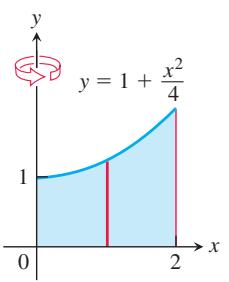
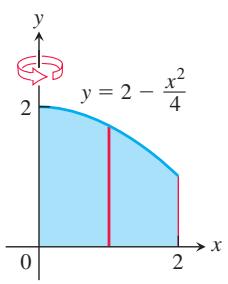
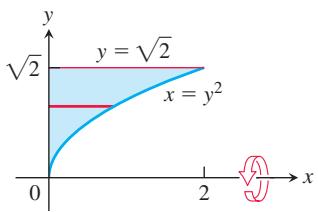
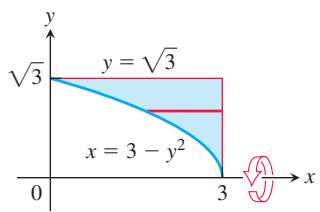
- The y-axis
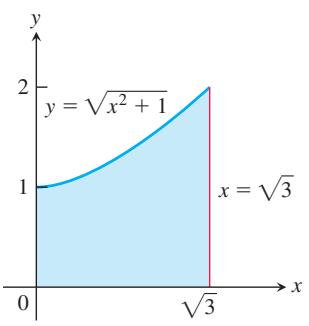
- The y-axis
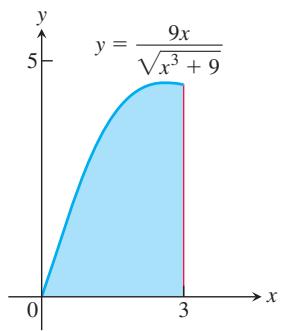
Revolution About the y-Axis
Use the shell method to find the volumes of the solids generated by revolving the regions bounded by the curves and lines in Exercises 7–12 about the y-axis.
-
𝑦 = 𝑥 , 𝑦 = − 𝑥 / 2 , 𝑥 = 2 -
𝑦 = 2 𝑥 , 𝑦 = 𝑥 / 2 , 𝑥 = 1 -
𝑦 = 𝑥 2 , 𝑦 = 2 − 𝑥 , 𝑥 = 0 , f o r 𝑥 ≥ 0 -
𝑦 = 2 − 𝑥 2 , 𝑦 = 𝑥 2 , 𝑥 = 0 -
𝑦 = 2 𝑥 − 1 , 𝑦 = √ 𝑥 , 𝑥 = 0 -
𝑦 = 3 / ( 2 √ 𝑥 ) , 𝑦 = 0 , 𝑥 = 1 , 𝑥 = 4 -
Let
𝑓 ( 𝑥 ) = { ( s i n 𝑥 ) / 𝑥 , 0 < 𝑥 ≤ 𝜋 1 , 𝑥 = 0 .
a. Show that
b. Find the volume of the solid generated by revolving the shaded region about the y-axis in the accompanying figure.
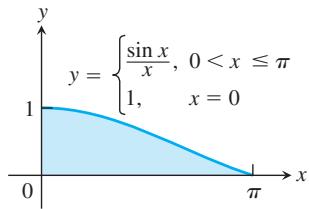
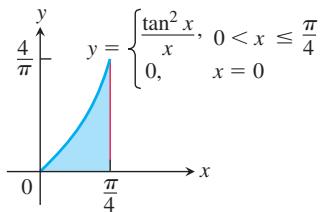
- Let
𝑔 ( 𝑥 ) = { ( t a n 𝑥 ) 2 / 𝑥 , 0 < 𝑥 ≤ 𝜋 / 4 0 , 𝑥 = 0 .
a. Show that
b. Find the volume of the solid generated by revolving the shaded region about the y-axis in the accompanying figure.
Revolution About the x-Axis
Use the shell method to find the volumes of the solids generated by revolving the regions bounded by the curves and lines in Exercises 15–22 about the x-axis.
-
𝑥 = √ 𝑦 , 𝑥 = − 𝑦 , 𝑦 = 2 -
𝑥 = 𝑦 2 , 𝑥 = − 𝑦 , 𝑦 = 2 , 𝑦 ≥ 0 -
𝑥 = 2 𝑦 − 𝑦 2 , 𝑥 = 0 -
𝑥 = 2 𝑦 − 𝑦 2 , 𝑥 = 𝑦 -
𝑦 = | 𝑥 | , 𝑦 = 1 -
𝑦 = 𝑥 , 𝑦 = 2 𝑥 , 𝑦 = 2 -
𝑦 = √ 𝑥 , 𝑦 = 0 , 𝑦 = 𝑥 − 2 -
𝑦 = √ 𝑥 , 𝑦 = 0 , 𝑦 = 2 − 𝑥
Revolution About Horizontal and Vertical Lines
In Exercises 23–26, use the shell method to find the volumes of the solids generated by revolving the regions bounded by the given curves about the given lines.
-
𝑦 = 3 𝑥 , 𝑦 = 0 , 𝑥 = 2 𝑥 = 4 𝑥 = − 1 𝑦 = 7 𝑦 = − 2 -
𝑦 = 𝑥 3 , 𝑦 = 8 , 𝑥 = 0 𝑥 = 3 𝑥 = − 2 𝑦 = 8 𝑦 = − 1 -
𝑦 = 𝑥 + 2 , 𝑦 = 𝑥 2 𝑥 = 2 𝑥 = − 1 𝑥 𝑦 = 4 -
𝑦 = 𝑥 4 , 𝑦 = 4 − 3 𝑥 2 𝑥 = 1 𝑥
In Exercises 27 and 28, use the shell method to find the volumes of the solids generated by revolving the shaded regions about the indicated axes.
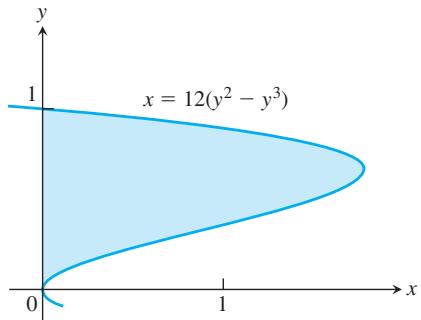
- a. The
𝑥 𝑦 = 1 𝑦 = 8 / 5 𝑦 = − 2 / 5
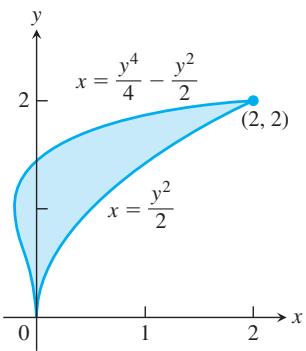
- a. The
𝑥 𝑦 = 2 𝑦 = 5 𝑦 = − 5 / 8
Choosing the Washer Method or the Shell Method
For some regions, both the washer and shell methods work well for the solid generated by revolving the region about the coordinate axes, but this is not always the case. When a region is revolved about the y-axis, for example, and washers are used, we must integrate with respect to y. It may not be possible, however, to express the integrand in terms of y. In such a case, the shell method allows us to integrate with respect to x instead. Exercises 29 and 30 provide some insight.
- Compute the volume of the solid generated by revolving the region bounded by y = x and
𝑦 = 𝑥 2
a. the shell method.
b. the washer method.
- Compute the volume of the solid generated by revolving the triangular region bounded by the lines
2 𝑦 = 𝑥 + 4 𝑦 = 𝑥 𝑥 = 0 𝑥 𝑦 𝑥 = 4 𝑦 = 8
In Exercises 31–36, find the volumes of the solids generated by revolving the regions about the given axes. If you think it would be better to use washers in any given instance, feel free to do so.
-
The triangle with vertices
( 1 , 1 ) ( 1 , 2 ) ( 2 , 2 ) 𝑥 𝑦 𝑥 = 1 0 / 3 𝑦 = 1 -
The region bounded by
𝑦 = √ 𝑥 , 𝑦 = 2 , 𝑥 = 0 𝑥 𝑦 𝑥 = 4 𝑦 = 2 -
The region in the first quadrant bounded by the curve
𝑥 = 𝑦 − 𝑦 3 𝑦 𝑥 𝑦 = 1 -
The region in the first quadrant bounded by
𝑥 = 𝑦 − 𝑦 3 𝑥 = 1 𝑦 = 1 𝑥 𝑦 𝑥 = 1 𝑦 = 1 -
The region bounded by
𝑦 = √ 𝑥 𝑦 = 𝑥 2 / 8 𝑥 𝑦 -
The region bounded by
𝑦 = 2 𝑥 − 𝑥 2 𝑦 = 𝑥 𝑦 𝑥 = 1 -
The region in the first quadrant that is bounded above by the curve
𝑦 = 1 / 𝑥 1 / 4 𝑥 = 1 / 1 6 𝑦 = 1 𝑥 -
The region in the first quadrant that is bounded above by the curve
𝑦 = 1 / √ 𝑥 𝑥 = 1 / 4 𝑦 = 1 𝑦
a. the washer method. b. the shell method.
Theory and Examples
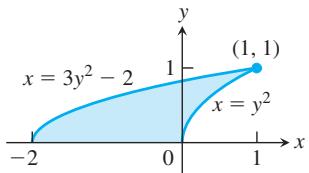
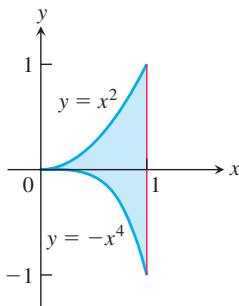
- The region shown here is to be revolved about the x-axis to generate a solid. Which of the methods (disk, washer, shell) could you use to find the volume of the solid? How many integrals would be required in each case? Explain.
- The region shown here is to be revolved about the y-axis to generate a solid. Which of the methods (disk, washer, shell) could you use to find the volume of the solid? How many integrals would be required in each case? Give reasons for your answers.
- A bead is formed from a sphere of radius 5 by drilling through a diameter of the sphere with a drill bit of radius 3.
a. Find the volume of the bead.
b. Find the volume of the removed portion of the sphere.
-
A Bundt cake, well known for having a ringed shape, is formed by revolving around the
𝑦 𝑦 = s i n ( 𝑥 2 − 1 ) 𝑥 1 ≤ 𝑥 ≤ √ 1 + 𝜋 -
Derive the formula for the volume of a right circular cone of height h and radius r using an appropriate solid of revolution.
-
Derive the equation for the volume of a sphere of radius r using the shell method.
-
Equivalence of the washer and shell methods for finding volume Let f be differentiable and increasing on the interval
𝑎 ≤ 𝑥 ≤ 𝑏 𝑓 − 1 𝑦 = 𝑓 ( 𝑏 )
To prove this equality, define
Then show that the functions W and S agree at a point of
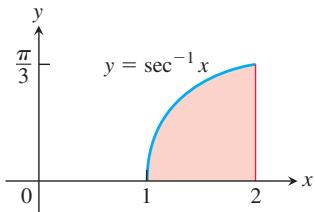
- The region between the curve
𝑦 = s e c − 1 𝑥
-
Find the volume of the solid generated by revolving the region enclosed by the graphs of
𝑦 = 𝑒 − 𝑥 2 , 𝑦 = 0 , 𝑥 = 0 𝑥 = 1 𝑦 -
Find the volume of the solid generated by revolving the region enclosed by the graphs of
𝑦 = 𝑒 𝑥 / 2 𝑥 = l n 3 -
Consider the region R bounded by the graphs of
𝑦 = 𝑓 ( 𝑥 ) > 0 2 𝜋 1 0 𝜋
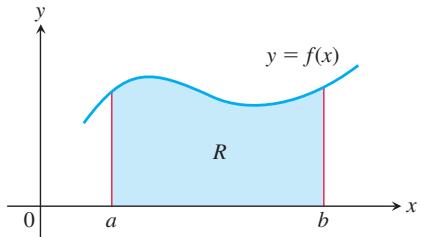
- Consider the region R given in Exercise 49. If the area of region R is 1, and the volume of the solid formed by revolving R about the line x = -3 is
1 0 𝜋
6.3 Arc Length
We know what is meant by the length of a straight-line segment, but without calculus, we have no precise definition of the length of a general winding curve. If the curve is the graph of a continuous function defined over an interval, then we can find the length of the curve using a procedure similar to that we used for defining the area between the curve and the x-axis. We divide the curve into many pieces, and we approximate each piece by a straight-line segment. The sum of the lengths of these segments is an approximation to the total curve length that we seek. The total length of the curve is the limiting value of these approximations as the number of segments goes to infinity.
Length of a Curve 𝑦 = 𝑓 ( 𝑥 )
Suppose the curve whose length we want to find is the graph of the function
We partition the interval
If
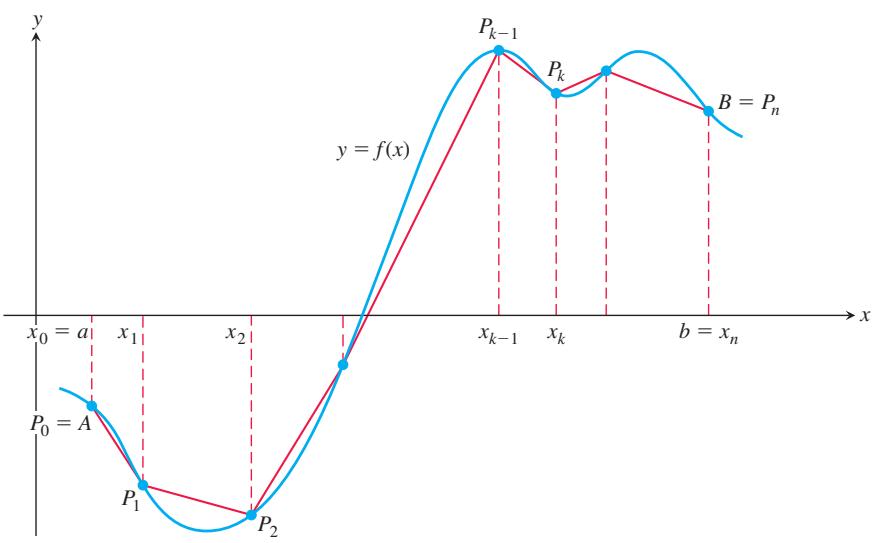
(see Figure 6.23), so the length of the curve is approximated by the sum
We expect the approximation to improve as the partition of
FIGURE 6.22 The length of the polygonal path
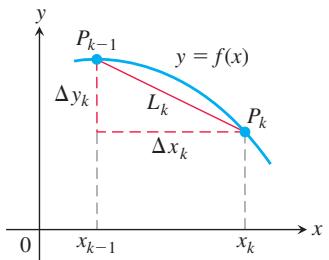
FIGURE 6.23 The arc
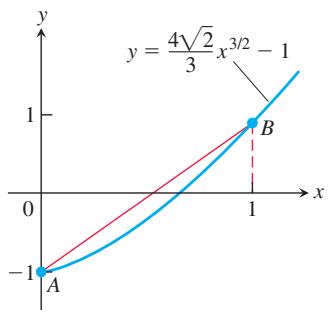
FIGURE 6.24 The length of the curve is slightly larger than the length of the line segment joining points A and B (Example 1).
When this is substituted for
This is a Riemann sum whose limit we can evaluate. Because
We define the length of the curve to be this integral.
DEFINITION If
is continuous on 𝑓 ′ , then the length (arc length) of the curve [ 𝑎 , 𝑏 ] from the point 𝑦 = 𝑓 ( 𝑥 ) to the point 𝐴 = ( 𝑎 , 𝑓 ( 𝑎 ) ) is the value of the integral 𝐵 = ( 𝑏 , 𝑓 ( 𝑏 ) ) 𝐿 = ∫ 𝑏 𝑎 √ 1 + [ 𝑓 ′ ( 𝑥 ) ] 2 𝑑 𝑥 = ∫ 𝑏 𝑎 √ 1 + ( 𝑑 𝑦 𝑑 𝑥 ) 2 𝑑 𝑥 . ( 3 )
EXAMPLE 1 Find the length of the curve shown in Figure 6.24, which is the graph of the function
Solution We use Equation (3) with a = 0, b = 1, and
The length of the curve over x = 0 to x = 1 is
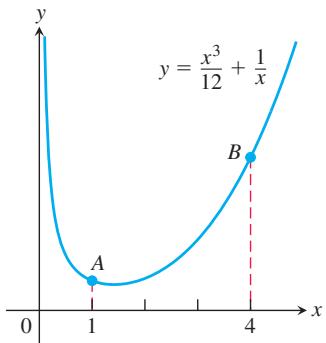
FIGURE 6.25 The curve in Example 2, where
Notice that the length of the curve is slightly larger than the length of the straight-line segment joining the points
Decimal approximations
EXAMPLE 2 Find the length of the graph of
Solution A graph of the function is shown in Figure 6.25. To use Equation (3), we find
SO
and
The length of the graph over
EXAMPLE 3 Find the length of the curve
Solution We use Equation (3) with a = 0, b = 2, and
The length of the curve from
Even if the derivative
Dealing with Discontinuities in dy/dx
FIGURE 6.26 The graph of
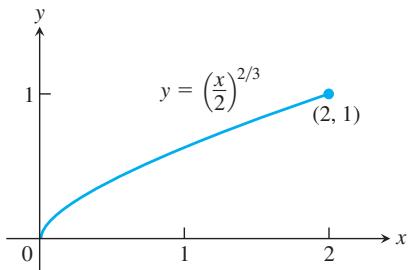
EXAMPLE 4 Find the length of the curve
Solution The derivative
is not defined at
We therefore rewrite the equation to express x in terms of y:
From this we see that the curve whose length we want is also the graph of
The derivative
is continuous on
The Differential Formula for Arc Length
If
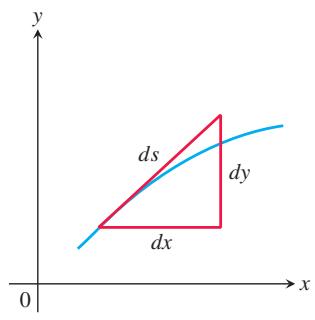
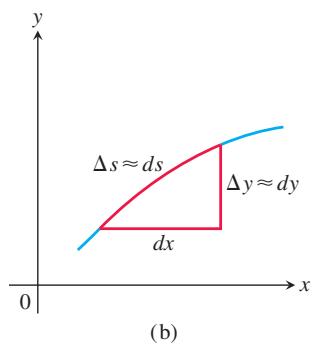
FIGURE 6.27 Diagrams for remembering the equation
From Equation (3) and Figure 6.22, we see that this function
Then the differential of arc length is
A useful way to remember Equation (6) is to write
which can be integrated between appropriate limits to give the total length of a curve. From this point of view, all the arc length formulas are simply different expressions for the equation
EXAMPLE 5 Find the arc length function for the curve in Example 2, taking
Solution In the solution to Example 2, we found that
Therefore the arc length function is given by
To compute the arc length along the curve from
This is the same result we obtained in Example 2.
Exercises 6.3
Finding Lengths of Curves
Find the lengths of the curves in Exercises 1–16. If you have graphing software, you may want to graph these curves to see what they look like.
𝑦 = 𝑥 3 / 2 f r o m 𝑥 = 0 t o 𝑥 = 4
-
𝑥 = ( 𝑦 3 / 2 / 3 ) − 𝑦 1 / 2 f r o m 𝑦 = 1 t o 𝑦 = 9 -
𝑥 = ( 𝑦 4 / 4 ) + 1 / ( 8 𝑦 2 ) f r o m 𝑦 = 1 t o 𝑦 = 2
-
𝑥 = ( 𝑦 3 / 6 ) + 1 / ( 2 𝑦 ) f r o m 𝑦 = 2 t o 𝑦 = 3 -
𝑦 = l n 𝑥 − 𝑥 2 8 -
𝑦 = 𝑥 2 2 − l n 𝑥 4 𝑥 = 1 𝑥 = 3 -
𝑦 = 𝑥 3 3 + 1 4 𝑥 , 1 ≤ 𝑥 ≤ 3 -
𝑦 = 𝑥 5 5 + 1 1 2 𝑥 3 , 1 2 ≤ 𝑥 ≤ 1 -
𝑦 = 3 2 𝑥 2 / 3 + 1 , 1 8 ≤ 𝑥 ≤ 1 -
𝑦 = 1 2 ( 𝑒 𝑥 + 𝑒 − 𝑥 ) , − 1 ≤ 𝑥 ≤ 1 -
𝑥 = ∫ 𝑦 0 √ s e c 4 𝑡 − 1 𝑑 𝑡 , − 𝜋 / 4 ≤ 𝑦 ≤ 𝜋 / 4 -
𝑦 = ∫ 𝑥 − 2 √ 3 𝑡 4 − 1 𝑑 𝑡 , − 2 ≤ 𝑥 ≤ − 1
T Finding Integrals for Lengths of Curves
In Exercises 17–24, do the following.
a. Set up an integral for the length of the curve.
b. Graph the curve to see what it looks like.
c. Use your grapher’s or computer’s integral evaluator to find the curve’s length numerically.
-
𝑦 = 𝑥 2 , − 1 ≤ 𝑥 ≤ 2 -
𝑦 = t a n 𝑥 , − 𝜋 / 3 ≤ 𝑥 ≤ 0 -
𝑥 = s i n 𝑦 , 0 ≤ 𝑦 ≤ 𝜋 -
𝑥 = √ 1 − 𝑦 2 , − 1 / 2 ≤ 𝑦 ≤ 1 / 2 -
𝑦 2 + 2 𝑦 = 2 𝑥 + 1 ( − 1 , − 1 ) ( 7 , 3 ) -
𝑦 = s i n 𝑥 − 𝑥 c o s 𝑥 , 0 ≤ 𝑥 ≤ 𝜋 -
𝑦 = ∫ 𝑥 0 t a n 𝑡 𝑑 𝑡 , 0 ≤ 𝑥 ≤ 𝜋 / 6 -
𝑥 = ∫ 𝑦 0 √ s e c 2 𝑡 − 1 𝑑 𝑡 , − 𝜋 / 3 ≤ 𝑦 ≤ 𝜋 / 4
Theory and Examples
- a. Find a curve with a positive derivative through the point
( 1 , 1 )
b. How many such curves are there? Give reasons for your answer.
- a. Find a curve with a positive derivative through the point
( 0 , 1 )
b. How many such curves are there? Give reasons for your answer.
- Find the length of the curve
from x = 0 to
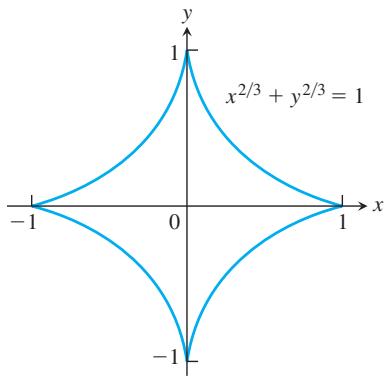
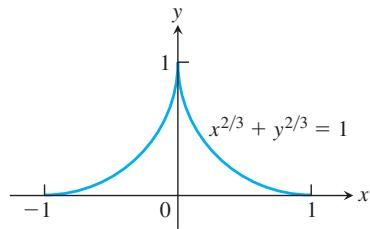
- The length of an astroid The graph of the equation
𝑥 2 / 3 + 𝑦 2 / 3 = 1 𝑦 = ( 1 − 𝑥 2 / 3 ) 3 / 2 √ 2 / 4 ≤ 𝑥 ≤ 1
-
Length of a line segment Use the arc length formula (Equation 3) to find the length of the line segment
𝑦 = 3 − 2 𝑥 0 ≤ 𝑥 ≤ 2 -
Circumference of a circle Set up an integral to find the circumference of a circle of radius r centered at the origin. You will learn how to evaluate the integral in Section 8.3.
-
If
9 𝑥 2 = 𝑦 ( 𝑦 − 3 ) 2
-
Is there a smooth (continuously differentiable) curve
𝑦 = 𝑓 ( 𝑥 ) 0 ≤ 𝑥 ≤ 𝑎 √ 2 𝑎 -
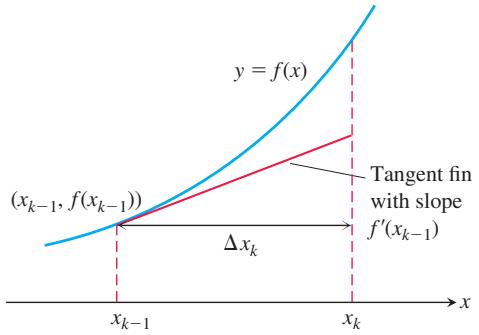
Using tangent fins to derive the length formula for curves Assume that
𝑓 [ 𝑎 , 𝑏 ] [ 𝑎 , 𝑏 ] [ 𝑥 𝑘 − 1 , 𝑥 𝑘 ] ( 𝑥 𝑘 − 1 , 𝑓 ( 𝑥 𝑘 − 1 ) )
a. Show that the length of the kth tangent fin over the interval
b. Show that
which is the length L of the curve
- Approximate the arc length of one-quarter of the unit circle (which is
𝜋 / 2
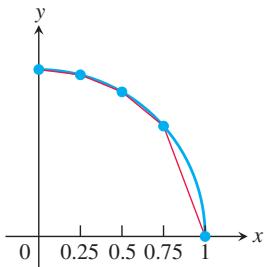
-
Distance between two points Assume that the two points
( 𝑥 1 , 𝑦 1 ) ( 𝑥 2 , 𝑦 2 ) 𝑦 = 𝑚 𝑥 + 𝑏 -
Find the arc length function for the graph of
𝑓 ( 𝑥 ) = 2 𝑥 3 / 2 -
Find the arc length function for the curve in Exercise 8, using
( 0 , 1 / 4 ) ( 0 , 1 / 4 ) ( 1 , 5 9 / 2 4 )
COMPUTER EXPLORATIONS
In Exercises 39–44, use a CAS to perform the following steps for the given graph of the function over the closed interval.
a. Plot the curve together with the polygonal path approximations for n = 2, 4, 8 partition points over the interval. (See Figure 6.22.)
b. Find the corresponding approximation to the length of the curve by summing the lengths of the line segments.
c. Evaluate the length of the curve using an integral. Compare your approximations for n = 2, 4, 8 with the actual length given by the integral. How does the actual length compare with the approximations as n increases? Explain your answer.
-
𝑓 ( 𝑥 ) = √ 1 − 𝑥 2 , − 1 ≤ 𝑥 ≤ 1 -
𝑓 ( 𝑥 ) = 𝑥 1 / 3 + 𝑥 2 / 3 , 0 ≤ 𝑥 ≤ 2 -
𝑓 ( 𝑥 ) = s i n ( 𝜋 𝑥 2 ) , 0 ≤ 𝑥 ≤ √ 2 -
𝑓 ( 𝑥 ) = 𝑥 2 c o s 𝑥 , 0 ≤ 𝑥 ≤ 𝜋 -
𝑓 ( 𝑥 ) = 𝑥 − 1 4 𝑥 2 + 1 , − 1 2 ≤ 𝑥 ≤ 1 -
𝑓 ( 𝑥 ) = 𝑥 3 − 𝑥 2 , − 1 ≤ 𝑥 ≤ 1
6.4 Areas of Surfaces of Revolution
When you jump rope, the rope sweeps out a surface in the space around you similar to what is called a surface of revolution. The surface surrounds a volume of revolution, and many applications require that we know the area of the surface rather than the volume it encloses. In this section we define areas of surfaces of revolution. More general surfaces are treated in Chapter 15.
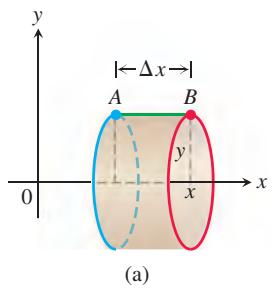
Defining Surface Area
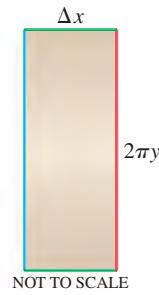
FIGURE 6.28 (a) A cylindrical surface generated by rotating the horizontal line segment AB of length
If you revolve a region in the plane that is bounded by the graph of a function over an interval, it sweeps out a solid of revolution, as we saw earlier in the chapter. However, if you revolve only the bounding curve itself, it does not sweep out any interior volume but rather a surface that surrounds the solid and forms part of its boundary. Just as we were interested in defining and finding the length of a curve in the last section, we are now interested in defining and finding the area of a surface generated by revolving a curve about an axis.
Before considering general curves, we begin by rotating horizontal and slanted line segments about the x-axis. If we rotate the horizontal line segment AB having length
Suppose the line segment AB has length L and is slanted rather than horizontal. Now when AB is rotated about the x-axis, it generates a frustum of a cone (Figure 6.29a). From classical geometry, the surface area of this frustum is
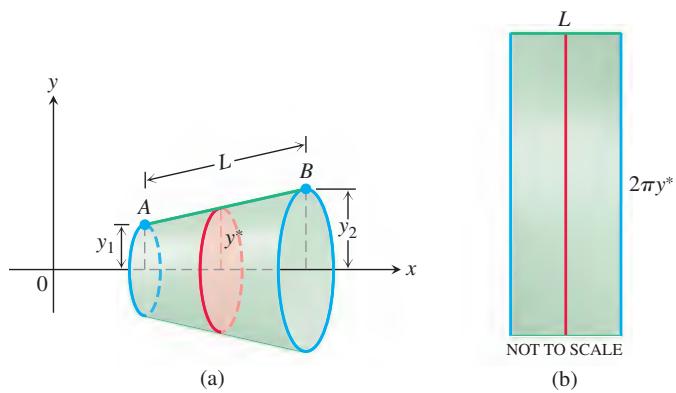
FIGURE 6.29 (a) The frustum of a cone generated by rotating the slanted line segment AB of length L about the x-axis has area
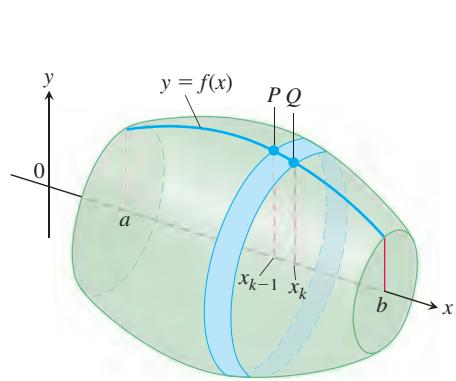
FIGURE 6.30 The surface generated by revolving the graph of a nonnegative function
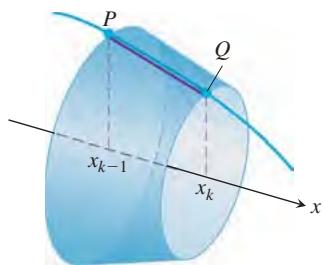
FIGURE 6.31 The line segment joining P and Q sweeps out a frustum of a cone.
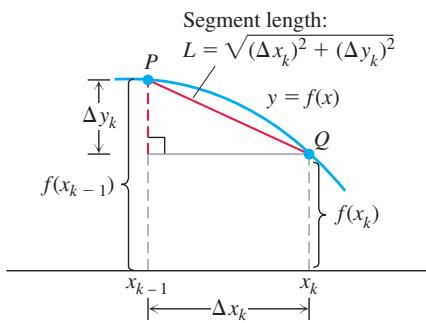
FIGURE 6.32 Dimensions associated with the arc and line segment PQ.
Let’s build on these geometric principles to define the area of a surface swept out by revolving more general curves about the
As the arc PQ revolves about the x-axis, the line segment joining P and Q sweeps out a frustum of a cone whose axis lies along the x-axis (Figure 6.31). The surface area of this frustum approximates the surface area of the band swept out by the arc PQ. The surface area of the frustum of the cone shown in Figure 6.31 is
The area of the original surface, being the sum of the areas of the bands swept out by arcs like arc PQ, is approximated by the frustum area sum
We expect the approximation to improve as the partition of
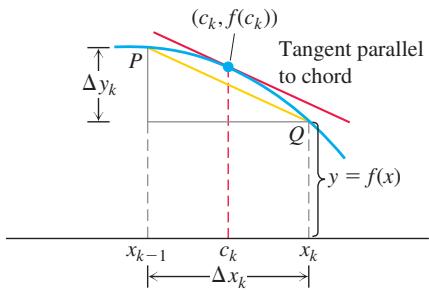
FIGURE 6.33 If f is smooth, the Mean Value Theorem guarantees the existence of a point
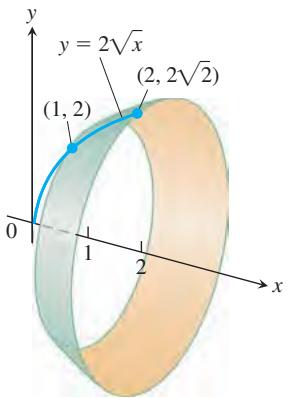
FIGURE 6.34 In Example 1 we calculate the area of this surface.
With this substitution for
These sums are not the Riemann sums of any function because the points
We therefore define this integral to be the area of the surface swept out by the graph of f from a to b.
DEFINITION If the function
is continuously differentiable on 𝑓 ( 𝑥 ) ≥ 0 , the area of the surface generated by revolving the graph of [ 𝑎 , 𝑏 ] about the x-axis is 𝑦 = 𝑓 ( 𝑥 ) 𝑆 = ∫ 𝑏 𝑎 2 𝜋 𝑦 √ 1 + ( 𝑑 𝑦 𝑑 𝑥 ) 2 𝑑 𝑥 = ∫ 𝑏 𝑎 2 𝜋 𝑓 ( 𝑥 ) √ 1 + ( 𝑓 ′ ( 𝑥 ) ) 2 𝑑 𝑥 . ( 3 )
Note that the square root in Equation (3) is similar to the one that appears in the formula for the arc length of the generating curve in Equation (6) of Section 6.3.
EXAMPLE 1 Find the area of the surface generated by revolving the curve
Solution We evaluate the formula
with
First, we perform some algebraic manipulation on the radical in the integrand to transform it into an expression that is easier to integrate.
With these substitutions, we have
Revolution About the y-Axis
For revolution about the y-axis, we interchange x and y in Equation (3).
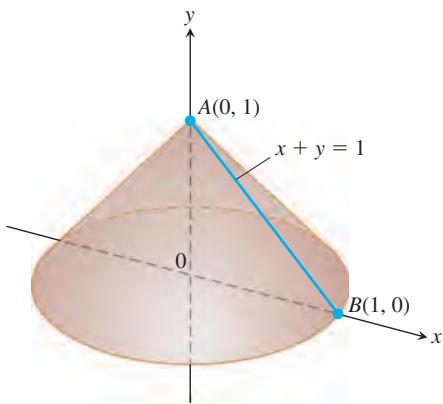
FIGURE 6.35 Revolving line segment AB about the y-axis generates a cone whose lateral surface area we can now calculate in two different ways (Example 2).
Surface Area for Revolution About the y-Axis
If
EXAMPLE 2 The line segment
Solution Here we have a calculation we can check with a formula from geometry:
To see how Equation (4) gives the same result, we take
and calculate
EXERCISES 6.4
Finding Integrals for Surface Area
In Exercises 1–8:
a. Set up an integral for the area of the surface generated by revolving the given curve about the indicated axis.
T b. Graph the curve to see what it looks like. If you can, graph the surface too.
T c. Use your utility’s integral evaluator to find the surface’s area numerically.
-
𝑦 = t a n 𝑥 , 0 ≤ 𝑥 ≤ 𝜋 / 4 ; 𝑥 -
𝑦 = 𝑥 2 0 ≤ 𝑥 ≤ 2 𝑥 -
𝑥 𝑦 = 1 , 1 ≤ 𝑦 ≤ 2 ; 𝑦 -
𝑥 = s i n 𝑦 , 0 ≤ 𝑦 ≤ 𝜋 ; 𝑦 -
𝑥 1 / 2 + 𝑦 1 / 2 = 3 𝑥 -
𝑦 + 2 √ 𝑦 = 𝑥 , 1 ≤ 𝑦 ≤ 2 ; 𝑦 -
𝑥 = ∫ 𝑦 0 t a n 𝑡 𝑑 𝑡 , 0 ≤ 𝑦 ≤ 𝜋 / 3 ; -
𝑦 = ∫ 𝑥 1 √ 𝑡 2 − 1 𝑑 𝑡 , 1 ≤ 𝑥 ≤ √ 5 ; 𝑥
Finding Surface Area
- Find the lateral (side) surface area of the cone generated by revolving the line segment
𝑦 = 𝑥 / 2 0 ≤ 𝑥 ≤ 4
Lateral surface area =
-
Find the lateral surface area of the cone generated by revolving the line segment
𝑦 = 𝑥 / 2 0 ≤ 𝑥 ≤ 4 -
Find the surface area of the cone frustum generated by revolving the line segment
𝑦 = ( 𝑥 / 2 ) + ( 1 / 2 ) 1 ≤ 𝑥 ≤ 3
Frustum surface area =
- Find the surface area of the cone frustum generated by revolving the line segment
𝑦 = ( 𝑥 / 2 ) + ( 1 / 2 ) 1 ≤ 𝑥 ≤ 3
Find the areas of the surfaces generated by revolving the curves in Exercises 13–23 about the indicated axes. If you have a grapher, you may want to graph these curves to see what they look like.
-
𝑦 = 𝑥 3 / 9 , 0 ≤ 𝑥 ≤ 2 ; 𝑥 -
𝑦 = √ 𝑥 , 3 / 4 ≤ 𝑥 ≤ 1 5 / 4 ; 𝑥 -
𝑦 = √ 2 𝑥 − 𝑥 2 0 . 5 ≤ 𝑥 ≤ 1 . 5 -
𝑦 = √ 𝑥 + 1 , 1 ≤ 𝑥 ≤ 5 ; 𝑥 -
𝑥 = 𝑦 3 / 3 , 0 ≤ 𝑦 ≤ 1 -
𝑥 = ( 1 / 3 ) 𝑦 3 / 2 − 𝑦 1 / 2 , 1 ≤ 𝑦 ≤ 3 ; 𝑦 -
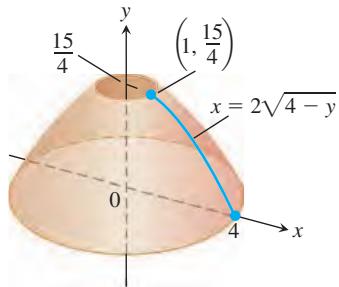
𝑥 = 2 √ 4 − 𝑦 0 ≤ 𝑦 ≤ 1 5 / 4
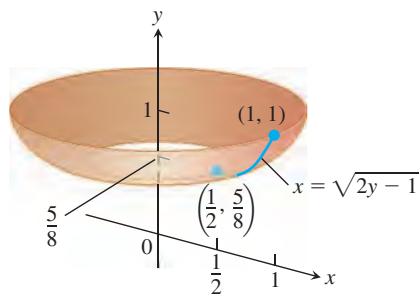
𝑥 = √ 2 𝑦 − 1
𝑥 = ( 𝑒 𝑦 + 𝑒 − 𝑦 ) / 2 , 0 ≤ 𝑦 ≤ l n 2 ; 𝑦
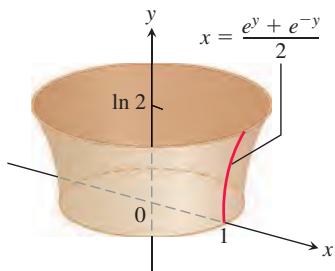
-
𝑦 = ( 1 / 3 ) ( 𝑥 2 + 2 ) 3 / 2 , 0 ≤ 𝑥 ≤ √ 2 ; 𝑦 𝑑 𝑠 = √ 𝑑 𝑥 2 + 𝑑 𝑦 2 𝑆 = ∫ 2 𝜋 𝑥 𝑑 𝑠 -
𝑥 = ( 𝑦 4 / 4 ) + 1 / ( 8 𝑦 2 ) 1 ≤ 𝑦 ≤ 2 𝑑 𝑠 = √ 𝑑 𝑥 2 + 𝑑 𝑦 2 𝑆 = ∫ 2 𝜋 𝑦 𝑑 𝑠 -
Write an integral for the area of the surface generated by revolving the curve
𝑦 = c o s 𝑥 , − 𝜋 / 2 ≤ 𝑥 ≤ 𝜋 / 2 -
Testing the new definition Show that the surface area of a sphere of radius
𝑎 4 𝜋 𝑎 2 𝑦 = √ 𝑎 2 − 𝑥 2 − 𝑎 ≤ 𝑥 ≤ 𝑎 𝑥 -
Testing the new definition The lateral (side) surface area of a cone of height h and base radius r should be
𝜋 𝑟 √ 𝑟 2 + ℎ 2 𝑦 = ( 𝑟 / ℎ ) 𝑥 , 0 ≤ 𝑥 ≤ ℎ -
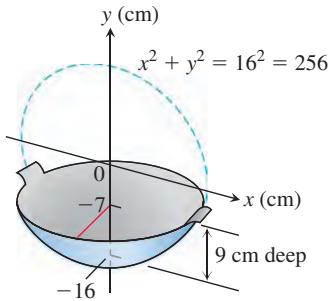
Enameling woks Your company decided to put out a deluxe version of a wok you designed. The plan is to coat it inside with white enamel and outside with blue enamel. Each enamel will be sprayed on 0.5 mm thick before baking. (See accompanying figure.) Your manufacturing department wants to know how much enamel to have on hand for a production run of 5000 woks. What do you tell them? (Neglect waste and unused material and give your answer in liters. Remember that
1 𝑐 𝑚 3 = 1 𝑚 𝐿 1 𝐿 = 1 0 0 0 𝑐 𝑚 3
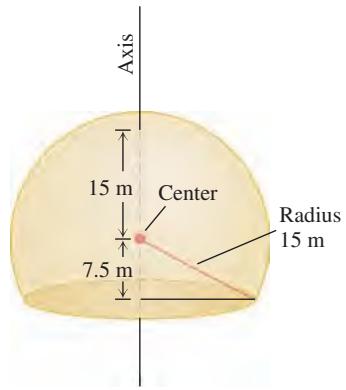
- Here is a schematic drawing of the 30-m dome used by the U.S. National Weather Service to house radar in Bozeman, Montana.
a. How much outside surface is there to paint (not counting the bottom)?
T b. Express the answer to the nearest square meter.
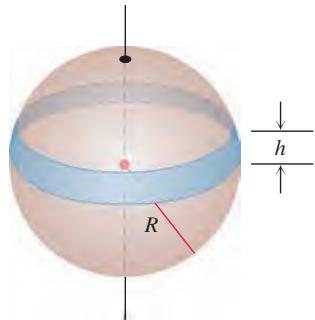
- The shaded band shown here is cut from a sphere of radius
𝑅 ℎ 2 𝜋 𝑅 ℎ
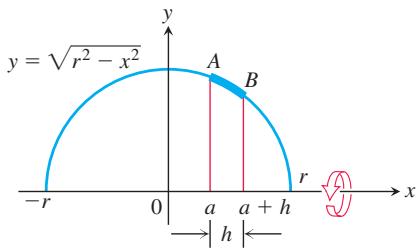
- Slicing bread Did you know that if you cut a spherical loaf of bread into slices of equal width, each slice will have the same amount of crust? To see why, suppose the semicircle
𝑦 = √ 𝑟 2 − 𝑥 2
- An alternative derivation of the surface area formula Assume
𝑓 [ 𝑎 , 𝑏 ] [ 𝑎 , 𝑏 ] 𝑘 [ 𝑥 𝑘 − 1 , 𝑥 𝑘 ] 𝑚 𝑘 = ( 𝑥 𝑘 − 1 + 𝑥 𝑘 ) / 2
b. Show that the length
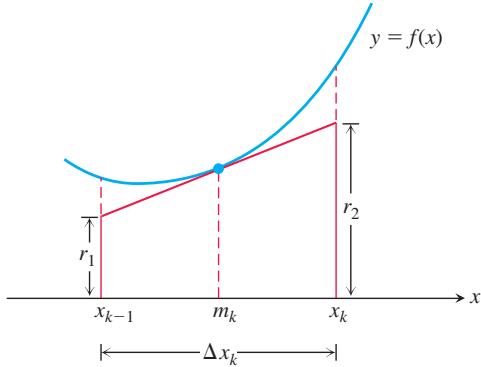
c. Show that the lateral surface area of the frustum of the cone swept out by the tangent line segment as it revolves about the
d. Show that the area of the surface generated by revolving
- The surface of an astroid Find the area of the surface generated by revolving about the
𝑥 𝑥 2 / 3 + 𝑦 2 / 3 = 1
(Hint: Revolve the first-quadrant portion
6.5 Work and Fluid Forces
In everyday life, work means an activity that requires muscular or mental effort. In science, the term refers specifically to a force acting on an object and the object’s subsequent displacement. This section shows how to calculate work. The applications run from compressing railroad car springs and emptying subterranean tanks to forcing subatomic particles to collide and lifting satellites into orbit.
Work Done by a Constant Force
When an object moves a distance d along a straight line as a result of being acted on by a force of constant magnitude F in the direction of motion, we define the work W done by the force on the object with the formula
From Equation (1) we see that the unit of work in any system is the unit of force multiplied by the unit of distance. In SI units (SI stands for Système International, or International System), the unit of force is a newton (N), the unit of distance is a meter (m), and the unit of work is a newton-meter (N·m). This combination appears so often, it has
Joules
The joule, abbreviated J, is named after the English physicist James Prescott Joule (1818–1889). The defining equation is
In symbols,
a special name, the joule (J). Taking gravitational acceleration at sea level to be
EXAMPLE 1 Suppose you jack up the side of a 1000-kg car 35 cm to change a tire. The jack applies a constant vertical force of about 5000 N in lifting the side of the car (but because of the mechanical advantage of the jack, the force you apply to the jack itself is only about 150 N). The total work performed by the jack on the car is
Work Done by a Variable Force Along a Line
If the force you apply varies along the way, as it will if you are stretching or compressing a spring, the formula W = Fd has to be replaced by an integral formula that takes the variation in F into account.
Suppose that the force performing the work acts on an object moving along a straight line, which we take to be the x-axis. We assume that the magnitude of the force is a continuous function F of the object’s position x. We want to find the work done over the interval from x = a to x = b. We partition
We expect the approximation to improve as the norm of the partition goes to zero, so we define the work done by the force from a to b to be the integral of F from a to b:
DEFINITION The work done by a variable force
in moving an object along the x-axis from x = a to x = b is 𝐹 ( 𝑥 ) 𝑊 = ∫ 𝑏 𝑎 𝐹 ( 𝑥 ) 𝑑 𝑥 . ( 2 )
The units of the integral are joules if
Hooke’s Law for Springs: 𝐹 = 𝑘 𝑥
One calculation for work arises in finding the work required to stretch or compress a spring. Hooke’s Law says that the force required to hold a stretched or compressed spring
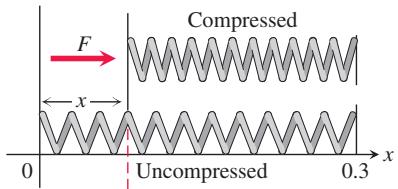
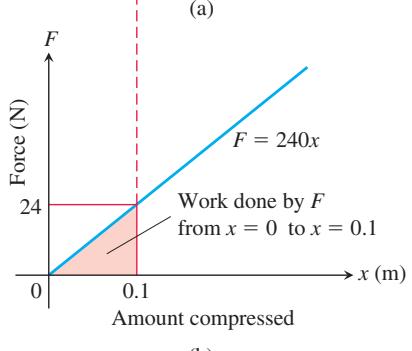
FIGURE 6.36 The force F needed to hold a spring under compression increases linearly as the spring is compressed (Example 2).
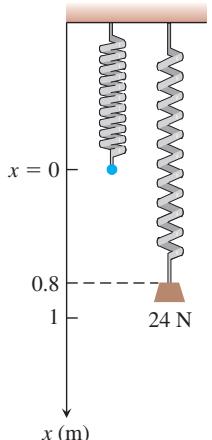
FIGURE 6.37 A 24-N weight stretches this spring 0.8 m beyond its unstressed length (Example 3).
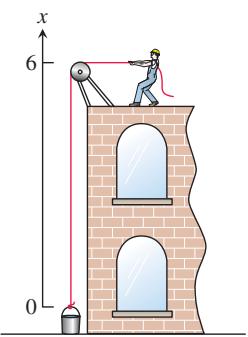
FIGURE 6.38 Lifting the bucket in Example 4.
The constant
EXAMPLE 2 Find the work required to compress a spring from its natural length of 30 cm to a length of 20 cm if the force constant is k = 240 N/m.
Solution We picture the uncompressed spring laid out along the x-axis with its movable end at the origin and its fixed end at x = 0.3 m (Figure 6.36). This enables us to describe the force required to compress the spring from 0 to x with the formula F = 240x. To compress the spring from 0 to 0.1 m, the force must increase from
The work done by F over this interval is
EXAMPLE 3 A spring has a natural length of 1 m. A force of 24 N holds the spring stretched to a total length of 1.8 m.
(a) Find the force constant k.
(b) How much work will it take to stretch the spring from its natural length to a length of
(c) How far will a 45-N force stretch the spring?
Solution
(a) The force constant. We find the force constant from Equation (3). A force of 24 N maintains the spring at a position where it is stretched 0.8 m from its natural length, so
(b) The work to stretch the spring
The work done by F on the spring from x = 0 m to x = 2 m is
(c) How far will a 45-N force stretch the spring? We substitute
A 45-N force will keep the spring stretched 1.5 m beyond its natural length.
Lifting Objects and Pumping Liquids from Containers
The work integral is useful for calculating the work done in lifting objects whose weights vary with their elevation.
EXAMPLE 4 A 2-kg bucket is lifted from the ground into the air by pulling in 6 m of rope at a constant speed (Figure 6.38). The rope weighs 0.1 kg/m. How much work was spent lifting the bucket and rope?
Solution The bucket has constant weight, so the work done lifting it alone is
The weight of the rope varies with the bucket’s elevation, because less of it is freely hanging. When the bucket is
The total work for the bucket and rope combined is
FIGURE 6.39 The olive oil and tank in Example 5.
How much work does it take to pump all or part of the liquid from a container? Engineers often need to know the answer in order to design or choose the right pump, or to compute the cost to transport water or some other liquid from one place to another. To find out how much work is required to pump the liquid, we imagine lifting the liquid out one thin horizontal slab at a time and applying the equation W = Fd to each slab. We then evaluate the integral that this leads to as the slabs become thinner and more numerous.
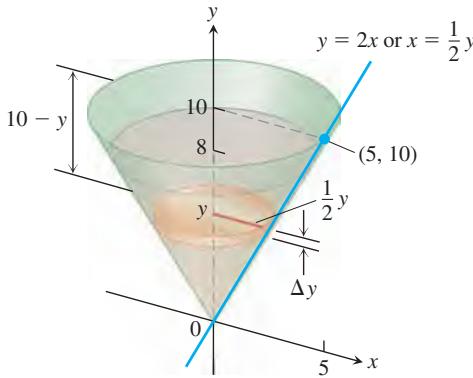
EXAMPLE 5 The conical tank in Figure 6.39 is filled to within 2 m of the top with olive oil weighing 0.9 g/cm
Solution We imagine the oil divided into thin slabs by planes perpendicular to the y-axis at the points of a partition of the interval
The typical slab between the planes at y and
The force
The distance through which
Assuming there are n slabs associated with the partition of
The work of pumping the oil to the rim is the limit of these sums as the norm of the partition goes to zero, and the number of slabs tends to infinity:
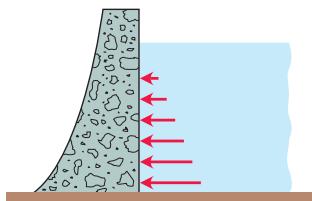
FIGURE 6.40 To withstand the increasing pressure, dams are built thicker as they go down.
Weight-density
A fluid’s weight-density
| Gasoline | 6600 |
| Mercury | 133,000 |
| Milk | 10,100 |
| Molasses | 15,700 |
| Olive oil | 8820 |
| Seawater | 10,050 |
| Freshwater | 9800 |
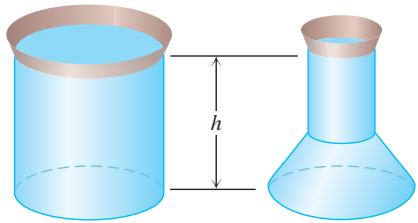
FIGURE 6.41 These containers are
filled with water to the same depth and have the same base area. The total force is therefore the same on the bottom of each container. The containers’ shapes do not matter here.
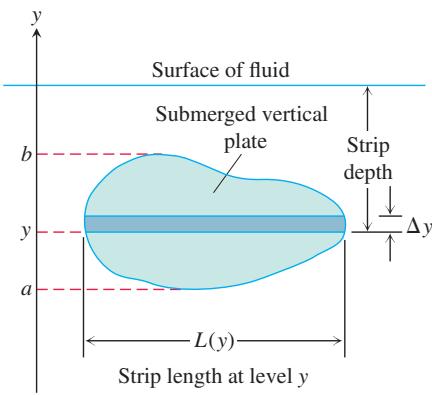
FIGURE 6.42 The force exerted
Fluid Pressure and Forces
Dams are built thicker at the bottom than at the top (Figure 6.40) because the pressure against them increases with depth. The pressure at any point on a dam depends only on how far below the surface the point is and not on how much the surface of the dam happens to be tilted at that point. The pressure, in newtons per square meter at a point h meters below the surface, is always 9800h. The number 9800 is the weight-density of freshwater in newtons per cubic meter. The pressure h meters below the surface of any fluid is the fluid’s weight-density times h.
The Pressure-Depth Equation
In a fluid that is standing still, the pressure
In a container of fluid with a flat horizontal base, the total force exerted by the fluid against the base can be calculated by multiplying the area of the base by the pressure at the base. We can do this because total force equals force per unit area (pressure) times area. (See Figure 6.41.) If F, p, and A are the total force, pressure, and area, then
Fluid Force on a Constant-Depth Surface
For example, the weight-density of freshwater is
For a flat plate submerged horizontally, like the bottom of the swimming pool just discussed, the downward force acting on its upper face due to liquid pressure is given by Equation (5). If the plate is submerged vertically, however, then the pressure against it will be different at different depths and Equation (5) no longer is usable in that form (because h varies).
Suppose we want to know the force exerted by a fluid against one side of a vertical plate submerged in a fluid of weight-density w. To find it, we model the plate as a region extending from y = a to y = b in the xy-plane (Figure 6.42). We partition
The pressure varies across the strip from top to bottom. If the strip is narrow enough, however, the pressure will remain close to its bottom-edge value of
Assume there are n strips associated with the partition of
The sum in Equation (6) is a Riemann sum for a continuous function on
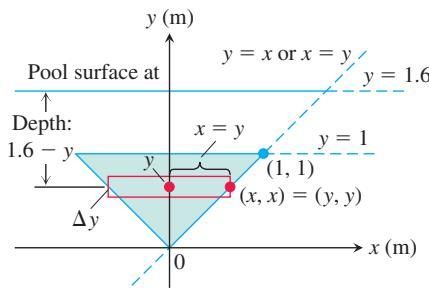
FIGURE 6.43 To find the force on one side of the submerged plate in Example 6, we can use a coordinate system like the one here.
Suppose that a plate submerged vertically in fluid of weight-density w runs from y = a to y = b on the y-axis. Let
The Integral for Fluid Force Against a Vertical Flat Plate
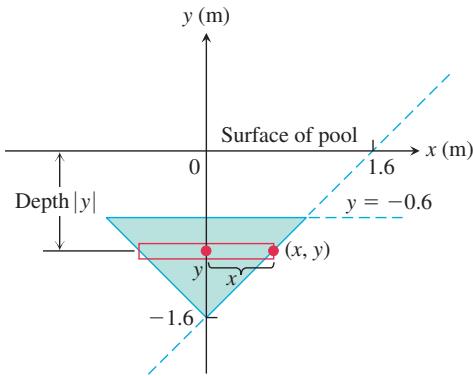
EXAMPLE 6 A flat isosceles right-triangular plate with base 2 m and height 1 m is submerged vertically, base up, 0.6 m below the surface of a swimming pool. Find the force exerted by the water against one side of the plate.
Solution We establish a coordinate system to work in by placing the origin at the plate’s bottom vertex and running the y-axis upward along the plate’s axis of symmetry (Figure 6.43). The surface of the pool lies along the line y = 1.6, and the plate’s top edge along the line y = 1. The plate’s right-hand edge lies along the line y = x, with the upper-right vertex at (1, 1). The length of a thin strip at level y is
The depth of the strip beneath the surface is
Exercises 6.5
For some exercises, a calculator may be helpful when expressing answers in decimal form.
Springs
The graphs of force functions (in newtons) are given in Exercises 1 and 2. How much work is done by each force in moving an object
𝐹 ( 𝑁 )
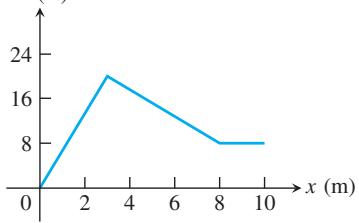
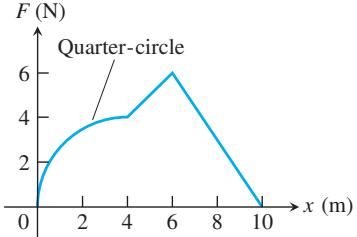
-
Spring constant It took 1800 J of work to stretch a spring from its natural length of 2 m to a length of 5 m. Find the spring’s force constant.
-
Stretching a spring A spring has a natural length of 10 cm. An 800-N force stretches the spring to 14 cm.
a. Find the force constant.
b. How much work is done in stretching the spring from 10 cm to 12 cm?
c. How far beyond its natural length will a 1600-N force stretch the spring?
-
Stretching a rubber band A force of
2 N 2 c m ( 0 . 0 2 m ) -
Stretching a spring If a force of
9 0 N 1 m 5 m -
Subway car springs It takes a force of 96,000 N to compress a coil spring assembly on a New York City Transit Authority subway car from its free height of 20 cm to its fully compressed height of 12 cm.
a. What is the assembly’s force constant?
b. How much work does it take to compress the assembly the first centimeter? the second centimeter? Answer to the nearest joule.
- Bathroom scale A bathroom scale is compressed 1.5 mm when a 70-kg person stands on it. Assuming that the scale behaves like a spring that obeys Hooke’s Law, how much does someone who compresses the scale 3 mm weigh? How much work is done compressing the scale 3 mm?
Work Done by a Variable Force
-
Lifting a rope A mountain climber is about to haul up a 50-m length of hanging rope. How much work will it take if the rope weighs 0.624 N/m?
-
Leaky sandbag A bag of sand originally weighing 600 N was lifted at a constant rate. As it rose, sand also leaked out at a constant rate. The sand was half gone by the time the bag had been lifted to 6 m. How much work was done lifting the sand this far? (Neglect the weight of the bag and lifting equipment.)
-
Lifting an elevator cable An electric elevator with a motor at the top has a multistrand cable weighing 60 N/m. When the car is at the first floor, 60 m of cable are paid out, and effectively 0 m are out when the car is at the top floor. How much work does the motor do just lifting the cable when it takes the car from the first floor to the top?
-
Force of attraction When a particle of mass m is at
( 𝑥 , 0 ) 𝑘 / 𝑥 2 -
Leaky bucket Assume the bucket in Example 4 is leaking. It starts with 8 L of water (78 N) and leaks at a constant rate. It finishes draining just as it reaches the top. How much work was spent lifting the water alone? (Hint: Do not include the rope and bucket, and find the proportion of water left at elevation x m.)
-
(Continuation of Exercise 11) The workers in Example 4 and Exercise 11 changed to a larger bucket that held 20 L (195 N) of water, but the new bucket had an even larger leak so that it, too, was empty by the time it reached the top. Assuming that the water leaked out at a steady rate, how much work was done lifting the water alone? (Do not include the rope and bucket.)
Pumping Liquids from Containers
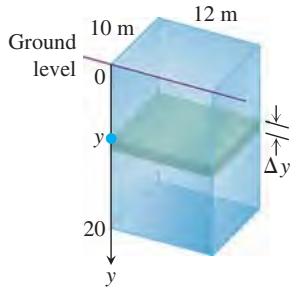
- Pumping water The rectangular tank shown here, with its top at ground level, is used to catch runoff water. Assume that the water weighs
9 8 0 0 N / m 3
a. How much work does it take to empty the tank by pumping the water back to ground level once the tank is full?
b. If the water is pumped to ground level with a 5-horsepower (hp) motor (work output 3678 W), how long will it take to empty the full tank (to the nearest minute)?
c. Show that the pump in part (b) will lower the water level 10 m (halfway) during the first 266 min of pumping.
d. The weight of water What are the answers to parts (a) and (b) in a location where water weighs
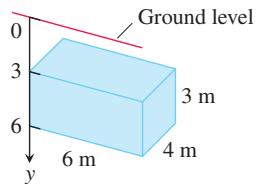
- Emptying a cistern The rectangular cistern (storage tank for rainwater) shown has its top 3 m below ground level. The cistern, currently full, is to be emptied for inspection by pumping its contents to ground level.
a. How much work will it take to empty the cistern?
b. How long will it take a 1/2-hp pump, rated at 370 W, to pump the tank dry?
c. How long will it take the pump in part (b) to empty the tank halfway? (It will be less than half the time required to empty the tank completely.)
d. The weight of water What are the answers to parts (a) through (c) in a location where water weighs
-
Pumping oil How much work would it take to pump oil from the tank in Example 5 to the level of the top of the tank if the tank were completely full?
-
Pumping a half-full tank Suppose that, instead of being full, the tank in Example 5 is only half full. How much work does it take to pump the remaining oil to a level 1 m above the top of the tank?
-
Emptying a tank A vertical right-circular cylindrical tank measures 9 m high and 6 m in diameter. It is full of kerosene weighing 7840 N/m
3 -
a. Pumping milk Suppose that the conical container in Example 5 contains milk (weighing
1 0 , 1 0 0 𝑁 / 𝑚 3
b. Pumping oil How much work will it take to pump the oil in Example 5 to a level
-
The graph of
𝑦 = 𝑥 2 0 ≤ 𝑥 ≤ 2 1 1 , 5 0 0 𝑁 / 𝑚 3 -
A right-circular cylindrical tank of height 3 m and radius 1.5 m is lying horizontally and is full of diesel fuel weighing 8300 N/m
3 -
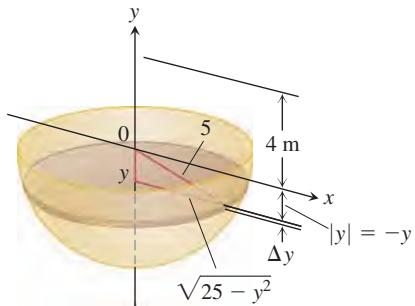
Emptying a water reservoir We model pumping from spherical containers the way we do from other containers, with the axis of integration along the vertical axis of the sphere. Use the figure here to find how much work it takes to empty a full hemispherical water reservoir of radius 5 m by pumping the water to a height of 4 m above the top of the reservoir. Water weighs
9 8 0 0 𝑁 / 𝑚 3
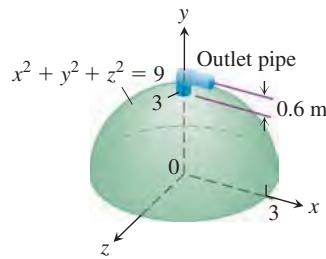
- You are in charge of the evacuation and repair of the storage tank shown here. The tank is a hemisphere of radius 3 m and is full of benzene weighing 8800 N/m
3
Work and Kinetic Energy
- Kinetic energy If a variable force of magnitude
𝐹 ( 𝑥 ) 𝑚 𝑥 𝑥 1 𝑥 2 𝑣 𝑑 𝑥 / 𝑑 𝑡 𝑡 𝐹 = 𝑚 ( 𝑑 𝑣 / 𝑑 𝑡 )
to show that the net work done by the force in moving the object from
where
In Exercises 26–30, use the result of Exercise 25.
-
Tennis A 57 g tennis ball was served at 50 m/s (180 km/h). How much work was done on the ball to make it go this fast?
-
Baseball How many joules of work does it take to throw a baseball 144 km/h? A baseball’s mass is 150 g.
-
Golf A 50 g golf ball is driven off the tee at a speed of 84 m/s (302.4 km/h). How many joules of work are done on the ball getting it into the air?
-
Tennis At the 2012 Busan Open Challenger Tennis Tournament in Busan, South Korea, the Australian Samuel Groth hit a serve measured at 263 km/ph. How much work was required by Groth to serve a 0.0567-kg tennis ball at that speed?
-
Softball How much work has to be performed on a 200 g softball to pitch it 40 m/s (144 km/h)?
-
Drinking a milkshake The truncated conical container shown here is full of strawberry milkshake, which has a density of
0 . 8 𝑔 / 𝑐 𝑚 3
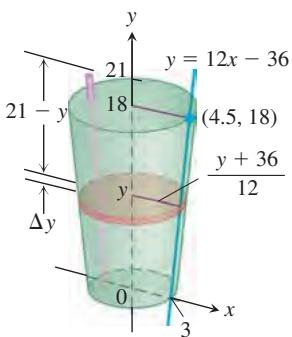
Dimensions in centimeters
- Water tower Your town has decided to drill a well to increase its water supply. As the town engineer, you have determined that a water tower will be necessary to provide the pressure needed for distribution, and you have designed the system shown here. The water is to be pumped from a 90 m well through a vertical 10 cm pipe into the base of a cylindrical tank 6 m in diameter and 7.5 m high. The base of the tank will be 18 m above ground. The pump is a 3-hp pump, rated at 2200 W (J/s). To the nearest hour, how long will it take to fill the tank the first time? (Include the time it takes to fill the pipe.) Assume that water weighs
9 8 0 0 𝑁 / 𝑚 3
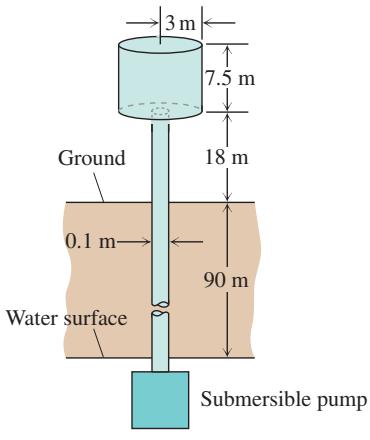
NOT TO SCALE
- Putting a satellite in orbit The strength of Earth’s gravitational field varies with the distance
𝑟 𝑚
Here,
is the universal gravitational constant, and
Evaluate the integral. The lower limit of integration is Earth’s radius in meters at the launch site. (This calculation does not take into account energy spent lifting the launch vehicle or energy spent bringing the satellite to orbit velocity.)
- Forcing electrons together Two electrons r meters apart repel each other with a force of
a. Suppose one electron is held fixed at the point
b. Suppose an electron is held fixed at each of the points
Finding Fluid Forces
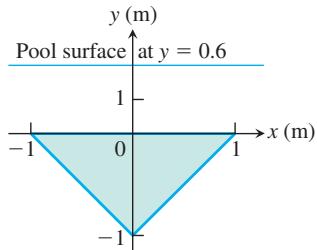
- Triangular plate Calculate the fluid force on one side of the plate in Example 6 using the coordinate system shown here.
- Triangular plate Calculate the fluid force on one side of the plate in Example 6 using the coordinate system shown here.
- Rectangular plate In a pool filled with water to a depth of 3 m, calculate the fluid force on one side of a 0.9 m by 1.2 m rectangular plate if the plate rests vertically at the bottom of the pool
a. on its 1.2-m edge.
b. on its 0.9-m edge.
- Semicircular plate Calculate the fluid force on one side of a semicircular plate of radius 5 m that rests vertically on its diameter at the bottom of a pool filled with water to a depth of 6 m.
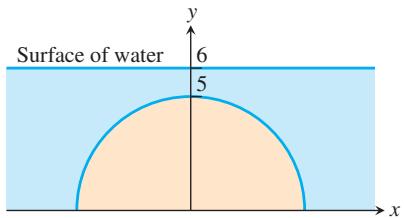
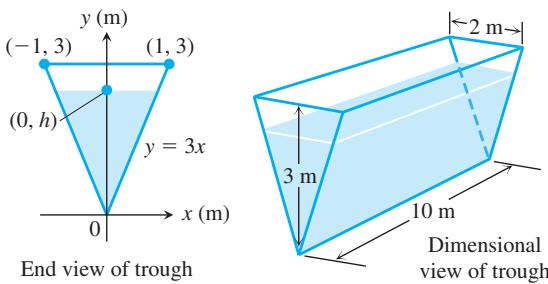
End view of trough
- Triangular plate The isosceles triangular plate shown here is submerged vertically 1 m below the surface of a freshwater lake. a. Find the fluid force against one face of the plate.
b. What would be the fluid force on one side of the plate if the water were seawater instead of freshwater?
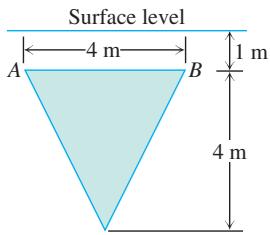
- Rotated triangular plate The plate in Exercise 37 is revolved
1 8 0 ∘ 𝐴 𝐵
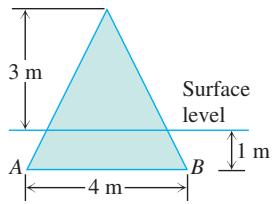
-
New England Aquarium The viewing portion of the rectangular glass window in a typical fish tank at the New England Aquarium in Boston is
1 . 6 m 0 . 0 1 m 0 . 8 5 m 1 0 , 0 5 0 N / m 3 2 c m 1 0 c m -
Semicircular plate A semicircular plate 2 m in diameter sticks straight down into freshwater with the diameter along the surface. Find the force exerted by the water on one side of the plate.
-
Tilted plate Calculate the fluid force on one side of a 1 m by 1 m square plate if the plate is at the bottom of a pool filled with water to a depth of 2 m and
a. lying flat on its 1 m by 1 m face.
b. resting vertically on a 1 m edge.
c. resting on a 1 m edge and tilted at
-
Tilted plate Calculate the fluid force on one side of a right-triangular plate with edges 3 m, 4 m, and 5 m if the plate sits at the bottom of a pool filled with water to a depth of 6 m on its 3-m edge and tilted at
6 0 ∘ -
The cubical metal tank shown here has a parabolic gate held in place by bolts and designed to withstand a fluid force of 25,000 N without rupturing. The liquid you plan to store has a weight-density of 8000 N/m
3
a. What is the fluid force on the gate when the liquid is
b. What is the maximum height to which the container can be filled without exceeding the gate’s design limitation?
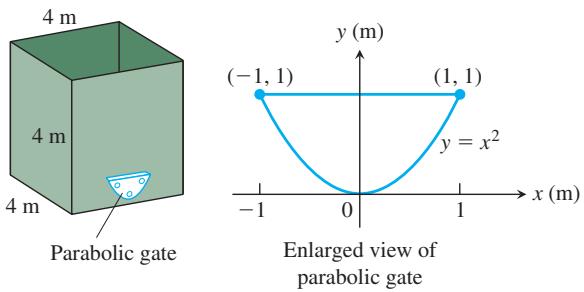
-
The end plates of the trough shown here were designed to withstand a fluid force of 25,000 N. How many cubic meters of water can the tank hold without exceeding this limitation? Round down to the nearest cubic meter. What is the value of h?
-
A vertical rectangular plate
𝑎 𝑏 𝑤 -
(Continuation of Exercise 47.) Show that the force exerted by the fluid on one side of the plate is the average value of the pressure (found in Exercise 47) times the area of the plate.
-
Water pours into the tank shown here at the rate of
0 . 5 m 3 / m i n 𝑘 = 3 0 0 0 N / m 2 . 5 m 0 . 6 m 3 / m i n
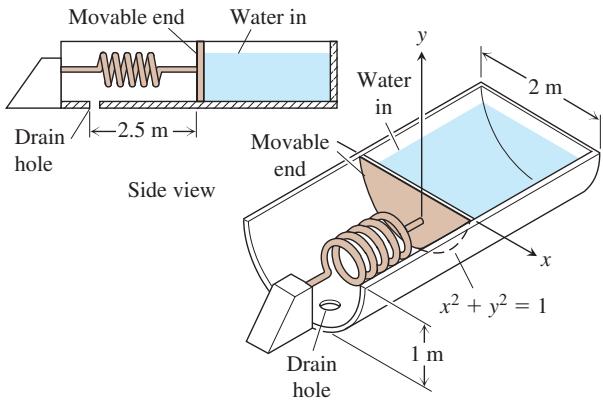
- Watering trough The vertical ends of a watering trough are squares 1 m on a side.
a. Find the fluid force against the ends when the trough is full.
b. How many centimeters do you have to lower the water level in the trough to reduce the fluid force by 25%?
6.6 Moments and Centers of Mass
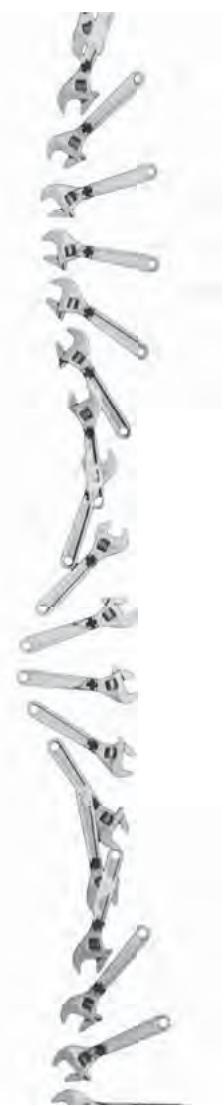
FIGURE 6.44 A wrench gliding on ice turning about its center of mass as the center glides in a vertical line. (Source: Berenice Abbott/ScienceSource)
Many structures and mechanical systems behave as if their masses were concentrated at a single point, called the center of mass (Figure 6.44). It is important to know how to locate this point, and doing so is basically a mathematical enterprise. Here we consider masses distributed along a line or region in the plane. Masses distributed across a region or curve in three-dimensional space are treated in Chapters 14 and 15.
Masses Along a Line
We develop our mathematical model in stages. The first stage is to imagine masses
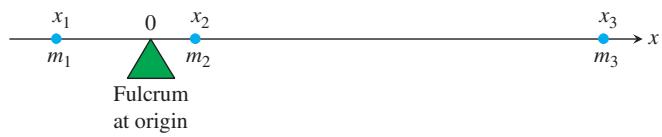
The resulting system might balance, or it might not, depending on how large the masses are and how they are arranged along the x-axis.
Each mass
The sum of the torques measures the tendency of a system to rotate about the origin. This sum is called the system torque.
The system will balance if and only if its torque is zero.
If we factor out the g in Equation (1), we see that the system torque is
Thus, the torque is the product of the gravitational acceleration g, which is a feature of the environment in which the system happens to reside, and the number
The number
(We shift to sigma notation here to allow for sums with more terms.)
We usually want to know where to place the fulcrum to make the system balance; that is, we want to know at what point
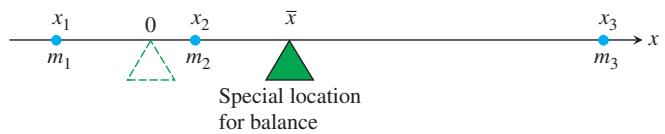
The torque of each mass about the fulcrum in this special location is
When we write the equation that says that the sum of these torques is zero, we get an equation we can solve for
This last equation tells us to find
The point
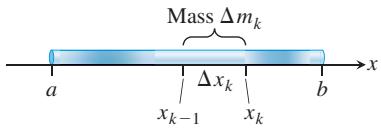
FIGURE 6.45 A rod of varying density can be modeled by a finite number of point masses of mass
Thin Wires
Instead of a discrete set of masses arranged in a line, suppose that we have a straight wire or rod located on interval
We often write this formula in one of the alternative forms
Partition the interval
The mass M of the wire and the moment
By taking a limit of these Riemann sums as the length of the intervals in the partition approaches zero, we get integral formulas for the mass and the moment of the wire about the origin. The mass M, moment about the origin
EXAMPLE 1 Find the mass M and the center of mass
Solution The mass of the rod is obtained by integrating the density,
and the center of mass is
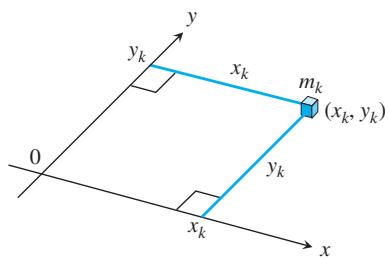
FIGURE 6.46 Each mass
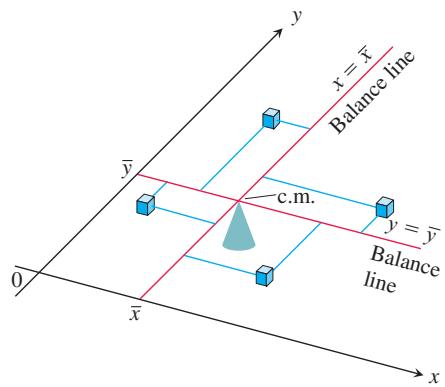
FIGURE 6.47 A two-dimensional array of masses balances on its center of mass.
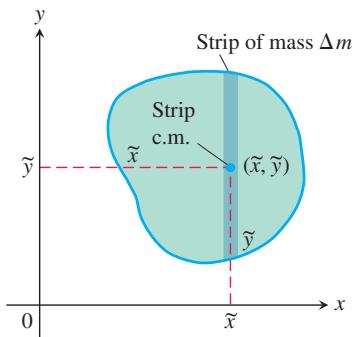
FIGURE 6.48 A plate cut into thin strips parallel to the y-axis. The moment exerted by a typical strip about each axis is the moment its mass
Density of a plate
A material’s density is its mass per unit area. For wires, rods, and narrow strips, the density is given in terms of mass per unit length.
Masses Distributed over a Plane Region
Suppose that we have a finite collection of masses located in the plane, with mass
Each mass
Moment about
Moment about y-axis:
The
With this choice of
The
With this choice of
Thin, Flat Plates
In many applications, we need to find the center of mass of a thin, flat plate: a disk of aluminum, say, or a triangular sheet of steel. In such cases, we assume the distribution of mass to be continuous, and the formulas we use to calculate
Imagine that the plate occupying a region in the
These sums are Riemann sums for integrals, and they approach these integrals in the limit as the strips become narrower and narrower. We write these integrals symbolically as
Moments, Mass, and Center of Mass of a Thin Plate Covering a Region in the xy-Plane
Moment about the x-axis:
Moment about the y-axis:
Mass:
Center of mass:
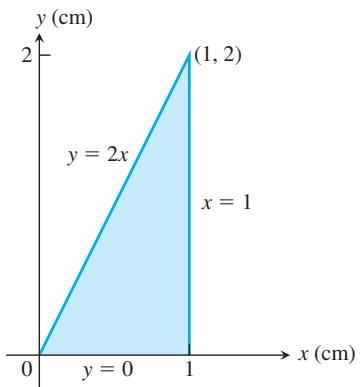
FIGURE 6.49 The plate in Example 2.
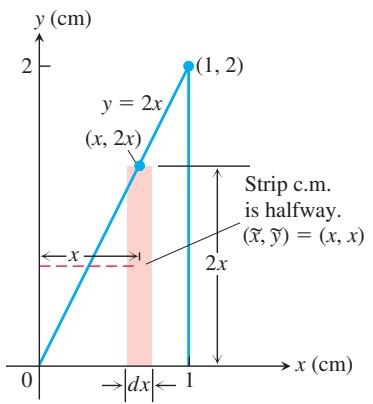
FIGURE 6.50 Modeling the plate in Example 2 with vertical strips.
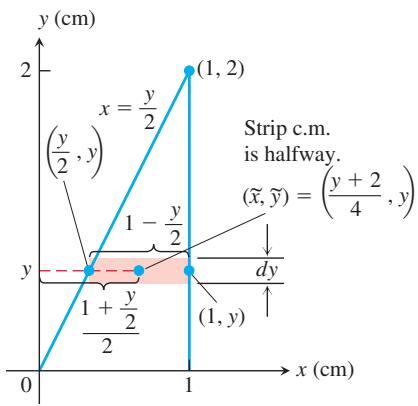
FIGURE 6.51 Modeling the plate in Example 2 with horizontal strips.
Although we do not indicate the limits of integration, the integrals that appear in Equation (5) are definite integrals.
The differential dm in these integrals is the mass of the strip. For this section, we assume the density
To evaluate the integrals in Equations (5), we picture the plate in the coordinate plane and sketch a strip of mass parallel to one of the coordinate axes. We then express the strip’s mass
EXAMPLE 2 The triangular plate shown in Figure 6.49 has a constant density of
(a) Find the plate’s moment
(b) Find the plate’s mass
(c) Find the
Solution Method 1: Vertical Strips (Figure 6.50)
(a) The moment
center of mass (c.m.):
The moment of the strip about the y-axis is
The moment of the plate about the y-axis is therefore
(b) The plate’s mass:
(c) The
By a similar computation, we could find
Method 2: Horizontal Strips (Figure 6.51)
(a) The moment
The
We also have
width: dy
distance of c.m. to y-axis:
The moment of the strip about the y-axis is
The moment of the plate about the y-axis is
(b) The plate’s mass:
(c) The
By a similar computation, we could find
If the distribution of mass in a thin, flat plate has an axis of symmetry, the center of mass will lie on this axis. If there are two axes of symmetry, the center of mass will lie at their intersection. These facts often help to simplify our work.
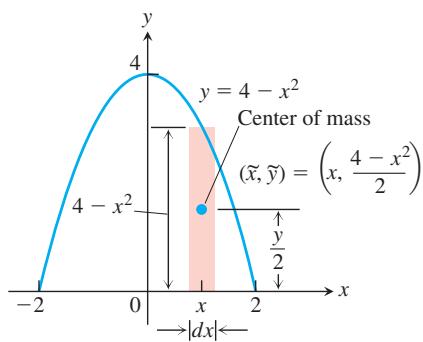
EXAMPLE 3 Find the center of mass of a thin plate covering the region bounded above by the parabola
Solution The mass distribution is symmetric about the y-axis, so
FIGURE 6.52 Modeling the plate in Example 3 with vertical strips.
The moment of the strip about the x-axis is
The moment of the plate about the x-axis is
The mass of the plate is
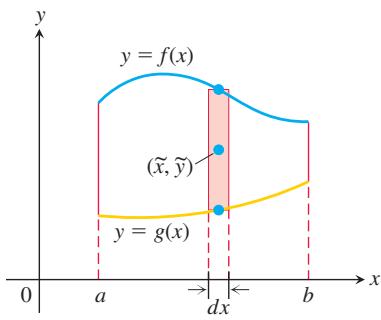
FIGURE 6.53 Modeling the plate bounded by two curves with vertical strips. The strip c.m. is halfway, so
Therefore,
The plate’s center of mass is
Plates Bounded by Two Curves
Suppose a plate covers a region that lies between two curves
center of mass (c.m.):
The moment of the plate about the y-axis is
and the moment about the x-axis is
These moments give us the following formulas.
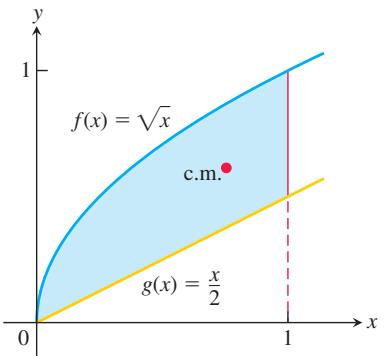
FIGURE 6.54 The region in Example 4.
EXAMPLE 4 Find the center of mass for the thin plate bounded by the curves
Solution We first compute the mass of the plate, using
Then, from Equations (6) and (7) we get
and
The center of mass is shown in Figure 6.54.
Centroids
The center of mass in Example 4 is not located at the geometric center of the region. This is due to the region’s nonuniform density. When the density function is constant, it cancels out of the numerator and denominator of the formulas for
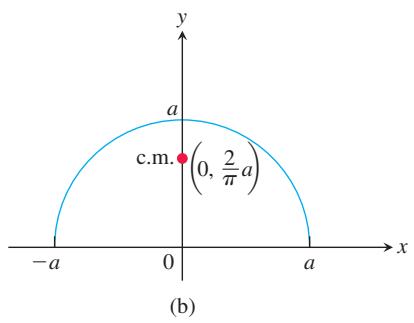
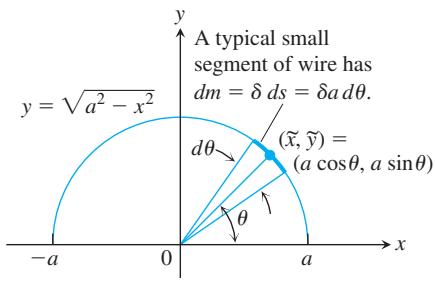
FIGURE 6.55 The semicircular wire in Example 5. (a) The dimensions and variables used in finding the center of mass. (b) The center of mass does not lie on the wire.
EXAMPLE 5 Find the center of mass (centroid) of a thin wire of constant density
Solution We model the wire with the semicircle
Hence,
The center of mass lies on the axis of symmetry at the point
In Example 5 we found the center of mass of a thin wire lying along the graph of a differentiable function in the xy-plane. In Chapter 15 we will learn how to find the center of mass of a wire lying along a more general smooth curve in the plane or in space.
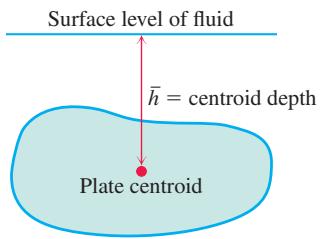
FIGURE 6.56 The force against one side of the plate is
Fluid Forces and Centroids
If we know the location of the centroid of a submerged flat vertical plate (Figure 6.56), we can take a shortcut to find the force against one side of the plate. From Equation (7) in Section 6.5, and the definition of the moment about the x-axis, we have
Fluid Forces and Centroids
The force of a fluid of weight-density
EXAMPLE 6 A flat isosceles triangular plate with base 2 m and height 1 m is submerged vertically, base up with its vertex at the origin, so that the base is 0.6 m below the surface of a swimming pool. (This is Example 6, Section 6.5.) Use Equation (8) to find the force exerted by the water against one side of the plate.
Solution The centroid of the triangle (Figure 6.43) lies on the y-axis, one-third of the way from the base to the vertex, so
Hence,
The Theorems of Pappus
In the fourth century, an Alexandrian Greek named Pappus discovered two formulas that relate centroids to surfaces and solids of revolution. The formulas provide shortcuts to a number of otherwise lengthy calculations.
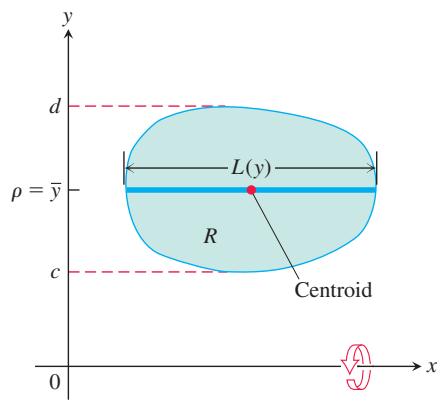
FIGURE 6.57 The region R is to be revolved (once) about the x-axis to generate a solid. A 1700-year-old theorem says that the solid’s volume can be calculated by multiplying the region’s area by the distance traveled by its centroid during the revolution.
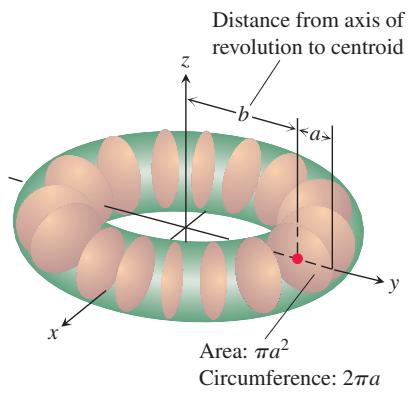
FIGURE 6.58 With Pappus’s first theorem, we can find the volume of a torus without having to integrate (Example 7).
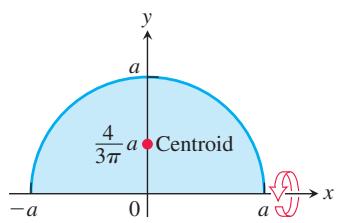
FIGURE 6.59 With Pappus’s first theorem, we can locate the centroid of a semicircular region without having to integrate (Example 8).
THEOREM 1—Pappus’s Theorem for Volumes
If a plane region is revolved once about a line in the plane that does not cut through the region’s interior, then the volume of the solid it generates is equal to the region’s area times the distance traveled by the region’s centroid during the revolution. If
Proof We draw the axis of revolution as the x-axis with the region R in the first quadrant (Figure 6.57). We let
By the method of cylindrical shells, the volume of the solid generated by revolving the region about the x-axis is
The
so that
Substituting
EXAMPLE 7 Find the volume of the torus (doughnut) generated by revolving a circular disk of radius a about an axis in its plane at a distance
Solution We apply Pappus’s Theorem for volumes. The centroid of a disk is located at its center, the area is
The next example shows how we can use Equation (9) in Pappus’s Theorem to find one of the coordinates of the centroid of a plane region of known area
EXAMPLE 8 Locate the centroid of a semicircular region of radius a.
Solution We consider the region between the semicircle
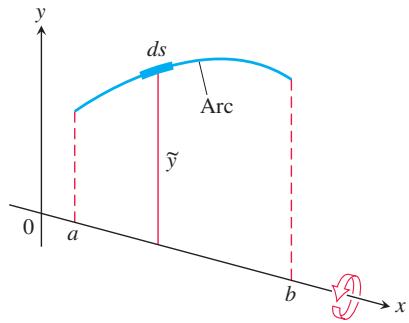
FIGURE 6.60 Figure for proving Pappus’s Theorem for surface area. The arc length differential
Hence
THEOREM 2—Pappus’s Theorem for Surface Areas
If an arc of a smooth plane curve is revolved once about a line in the plane that does not cut through the arc’s interior, then the area of the surface generated by the arc equals the length
The proof we give assumes that we can model the axis of revolution as the x-axis and the arc as the graph of a continuously differentiable function of x.
Proof We draw the axis of revolution as the x-axis with the arc extending from x = a to x = b in the first quadrant (Figure 6.60). The area of the surface generated by the arc is
The
Substituting
EXAMPLE 9 Use Pappus’s area theorem to find the surface area of the torus in Example 7.
Solution From Figure 6.58, the surface of the torus is generated by revolving a circle of radius a about the z-axis, and
EXERCISES 6.6
Mass of a wire
In Exercises 1–6, find the mass M and center of mass
-
1 ≤ 𝑥 ≤ 4 , 𝛿 ( 𝑥 ) = √ 𝑥 -
− 3 ≤ 𝑥 ≤ 3 , 𝛿 ( 𝑥 ) = 1 + 3 𝑥 2 -
0 ≤ 𝑥 ≤ 3 , 𝛿 ( 𝑥 ) = 1 𝑥 + 1 -
1 ≤ 𝑥 ≤ 2 , 𝛿 ( 𝑥 ) = 8 𝑥 3
Thin Plates with Constant Density
In Exercises 7–20, find the center of mass of a thin plate of constant density
- The region bounded by the parabola
𝑦 = 𝑥 2

-
The region bounded by the parabola
𝑦 = 2 5 − 𝑥 2 -
The region bounded by the parabola
𝑦 = 𝑥 − 𝑥 2 𝑦 = − 𝑥 -
The region enclosed by the parabolas
𝑦 = 𝑥 2 − 3 𝑦 = − 2 𝑥 2 -
The region bounded by the
𝑦 𝑥 = 𝑦 − 𝑦 3 0 ≤ 𝑦 ≤ 1 -
The region bounded by the parabola
𝑥 = 𝑦 2 − 𝑦 𝑦 = 𝑥 -
The region bounded by the
𝑥 𝑦 = c o s 𝑥 − 𝜋 / 2 ≤ 𝑥 ≤ 𝜋 / 2 -
The region between the curve
𝑦 = s e c 2 𝑥 , − 𝜋 / 4 ≤ 𝑥 ≤ 𝜋 / 4 𝑥
T 15. The region between the curve
- a. The region cut from the first quadrant by the circle
𝑥 2 + 𝑦 2 = 9
b. The region bounded by the
Compare your answer in part (b) with the answer in part (a).
-
The region in the first and fourth quadrants enclosed by the curves
𝑦 = 1 / ( 1 + 𝑥 2 ) 𝑦 = − 1 / ( 1 + 𝑥 2 ) -
The region bounded by the parabolas
𝑦 = 2 𝑥 2 − 4 𝑥 𝑦 = 2 𝑥 − 𝑥 2 -
The region between the curve
𝑦 = 1 / 𝑥 𝑥 𝑥 = 1 𝑥 = 1 6 -
The region bounded above by the curve
𝑦 = 1 / 𝑥 3 𝑦 = − 1 / 𝑥 3 𝑥 = 1 𝑥 = 𝑎 > 1 l i m 𝑥 → ∞ 𝑥 -
Consider a region bounded by the graphs of
𝑦 = 𝑥 4 𝑦 = 𝑥 5 -
Consider a thin plate of constant density
𝛿 𝑦 = √ 𝑥 𝑥 = 2 𝑦
a. moment about the x-axis.
b. moment about the y-axis.
c. moment about the line x = 5.
d. moment about the line x = -1.
e. moment about the line y = 2.
f. moment about the line y = -3.
g. mass.
h. center of mass.
Thin Plates with Varying Density
-
Find the center of mass of a thin plate covering the region between the
𝑥 𝑦 = 2 / 𝑥 2 1 ≤ 𝑥 ≤ 2 ( 𝑥 , 𝑦 ) 𝛿 ( 𝑥 ) = 𝑥 2 -
Find the center of mass of a thin plate covering the region bounded below by the parabola
𝑦 = 𝑥 2 ( 𝑥 , 𝑦 ) 𝛿 ( 𝑥 ) = 1 2 𝑥 -
The region bounded by the curves
𝑦 = ± 4 / √ 𝑥
b. Find the center of mass of a thin plate covering the region if the plate’s density at the point
c. Sketch the plate and show the center of mass in your sketch.
- The region between the curve
𝑦 = 2 / 𝑥 𝑥 𝑥 = 1 𝑥 = 4 𝑥
a. Find the volume of the solid.
b. Find the center of mass of a thin plate covering the region if the plate’s density at the point
c. Sketch the plate and show the center of mass in your sketch.
Centroids of Triangles
- The centroid of a triangle lies at the intersection of the triangle’s medians You may recall that the point inside a triangle that lies one-third of the way from each side toward the opposite vertex is the point where the triangle’s three medians intersect. Show that the centroid lies at the intersection of the medians by showing that it too lies one-third of the way from each side toward the opposite vertex. To do so, take the following steps.
i) Stand one side of the triangle on the x-axis as in part (b) of the accompanying figure. Express dm in terms of L and dy.
ii) Use similar triangles to show that
iii) Show that
iv) Extend the argument to the other sides.
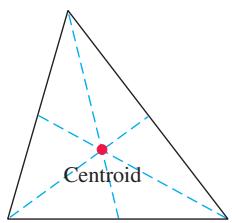
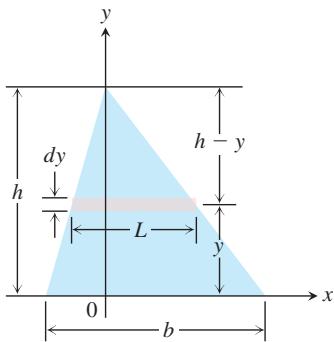
(a)
(b)
Use the result in Exercise 27 to find the centroids of the triangles whose vertices appear in Exercises 28–32. Assume a, b > 0.
-
( − 1 , 0 ) , ( 1 , 0 ) , ( 0 , 3 ) -
( 0 , 0 ) ( 1 , 0 ) ( 0 , 1 ) -
( 0 , 0 ) ( 𝑎 , 0 ) ( 0 , 𝑎 ) -
( 0 , 0 ) ( 𝑎 , 0 ) ( 0 , 𝑏 ) -
( 0 , 0 ) , ( 𝑎 , 0 ) , ( 𝑎 / 2 , 𝑏 )
Thin Wires
-
Constant density Find the moment about the x-axis of a wire of constant density that lies along the curve
𝑦 = √ 𝑥 -
Constant density Find the moment about the x-axis of a wire of constant density that lies along the curve
𝑦 = 𝑥 3 -
Variable density Suppose that the density of the wire in Example 5 is
𝛿 = 𝑘 s i n 𝜃 -
Variable density Suppose that the density of the wire in Example 5 is
𝛿 = 1 + 𝑘 | c o s 𝜃 | 𝑘
Plates Bounded by Two Curves
In Exercises 37–40, find the centroid of the thin plate bounded by the graphs of the given functions. Use Equations (6) and (7) with
-
𝑔 ( 𝑥 ) = 𝑥 2 𝑓 ( 𝑥 ) = 𝑥 + 6 -
𝑔 ( 𝑥 ) = 𝑥 2 ( 𝑥 + 1 ) 𝑓 ( 𝑥 ) = 2 -
𝑔 ( 𝑥 ) = 𝑥 2 ( 𝑥 − 1 ) 𝑓 ( 𝑥 ) = 𝑥 2 -
𝑔 ( 𝑥 ) = 0 , 𝑓 ( 𝑥 ) = 2 + s i n 𝑥 , 𝑥 = 0 , a n d 𝑥 = 2 𝜋
(Hint:
Theory and Examples
Verify the statements and formulas in Exercises 41 and 42.
- The coordinates of the centroid of a differentiable plane curve are
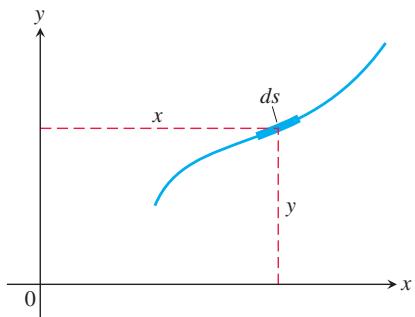
- Whatever the value of
𝑝 > 0 𝑦 = 𝑥 2 / ( 4 𝑝 ) 𝑦 ―― 𝑦 = ( 3 / 5 ) 𝑎
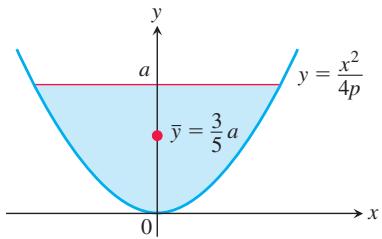
The Theorems of Pappus
-
The square region with vertices
( 0 , 2 ) ( 2 , 0 ) ( 4 , 2 ) ( 2 , 4 ) -
Use a theorem of Pappus to find the volume generated by revolving about the line x = 5 the triangular region bounded by the coordinate axes and the line
2 𝑥 + 𝑦 = 6 -
Find the volume of the torus generated by revolving the circle
( 𝑥 − 2 ) 2 + 𝑦 2 = 1 -
Use the theorems of Pappus to find the lateral surface area and the volume of a right-circular cone.
-
Use Pappus’s Theorem for surface area and the fact that the surface area of a sphere of radius
𝑎 4 𝜋 𝑎 2 𝑦 = √ 𝑎 2 − 𝑥 2 -
As found in Exercise 47, the centroid of the semicircle
𝑦 = √ 𝑎 2 − 𝑥 2 ( 0 , 2 𝑎 / 𝜋 ) 𝑦 = 𝑎 -
The area of the region R enclosed by the semiellipse
𝑦 = ( 𝑏 / 𝑎 ) √ 𝑎 2 − 𝑥 2 ( 1 / 2 ) 𝜋 𝑎 𝑏 ( 4 / 3 ) 𝜋 𝑎 𝑏 2 -
As found in Example 8, the centroid of the region enclosed by the x-axis and the semicircle
𝑦 = √ 𝑎 2 − 𝑥 2 ( 0 , 4 𝑎 / 3 𝜋 ) -
The region of Exercise 50 is revolved about the line y = x - a to generate a solid. Find the volume of the solid.
-
As found in Exercise 47, the centroid of the semicircle
𝑦 = √ 𝑎 2 − 𝑥 2 ( 0 , 2 𝑎 / 𝜋 ) 𝑦 = 𝑥 − 𝑎
In Exercises 53 and 54, use a theorem of Pappus to find the centroid of the given triangle. Use the fact that the volume of a cone of radius r and height h is
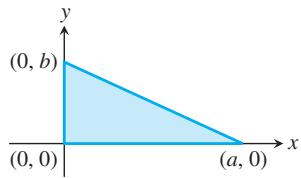
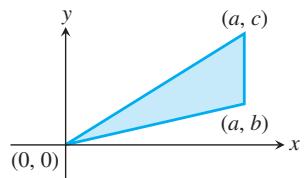
CHAPTER 6 Questions to Guide Your Review
-
How do you define and calculate the volumes of solids by the method of slicing? Give an example.
-
How are the disk and washer methods for calculating volumes derived from the method of slicing? Give examples of volume calculations by these methods.
-
Describe the method of cylindrical shells. Give an example.
-
How do you find the length of the graph of a smooth function over a closed interval? Give an example. What about functions that do not have continuous first derivatives?
-
How do you define and calculate the area of the surface swept out by revolving the graph of a smooth function
𝑦 = 𝑓 ( 𝑥 ) 𝑎 ≤ 𝑥 ≤ 𝑏 -
How do you define and calculate the work done by a variable force directed along a portion of the x-axis? How do you calculate the work it takes to pump a liquid from a tank? Give examples.
-
What is a center of mass? What is a centroid?
-
How do you locate the center of mass of a thin flat plate of material? Give an example.
-
How do you locate the center of mass of a thin plate bounded by two curves
𝑦 = 𝑓 ( 𝑥 ) 𝑦 = 𝑔 ( 𝑥 ) 𝑎 ≤ 𝑥 ≤ 𝑏
CHAPTER 6 Practice Exercises
Volumes
Find the volumes of the solids in Exercises 1–18.
-
The solid lies between planes perpendicular to the x-axis at x = 0 and x = 1. The cross-sections perpendicular to the x-axis between these planes are circular disks whose diameters run from the parabola
𝑦 = 𝑥 2 𝑦 = √ 𝑥 -
The base of the solid is the region in the first quadrant between the line y = x and the parabola
𝑦 = 2 √ 𝑥 -
The solid lies between planes perpendicular to the x-axis at
𝑥 = 𝜋 / 4 𝑥 = 5 𝜋 / 4 𝑦 = 2 c o s 𝑥 𝑦 = 2 s i n 𝑥 -
The solid lies between planes perpendicular to the x-axis at x = 0 and x = 6. The cross-sections between these planes are squares whose bases run from the x-axis up to the curve
𝑥 1 / 2 + 𝑦 1 / 2 = √ 6
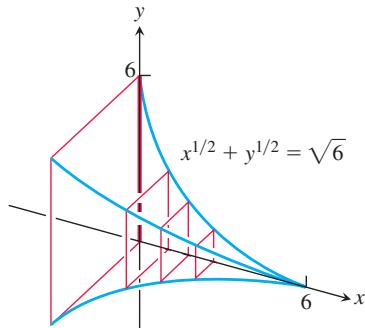
-
The solid lies between planes perpendicular to the x-axis at x = 0 and x = 4. The cross-sections of the solid perpendicular to the x-axis between these planes are circular disks whose diameters run from the curve
𝑥 2 = 4 𝑦 𝑦 2 = 4 𝑥 -
The base of the solid is the region bounded by the parabola
𝑦 2 = 4 𝑥 -
Find the volume of the solid generated by revolving the region bounded by the x-axis, the curve
𝑦 = 3 𝑥 4 -
Find the volume of the solid generated by revolving the “triangular” region bounded by the curve
𝑦 = 4 / 𝑥 3 -
Find the volume of the solid generated by revolving the region bounded on the left by the parabola
𝑥 = 𝑦 2 + 1 -
Find the volume of the solid generated by revolving the region bounded by the parabola
𝑦 2 = 4 𝑥 -
Find the volume of the solid generated by revolving the “triangular” region bounded by the x-axis, the line
𝑥 = 𝜋 / 3 𝑦 = t a n 𝑥 -
Find the volume of the solid generated by revolving the region bounded by the curve
𝑦 = s i n 𝑥 𝑥 = 0 , 𝑥 = 𝜋 -
Find the volume of the solid generated by revolving the region bounded by the curve
𝑥 = 𝑒 𝑦 2 -
Find the volume of the solid generated by revolving about the
𝑥 𝑦 = 2 t a n 𝑥 𝑦 = 0 𝑥 = − 𝜋 / 4 𝑥 = 𝜋 / 4 -
Volume of a solid sphere hole A round hole of radius
√ 3 -
Volume of a football A football resembles the surface of revolution obtained by revolving the ellipse shown here around the
𝑥
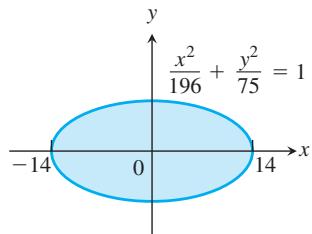
- Set up and evaluate an integral to find the volume of the given circular frustum of height h and radii a and b.
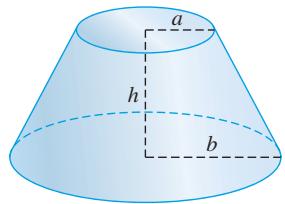
- The graph of
𝑥 2 / 3 + 𝑦 2 / 3 = 1
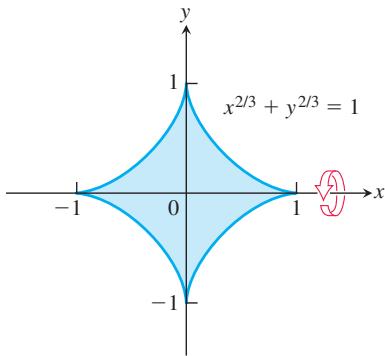
Lengths of Curves
Find the lengths of the curves in Exercises 19-24.
-
𝑦 = 𝑥 1 / 2 − ( 1 / 3 ) 𝑥 3 / 2 , 1 ≤ 𝑥 ≤ 4 -
𝑥 = 𝑦 2 / 3 1 ≤ 𝑦 ≤ 8 -
𝑦 = 𝑥 2 − ( l n 𝑥 ) / 8 , 1 ≤ 𝑥 ≤ 2 -
𝑥 = ( 𝑦 3 / 1 2 ) + ( 1 / 𝑦 ) , 1 ≤ 𝑦 ≤ 2
𝑦 = 2 3 𝑥 3 / 2 − 1 , 0 ≤ 𝑥 ≤ 1
Areas of Surfaces of Revolution
In Exercises 25–28, find the areas of the surfaces generated by revolving the curves about the given axes.
-
𝑦 = √ 2 𝑥 + 1 0 ≤ 𝑥 ≤ 3 -
𝑦 = 𝑥 3 / 3 , 0 ≤ 𝑥 ≤ 1 ; 𝑥 -
𝑥 = √ 4 𝑦 − 𝑦 2 1 ≤ 𝑦 ≤ 2 𝑦 -
𝑥 = √ 𝑦 , 2 ≤ 𝑦 ≤ 6 ; 𝑦
Work
-
Lifting equipment A rock climber is about to haul up 100 N of equipment that has been hanging beneath her on 40 m of rope that weighs 0.8 N/m. How much work will it take? (Hint: Solve for the rope and equipment separately, then add.)
-
Leaky tank truck You drove an 4000-L tank truck of water from the base of Mt. Washington to the summit and discovered on arrival that the tank was only half full. You started with a full tank, climbed at a steady rate, and accomplished the 1500-m elevation change in 50 min. Assuming that the water leaked out at a steady rate, how much work was spent in carrying water to the top? Do not count the work done in getting yourself and the truck there. Water weighs 9.8 N/L.
-
Earth’s attraction The force of attraction on an object below Earth’s surface is directly proportional to its distance from Earth’s center. Find the work done in moving a weight of
𝑤 𝑎 𝑟 -
Garage door spring A force of 200 N will stretch a garage door spring 0.8 m beyond its unstressed length. How far will a 300-N force stretch the spring? How much work does it take to stretch the spring this far from its unstressed length?
-
Pumping a reservoir A reservoir shaped like a right-circular cone, point down, 20 m across the top and 8 m deep, is full of water. How much work does it take to pump the water to a level 6 m above the top?
-
Pumping a reservoir (Continuation of Exercise 33.) The reservoir is filled to a depth of 5 m, and the water is to be pumped to the same level as the top. How much work does it take?
-
Pumping a conical tank A right-circular conical tank, point down, with top radius 5 m and height 10 m, is filled with a liquid whose weight-density is
9 0 0 0 𝑁 / 𝑚 3 -
Pumping a cylindrical tank A storage tank is a right-circular cylinder 6 m long and 2.5 m in diameter with its axis horizontal. If the tank is half full of olive oil weighing 8950 N/m
3 -
Assume that a spring does not follow Hooke’s Law. Instead, the force required to stretch the spring
𝑥 𝐹 ( 𝑥 ) = 5 𝑥 3 / 2
a. stretch the spring 2 m from its natural length?
b. stretch the spring from an initial 1 m past its natural length to 3 m past its natural length?
- Assume that a spring does not follow Hooke’s Law. Instead, the force required to stretch the spring
𝑥 𝐹 ( 𝑥 ) = 𝑘 √ 5 + 𝑥 2
a. If a 3-N force stretches the spring 2 m, find the value of k.
b. How much work is required to stretch the spring 1 m from its natural length?
Centers of Mass and Centroids
-
Find the centroid of a thin, flat plate covering the region enclosed by the parabolas
𝑦 = 2 𝑥 2 𝑦 = 3 − 𝑥 2 -
Find the centroid of a thin, flat plate covering the region enclosed by the x-axis, the lines x = 2 and x = -2, and the parabola
𝑦 = 𝑥 2 -
Find the centroid of a thin, flat plate covering the “triangular” region in the first quadrant bounded by the y-axis, the parabola
𝑦 = 𝑥 2 / 4 -
Find the centroid of a thin, flat plate covering the region enclosed by the parabola
𝑦 2 = 𝑥 -
Find the center of mass of a thin, flat plate covering the region enclosed by the parabola
𝑦 2 = 𝑥 𝛿 ( 𝑦 ) = 1 + 𝑦 -
a. Find the center of mass of a thin plate of constant density covering the region between the curve
𝑦 = 3 / 𝑥 3 / 2
b. Find the plate’s center of mass if, instead of being constant, the density is
Fluid Force
- Trough of water The vertical triangular plate shown here is the end plate of a trough full of water (w = 9800). What is the fluid force against the plate?
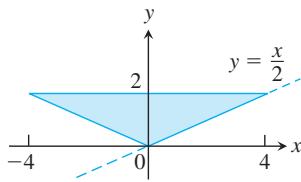
UNITS IN METERS
- Trough of maple syrup The vertical trapezoidal plate shown here is the end plate of a trough full of maple syrup weighing
1 1 , 0 0 0 𝑁 / 𝑚 3
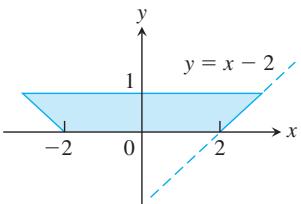
UNITS IN METERS
- Force on a parabolic gate A flat vertical gate in the face of a dam is shaped like the parabolic region between the curve
𝑦 = 4 𝑥 2
T 48. You plan to store mercury (
CHAPTER 6 Additional and Advanced Exercises
Volume and Length
-
A solid is generated by revolving about the x-axis the region bounded by the graph of the positive continuous function
𝑦 = 𝑓 ( 𝑥 ) 𝑏 2 − 𝑎 𝑏 𝑓 ( 𝑥 ) -
A solid is generated by revolving about the x-axis the region bounded by the graph of the positive continuous function
𝑦 = 𝑓 ( 𝑥 ) 𝑎 2 + 𝑎 𝑓 ( 𝑥 ) -
Suppose that the increasing function
𝑓 ( 𝑥 ) 𝑥 ≥ 0 𝑓 ( 0 ) = 𝑎 𝑠 ( 𝑥 ) 𝑓 ( 0 , 𝑎 ) ( 𝑥 , 𝑓 ( 𝑥 ) ) 𝑥 > 0 𝑓 ( 𝑥 ) 𝑠 ( 𝑥 ) = 𝐶 𝑥 𝐶 𝐶 -
a. Show that for
0 < 𝛼 ≤ 𝜋 / 2
b. Generalize the result in part (a).
-
Find the volume of the solid formed by revolving the region bounded by the graphs of
𝑦 = 𝑥 𝑦 = 𝑥 2 𝑦 = 𝑥 -
Consider a right-circular cylinder of diameter 1. Form a wedge by making one slice parallel to the base of the cylinder completely through the cylinder, and another slice at an angle of
4 5 ∘
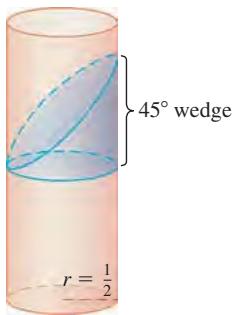
Surface Area
- At points on the curve
𝑦 = 2 √ 𝑥 ( 0 , 0 ) ( 3 , 2 √ 3 )
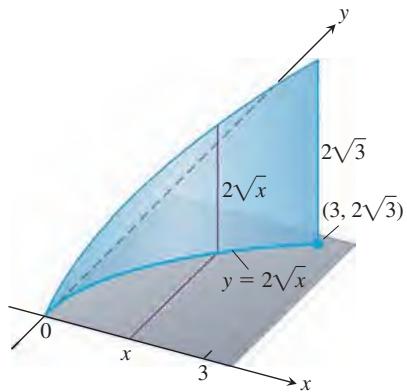
- At points on a circle of radius
𝑎 𝑃 𝑘 𝑠 𝑠 ( 𝑎 , 0 ) 𝑃 𝑘 ( 𝑎 , 0 )
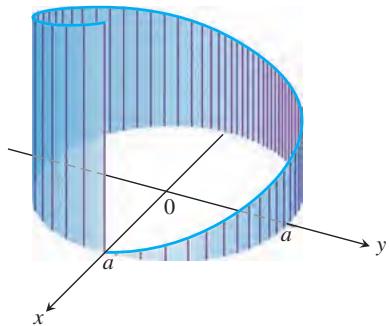
Work
-
A particle of mass m starts from rest at time t = 0 and is moved along the x-axis with constant acceleration a from x = 0 to x = h against a variable force of magnitude
𝐹 ( 𝑡 ) = 𝑡 2 -
Work and kinetic energy Suppose a 50-g golf ball is placed on a vertical spring with force constant
𝑘 = 2 N / c m
Centers of Mass
-
Find the centroid of the region bounded below by the
𝑥 𝑦 = 1 − 𝑥 𝑛 𝑛 𝑛 → ∞ -
If you haul a telephone pole on a two-wheeled carriage behind a truck, you want the wheels to be 1 m or so behind the pole’s center of mass to provide an adequate “tongue” weight. The 12-m wooden telephone poles used by Verizon have a 66-cm circumference at the top and a 104-cm circumference at the base. About how far from the top is the center of mass?
-
Suppose that a thin metal plate of area
𝐴 𝛿 𝑅 𝑥 𝑦 𝑀 𝑦 𝑦 𝑥 = 𝑏
a.
b.
-
Find the center of mass of a thin plate covering the region bounded by the curve
𝑦 2 = 4 𝑎 𝑥 ( 𝑥 , 𝑦 ) | 𝑦 | -
a. Find the centroid of the region in the first quadrant bounded by two concentric circles and the coordinate axes, if the circles have radii
𝑎 𝑏 0 < 𝑎 < 𝑏
b. Find the limits of the coordinates of the centroid as
- A triangular corner is cut from a square 40 cm on a side. The area of the triangle removed is
4 0 0 𝑐 𝑚 2
Fluid Force
-
A triangular plate ABC is submerged in water with its plane vertical. The side AB, 4 m long, is 6 m below the surface of the water, while the vertex C is 2 m below the surface. Find the force exerted by the water on one side of the plate.
-
A vertical rectangular plate is submerged in a fluid with its top edge parallel to the fluid’s surface. Show that the force exerted by the fluid on one side of the plate equals the average value of the pressure up and down the plate times the area of the plate.
CHAPTER 6
Technology Application Projects
Mathematica/Maple Projects
Projects can be found within MyLab Math.
- Using Riemann Sums to Estimate Areas, Volumes, and Lengths of Curves Visualize and approximate areas and volumes in Part I and Part II: Volumes of Revolution; and Part III: Lengths of Curves.
Collect data (or use data previously collected) to build and refine a model for the force exerted by a jumper’s bungee cord. Use the work-energy theorem to compute the distance fallen for a given jumper and a given length of bungee cord.
Integrals and Transcendental Functions

OVERVIEW Our treatment of the logarithmic and exponential functions has been rather informal. In this chapter, we give a rigorous analytic approach to the definitions and properties of these functions. We also introduce the hyperbolic functions and their inverses. Like the trigonometric functions, these functions belong to the class of transcendental functions.