Chapter 9: Infinite Sequences and Series
9.1 Sequences
HISTORICAL ESSAY
Sequences and Series To read this essay, visit the companion Website.
Sequences are fundamental to the study of infinite series and to many aspects of mathematics. We saw one example of a sequence when we studied Newton’s Method in Section 4.7. Newton’s Method produces a sequence of approximations
Representing Sequences
A sequence is a list of numbers
in a given order. Each of
has first term
We can think of the sequence
as a function that sends 1 to
sends 1 to
We can change the index to start at any given number n. For example, the sequence
is described by the formula
Sequences can be described by writing rules that specify their terms, such as
or by listing terms:
We also sometimes write a sequence using its rule, as with
and
Figure 9.1 shows two ways to represent sequences graphically. The first marks the first few points from
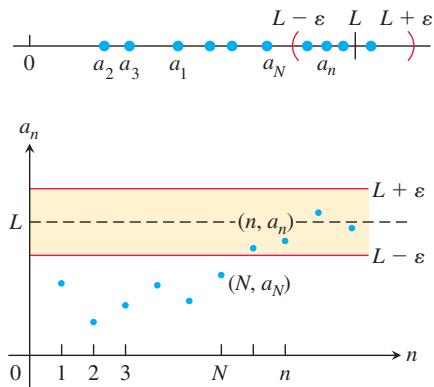
FIGURE 9.2 In the representation of a sequence as points in the plane,
HISTORICAL BIOGRAPHY
Nicole Oresme
(ca. 1320–1382)
Frenchman Oresme went to the University of Paris in the 1340s, studying theology and liberal arts. Later he was a faculty member and administrator at the same university. His work entitled De configurationibus (1350s) contained results in geometry and was the first to present graphs of velocities. The argument we use to show the divergence of the harmonic series was devised by Oresme in this publication.
To know more, visit the companion Website.
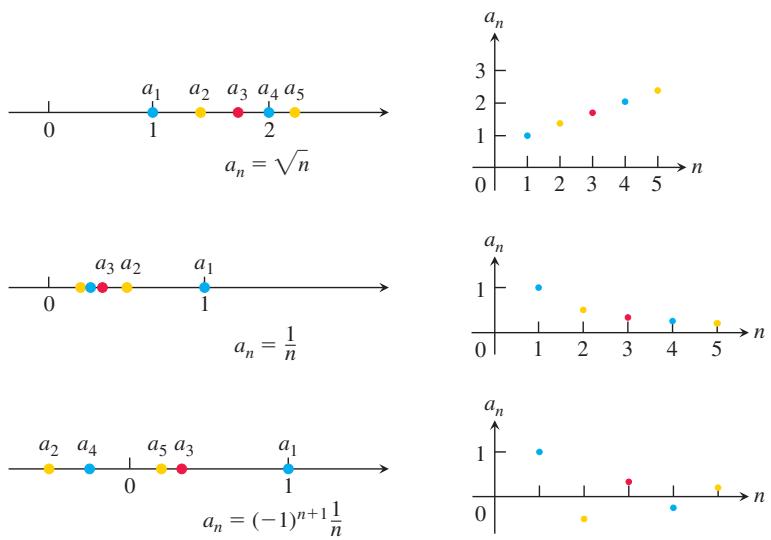
FIGURE 9.1 Sequences can be represented as points on the real line or as points in the plane where the horizontal axis n is the index number of the term and the vertical axis
Convergence and Divergence
Sometimes the numbers in a sequence approach a single value as the index
whose terms approach 0 as n gets large, and in the sequence
whose terms approach 1. On the other hand, sequences like
have terms that get larger than any number as n increases, and sequences like
bounce back and forth between 1 and -1, never converging to a single value. The following definition captures the meaning of having a sequence converge to a limiting value. It says that if we specify any number
DEFINITIONS The sequence
converges to the number { 𝑎 𝑛 } if for every positive number 𝐿 there corresponds an integer 𝜀 such that 𝑁 | 𝑎 𝑛 − 𝐿 | < 𝜀 w h e n e v e r 𝑛 > 𝑁 . If no such number
exists, we say that 𝐿 diverges. { 𝑎 𝑛 } If
converges to { 𝑎 𝑛 } , we write 𝐿 , or simply l i m 𝑛 → ∞ 𝑎 𝑛 = 𝐿 , and call 𝑎 𝑛 → 𝐿 the limit of the sequence (Figure 9.2). 𝐿
The definition is very similar to the definition of
EXAMPLE 1 Show that
Solution
(a) Let
FIGURE 9.3 (a) The sequence diverges to
(b)
The inequality
(b) Let
Since
EXAMPLE 2 Show that the sequence
(a)
Solution Since the terms in this sequence alternate between 1 and -1, our intuition is that they cannot approach arbitrarily close to some single limit L. To prove this, suppose that there did exist a number L that is the limit of this sequence. The definition of convergence then tells us that for every number
On the other hand, if
However, these two conditions on L cannot both hold, so we have reached a contradiction. Therefore there is no number L to which this sequence converges.
We chose
The sequence
In writing infinity as the limit of a sequence, we are not saying that the differences between the terms
DEFINITION The sequence
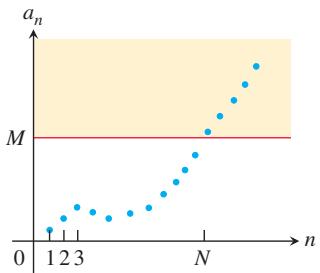
diverges to infinity if for every number M there is an integer N such that for all n larger than N, { 𝑎 𝑛 } . If this condition holds, then we write 𝑎 𝑛 > 𝑀 l i m 𝑛 → ∞ 𝑎 𝑛 = ∞ o r 𝑎 𝑛 → ∞ .
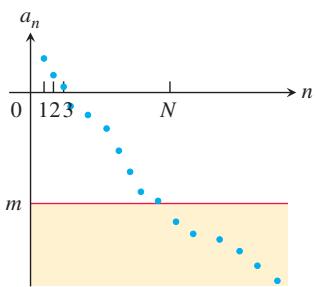
Similarly, if for every number m there is an integer N such that for all n > N, we have
A sequence may diverge without diverging to infinity or negative infinity, as we saw in Example 2. The sequences
The convergence or divergence of a sequence is not affected by the values of any number of its initial terms (whether we omit or change the first 10, the first 1000, or even the first million terms does not matter). From Figure 9.2, we can see that only the part of the sequence that remains after discarding some initial number of terms determines whether the sequence has a limit and the value of that limit when it does exist.
Calculating Limits of Sequences
Since sequences are functions with domain restricted to the positive integers, it is not surprising that the theorems on limits of functions given in Chapter 2 have versions for sequences.
THEOREM 1 Let
- Sum Rule:
- Difference Rule:
- Constant Multiple Rule:
- Product Rule:
- Quotient Rule:
The proof is similar to that of Theorem 1 in Section 2.2 and is omitted.
EXAMPLE 3 By combining Theorem 1 with the limits of Example 1, we have:
(a)
Constant Multiple Rule and Example 1a
(b)
(c)
Product Rule
(d)
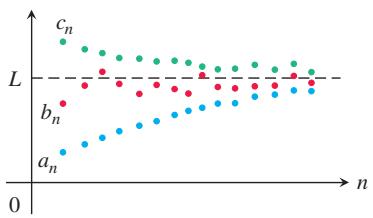
FIGURE 9.4 The terms of sequence
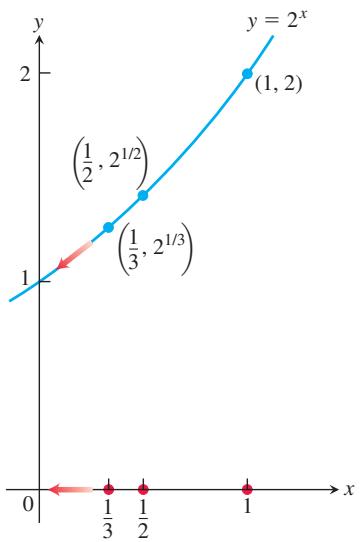
FIGURE 9.5 As
Be cautious in applying Theorem 1. It does not say, for example, that both of the sequences
One consequence of Theorem 1 is that every nonzero multiple of a divergent sequence
converges. Thus,
The next theorem is the sequence version of the Sandwich Theorem in Section 2.2. You are asked to prove the theorem in Exercise 119. (See Figure 9.4.)
THEOREM 2—The Sandwich Theorem for Sequences
Let
An immediate consequence of Theorem 2 is that if
EXAMPLE 4 Since
(a)
because
(b)
because
(c)
because
(d) If
because
The application of Theorems 1 and 2 is broadened by a theorem stating that applying a continuous function to a convergent sequence produces a convergent sequence. We state the theorem, leaving the proof as an exercise (Exercise 120).
THEOREM 3—The Continuous Function Theorem for Sequences
Let
EXAMPLE 5 Show that
Solution We know that
EXAMPLE 6 The sequence
Using L’Hôpital’s Rule
The next theorem formalizes the connection between
THEOREM 4 Suppose that
Proof Suppose that
Let
EXAMPLE 7 Show that
Solution The function
We conclude that
EXAMPLE 8 Does the sequence whose nth term is
converge? If so, find
Solution The function
The limit
Then
Therefore,
Commonly Occurring Limits
The next theorem gives some limits that arise frequently.
Factorial Notation
The notation
We define 0! to be 1. Factorials grow even faster than exponentials, as the table suggests. The values in the table are rounded.
THEOREM 5 The following six sequences converge to the limits listed below.
-
l i m 𝑛 → ∞ l n 𝑛 𝑛 = 0 -
l i m 𝑛 → ∞ 𝑛 √ 𝑛 = 1 -
l i m 𝑛 → ∞ 𝑥 1 / 𝑛 = 1 ( 𝑥 > 0 ) -
l i m 𝑛 → ∞ 𝑥 𝑛 = 0 ( | 𝑥 | < 1 ) -
l i m 𝑛 → ∞ ( 1 + 𝑥 𝑛 ) 𝑛 = 𝑒 𝑥
(any x)
l i m 𝑛 → ∞ 𝑥 𝑛 𝑛 ! = 0 𝑥
In Formulas (3) through (6),
| n | n! | |
| 1 | 3 | 1 |
| 5 | 148 | 120 |
| 10 | 22,026 | 3,628,800 |
| 20 |
Proof The first limit was computed in Example 7. The next two can be proved by taking logarithms and applying Theorem 4 (Exercises 117 and 118). The remaining proofs are given in Appendix A.6.
EXAMPLE 9 These are examples involving the limits in Theorem 5.
(a)
Formula 1
(b)
(c)
Formula 3 with
(d)
Formula 4 with
(e)
Formula 5 with
(f)
Formula 6 with
Recursive Definitions
So far, we have calculated each
-
The value(s) of the initial term or terms, and
-
a rule called a recursion formula for calculating any later term from terms that precede it.
EXAMPLE 10
(a) The statements
(b) The statements
(c) The statements
(d) As we can see by applying Newton’s method (see Exercise 145), the statements
Bounded Monotonic Sequences
Two concepts that play a key role in determining the convergence of a sequence are those of a bounded sequence and a monotonic sequence. First we define bounded sequences.
DEFINITION A sequence
is bounded from above if there exists a number M such that { 𝑎 𝑛 } for all n. The number M is an upper bound for 𝑎 𝑛 ≤ 𝑀 . If M is an upper bound for { 𝑎 𝑛 } but no number less than M is an upper bound for { 𝑎 𝑛 } , then M is the least upper bound for { 𝑎 𝑛 } . { 𝑎 𝑛 }
A sequence
If
EXAMPLE 11
(a) The sequence 1, 2, 3, …, n, … has no upper bound because it eventually surpasses every number M. However, it is bounded below by every real number less than or equal to 1. The number m = 1 is the greatest lower bound of the sequence.
(b) The sequence
Convergent sequences are bounded.
Suppose that a sequence
If M is a number larger than both
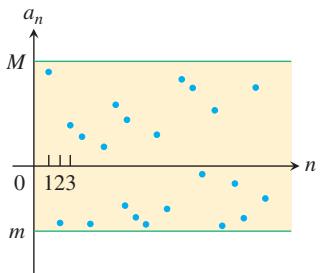
Although it is true that every convergent sequence is bounded, there are bounded sequences that fail to converge. One example is the bounded sequence
FIGURE 9.6 Some bounded sequences bounce around between their bounds and fail to converge to any limiting value.
DEFINITIONS A sequence
is nondecreasing if { 𝑎 𝑛 } for all 𝑎 𝑛 ≤ 𝑎 𝑛 + 1 . That is, 𝑛 . The sequence is nonincreasing if 𝑎 1 ≤ 𝑎 2 ≤ 𝑎 3 ≤ … for all 𝑎 𝑛 ≥ 𝑎 𝑛 + 1 . The sequence 𝑛 is monotonic if it is either nondecreasing or nonincreasing. { 𝑎 𝑛 }
EXAMPLE 12
(a) The sequence 1, 2, 3, …, n, … is nondecreasing.
(b) The sequence
(c) The sequence
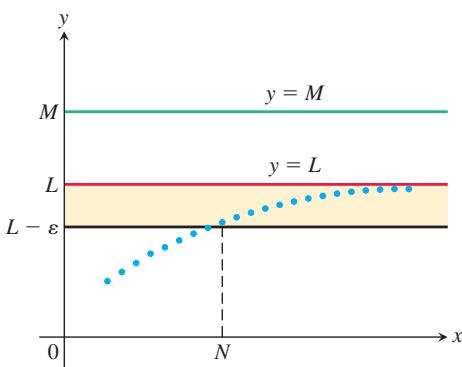
FIGURE 9.7 If the terms of a nondecreasing sequence have an upper bound M, then they have a limit
(d) The constant sequence 3, 3, 3, …, 3, … is both nondecreasing and nonincreasing.
(e) The sequence 1, -1, 1, -1, 1, -1, … is not monotonic.
A sequence that is bounded from above always has a least upper bound. Likewise, a sequence bounded from below always has a greatest lower bound. These results are based on the completeness property of the real numbers, discussed in Appendix A.9. We now prove that if L is the least upper bound of a nondecreasing sequence, then the sequence converges to L, and that if L is the greatest lower bound of a nonincreasing sequence, then the sequence converges to L.
THEOREM 6—The Monotonic Sequence Theorem
If a sequence
Proof Suppose
a.
b. given any
The fact that
Thus, all the numbers
The proof for nonincreasing sequences bounded from below is similar.
It is important to realize that Theorem 6 does not say that convergent sequences are monotonic. The sequence
Exercises 9.1
Finding Terms of a Sequence
Each of Exercises 1–6 gives a formula for the nth term
-
𝑎 𝑛 = 1 − 𝑛 𝑛 2 -
𝑎 𝑛 = 1 𝑛 ! -
𝑎 𝑛 = ( − 1 ) 𝑛 + 1 2 𝑛 − 1 -
𝑎 𝑛 = 2 + ( − 1 ) 𝑛 -
𝑎 𝑛 = 2 𝑛 2 𝑛 + 1 -
𝑎 𝑛 = 2 𝑛 − 1 2 𝑛
Each of Exercises 7–12 gives the first term or two of a sequence along with a recursion formula for the remaining terms. Write out the first ten terms of the sequence.
-
𝑎 1 = 1 , 𝑎 𝑛 + 1 = 𝑎 𝑛 + ( 1 / 2 𝑛 ) -
𝑎 1 = 1 , 𝑎 𝑛 + 1 = 𝑎 𝑛 / ( 𝑛 + 1 ) -
𝑎 1 = 2 , 𝑎 𝑛 + 1 = ( − 1 ) 𝑛 + 1 𝑎 𝑛 / 2 -
𝑎 1 = − 2 , 𝑎 𝑛 + 1 = 𝑛 𝑎 𝑛 / ( 𝑛 + 1 ) -
𝑎 1 = 𝑎 2 = 1 , 𝑎 𝑛 + 2 = 𝑎 𝑛 + 1 + 𝑎 𝑛 -
𝑎 1 = 2 , 𝑎 2 = − 1 , 𝑎 𝑛 + 2 = 𝑎 𝑛 + 1 / 𝑎 𝑛
Finding a Sequence’s Formula
In Exercises 13–30, find a formula for the nth term of the sequence.
- 1, -1, 1, -1, 1, …
1’s with alternating signs
- -1, 1, -1, 1, -1, …
1’s with alternating signs
- 1, -4, 9, -16, 25, …
Squares of the positive integers, with alternating signs
-
1 , − 1 4 , 1 9 , − 1 1 6 , 1 2 5 , … -
1 9 , 2 1 2 , 2 2 1 5 , 2 3 1 8 , 2 4 2 1 , …
Powers of 2 divided by multiples of 3
-
− 3 2 , − 1 6 , 1 1 2 , 3 2 0 , 5 3 0 , … -
0, 3, 8, 15, 24, …
Squares of the positive integers diminished by 1 Integers, beginning with -3
-
-3, -2, -1, 0, 1, …
-
1, 5, 9, 13, 17, …
Every other odd positive integer
- 2, 6, 10, 14, 18, …
Every other even positive integer
5 1 , 8 2 , 1 1 6 , 1 4 2 4 , 1 7 1 2 0 , …
Integers differing by 3 divided by factorials
1 2 5 , 8 1 2 5 , 2 7 6 2 5 , 6 4 3 1 2 5 , 1 2 5 1 5 , 6 2 5 , …
Cubes of positive integers divided by powers of 5
- 1, 0, 1, 0, 1, …
Alternating 1’s and 0’s
- 0, 1, 1, 2, 2, 3, 3, 4, …
Each positive integer repeated
-
1 2 − 1 3 , 1 3 − 1 4 , 1 4 − 1 5 , 1 5 − 1 6 , … -
√ 5 − √ 4 , √ 6 − √ 5 , √ 7 − √ 6 , √ 8 − √ 7 , … -
s i n ( √ 2 1 + 4 ) , s i n ( √ 3 1 + 9 ) , s i n ( √ 4 1 + 1 6 ) , s i n ( √ 5 1 + 2 5 ) , … -
√ 5 8 , √ 7 1 1 , √ 9 1 4 , √ 1 1 1 7 , ⋯
Convergence and Divergence
-
𝑎 𝑛 = 2 + ( 0 . 1 ) 𝑛 -
𝑎 𝑛 = 𝑛 + ( − 1 ) 𝑛 𝑛 -
𝑎 𝑛 = 1 − 2 𝑛 1 + 2 𝑛 -
𝑎 𝑛 = 2 𝑛 + 1 1 − 3 √ 𝑛 -
𝑎 𝑛 = 1 − 5 𝑛 4 𝑛 4 + 8 𝑛 3 -
𝑎 𝑛 = 𝑛 + 3 𝑛 2 + 5 𝑛 + 6 -
𝑎 𝑛 = 𝑛 2 − 2 𝑛 + 1 𝑛 − 1 , 𝑛 ≥ 2 -
𝑎 𝑛 = 1 − 𝑛 3 7 0 − 4 𝑛 2 -
𝑎 𝑛 = 1 + ( − 1 ) 𝑛 -
𝑎 𝑛 = ( − 1 ) 𝑛 ( 1 − 1 𝑛 ) -
𝑎 𝑛 = ( 𝑛 + 1 2 𝑛 ) ( 1 − 1 𝑛 ) -
𝑎 𝑛 = ( 2 − 1 2 𝑛 ) ( 3 + 1 2 𝑛 ) -
𝑎 𝑛 = ( − 1 ) 𝑛 + 1 2 𝑛 − 1 -
𝑎 𝑛 = ( − 1 2 ) 𝑛 -
𝑎 𝑛 = √ 2 𝑛 𝑛 + 1 -
𝑎 𝑛 = 1 ( 0 . 9 ) 𝑛 -
𝑎 𝑛 = s i n ( 𝜋 2 + 1 𝑛 ) -
𝑎 𝑛 = 𝑛 𝜋 c o s ( 𝑛 𝜋 ) -
𝑎 𝑛 = s i n 𝑛 𝑛 -
𝑎 𝑛 = s i n 2 𝑛 2 𝑛 -
𝑎 𝑛 = 𝑛 2 𝑛 -
𝑎 𝑛 = 3 𝑛 𝑛 3 -
𝑎 𝑛 = l n ( 𝑛 + 1 ) √ 𝑛 -
𝑎 𝑛 = l n 𝑛 l n 2 𝑛 -
𝑎 𝑛 = 8 1 / 𝑛 -
𝑎 𝑛 = ( 0 . 0 3 ) 1 / 𝑛 -
𝑎 𝑛 = ( 1 + 7 𝑛 ) 𝑛 -
𝑎 𝑛 = ( 1 − 1 𝑛 ) 𝑛
Integers differing by 2 divided by products of consecutive integers
-
𝑎 𝑛 = 𝑛 √ 1 0 𝑛 -
𝑎 𝑛 = 𝑛 √ 𝑛 2 -
𝑎 𝑛 = ( 3 𝑛 ) 1 / 𝑛 -
𝑎 𝑛 = ( 𝑛 + 4 ) 1 / ( 𝑛 + 4 ) -
𝑎 𝑛 = l n 𝑛 𝑛 1 / 𝑛 -
𝑎 𝑛 = l n 𝑛 − l n ( 𝑛 + 1 ) -
𝑎 𝑛 = 𝑛 √ 4 𝑛 𝑛 -
𝑎 𝑛 = 𝑛 √ 3 2 𝑛 + 1 -
𝑎 𝑛 = 𝑛 ! 𝑛 𝑛 1 / 𝑛 -
𝑎 𝑛 = ( − 4 ) 𝑛 𝑛 ! -
𝑎 𝑛 = 𝑛 ! 1 0 6 𝑛 -
𝑎 𝑛 = 𝑛 ! 2 𝑛 ⋅ 3 𝑛 -
𝑎 𝑛 = ( 1 𝑛 ) 1 / ( l n 𝑛 ) -
𝑎 𝑛 = ( 𝑛 + 1 ) ! ( 𝑛 + 3 ) ! -
𝑎 𝑛 = ( 2 𝑛 + 2 ) ! ( 2 𝑛 − 1 ) ! -
𝑎 𝑛 = 3 𝑒 𝑛 + 𝑒 − 𝑛 𝑒 𝑛 + 3 𝑒 − 𝑛 -
𝑎 𝑛 = 𝑒 − 2 𝑛 − 2 𝑒 − 3 𝑛 𝑒 − 2 𝑛 − 𝑒 − 𝑛 -
𝑎 𝑛 = ( 1 − 1 2 ) + ( 1 2 − 1 3 ) + ( 1 3 − 1 4 ) + ⋯ + ( 1 𝑛 − 2 − 1 𝑛 − 1 ) + ( 1 𝑛 − 1 − 1 𝑛 ) -
𝑎 𝑛 = ( l n 3 − l n 2 ) + ( l n 4 − l n 3 ) + ( l n 5 − l n 4 ) + ⋯ + ( l n ( 𝑛 − 1 ) − l n ( 𝑛 − 2 ) ) + ( l n 𝑛 − l n ( 𝑛 − 1 ) )
Which of the sequences
-
𝑎 𝑛 = l n ( 1 + 1 𝑛 ) 𝑛 -
𝑎 𝑛 = ( 3 𝑛 + 1 3 𝑛 − 1 ) 𝑛 -
𝑎 𝑛 = ( 𝑛 𝑛 + 1 ) 𝑛 -
𝑎 𝑛 = ( 𝑥 𝑛 2 𝑛 + 1 ) 1 / 𝑛 , 𝑥 > 0 -
𝑎 𝑛 = ( 1 − 1 𝑛 2 ) 𝑛 -
𝑎 𝑛 = 3 𝑛 ⋅ 6 𝑛 2 − 𝑛 ⋅ 𝑛 ! -
𝑎 𝑛 = ( 1 0 / 1 1 ) 𝑛 ( 9 / 1 0 ) 𝑛 + ( 1 1 / 1 2 ) 𝑛 -
𝑎 𝑛 = t a n h 𝑛 -
𝑎 𝑛 = s i n h ( l n 𝑛 ) -
𝑎 𝑛 = 𝑛 2 2 𝑛 − 1 s i n 1 𝑛 -
𝑎 𝑛 = 𝑛 ( 1 − c o s 1 𝑛 ) -
𝑎 𝑛 = √ 𝑛 s i n 1 √ 𝑛 -
𝑎 𝑛 = ( 3 𝑛 + 5 𝑛 ) 1 / 𝑛 -
𝑎 𝑛 = t a n − 1 𝑛 -
𝑎 𝑛 = 1 √ 𝑛 a r c t a n 𝑛 -
𝑎 𝑛 = ( 1 3 ) 𝑛 + 1 √ 2 𝑛 -
𝑎 𝑛 = 𝑛 √ 𝑛 2 + 𝑛 -
𝑎 𝑛 = ( l n 𝑛 ) 2 0 0 𝑛 -
𝑎 𝑛 = ( l n 𝑛 ) 5 √ 𝑛 -
𝑎 𝑛 = 𝑛 − √ 𝑛 2 − 𝑛 -
𝑎 𝑛 = 1 √ 𝑛 2 − 1 − √ 𝑛 2 + 𝑛 -
𝑎 𝑛 = 1 𝑛 ∫ 𝑛 1 1 𝑥 𝑑 𝑥 -
𝑎 𝑛 = ∫ 𝑛 1 1 𝑥 𝑝 𝑑 𝑥 , 𝑝 > 1
Recursively Defined Sequences
In Exercises 101–108, assume that each sequence converges and find its limit.
-
𝑎 1 = 2 , 𝑎 𝑛 + 1 = 7 2 1 + 𝑎 𝑛 -
𝑎 1 = − 1 , 𝑎 𝑛 + 1 = 𝑎 𝑛 + 6 𝑎 𝑛 + 2 -
𝑎 1 = − 4 , 𝑎 𝑛 + 1 = √ 8 + 2 𝑎 𝑛 -
𝑎 1 = 0 , 𝑎 𝑛 + 1 = √ 8 + 2 𝑎 𝑛 -
𝑎 1 = 5 , 𝑎 𝑛 + 1 = √ 5 𝑎 𝑛 -
𝑎 1 = 3 , 𝑎 𝑛 + 1 = 1 2 − √ 𝑎 𝑛 -
2 , 2 + 1 2 , 2 + 1 2 + 1 2 , 2 + 1 2 + 1 2 + 1 2 , … -
√ 1 , √ 1 + √ 1 , √ 1 + √ 1 + √ 1
Theory and Examples
- The first term of a sequence is
𝑥 1 = 1
Write out enough early terms of the sequence to deduce a general formula for
- A sequence of rational numbers is described as follows:
Here the numerators form one sequence, the denominators form a second sequence, and their ratios form a third sequence. Let
a. Verify that
respectively.
b. The fractions
- Newton’s method The following sequences come from the recursion formula for Newton’s method,
Do the sequences converge? If so, to what value? In each case, begin by identifying the function
b.
c.
- a. Suppose that
𝑓 ( 𝑥 ) 𝑓 ( 0 ) = 0 { 𝑎 𝑛 } 𝑎 𝑛 = 𝑛 𝑓 ( 1 / 𝑛 ) l i m 𝑛 → ∞ 𝑎 𝑛 = 𝑓 ′ ( 0 ) { 𝑎 𝑛 }
b.
d.
- Pythagorean triples A triple of positive integers
𝑎 , 𝑏 𝑐 𝑎 2 + 𝑏 2 = 𝑐 2 𝑎
be, respectively, the integer floor and ceiling for
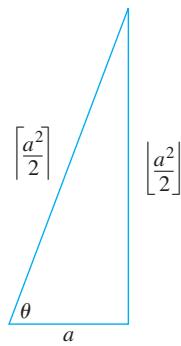
a. Show that
b. By direct calculation, or by appealing to the accompanying figure, find
- The
𝑛 𝑛 !
a. Show that
T b. Test the approximation in part (a) for
- a. Assuming that
l i m 𝑛 → ∞ ( 1 / 𝑛 𝑐 ) = 0 𝑐
if
b. Prove that
(Hint: If
- The zipper theorem Prove the “zipper theorem” for sequences: If
{ 𝑎 𝑛 } { 𝑏 𝑛 }
converges to
-
Prove that
l i m 𝑛 → ∞ 𝑛 √ 𝑛 = 1 -
Prove that
l i m 𝑛 → ∞ 𝑥 1 / 𝑛 = 1 , ( 𝑥 > 0 ) -
Prove Theorem 2.
-
Prove Theorem 3.
In Exercises 121–124, determine whether the sequence is monotonic and whether it is bounded.
-
𝑎 𝑛 = 3 𝑛 + 1 𝑛 + 1 -
𝑎 𝑛 = ( 2 𝑛 + 3 ) ! ( 𝑛 + 1 ) ! -
𝑎 𝑛 = 2 𝑛 3 𝑛 𝑛 ! -
𝑎 𝑛 = 2 − 2 𝑛 − 1 2 𝑛
In Exercises 125–134, determine whether the sequence is monotonic, whether it is bounded, and whether it converges.
-
𝑎 𝑛 = 1 − 1 𝑛 -
𝑎 𝑛 = 𝑛 − 1 𝑛 -
𝑎 𝑛 = 2 𝑛 − 1 2 𝑛 -
𝑎 𝑛 = 2 𝑛 − 1 3 𝑛 -
𝑎 𝑛 = ( ( − 1 ) 𝑛 + 1 ) ( 𝑛 + 1 𝑛 ) -
The first term of a sequence is
𝑥 1 = c o s ( 1 ) 𝑥 2 = 𝑥 1 c o s ( 2 ) 𝑥 3 = 𝑥 2 c o s ( 3 )
-
𝑎 𝑛 = 1 + √ 2 𝑛 √ 𝑛 -
𝑎 𝑛 = 𝑛 + 1 𝑛 -
𝑎 𝑛 = 4 𝑛 + 1 + 3 𝑛 4 𝑛 -
𝑎 1 = 1 , 𝑎 𝑛 + 1 = 2 𝑎 𝑛 − 3
In Exercises 135–136, use the definition of convergence to prove the given limit.
-
l i m 𝑛 → ∞ s i n 𝑛 𝑛 = 0 -
l i m 𝑛 → ∞ ( 1 − 1 𝑛 2 ) = 1 -
The sequence
{ 𝑛 / ( 𝑛 + 1 ) } 𝑀 { 𝑛 / ( 𝑛 + 1 ) } 𝑀 𝑀 < 1 𝑁 𝑛 / ( 𝑛 + 1 ) > 𝑀 𝑛 > 𝑁 𝑛 / ( 𝑛 + 1 ) < 1 𝑛 { 𝑛 / ( 𝑛 + 1 ) } -
Uniqueness of least upper bounds Show that if
𝑀 1 𝑀 2 { 𝑎 𝑛 } 𝑀 1 = 𝑀 2 -
Is it true that a sequence
{ 𝑎 𝑛 } -
Prove that if
{ 𝑎 𝑛 } 𝜀 𝑁
-
Uniqueness of limits Prove that limits of sequences are unique. That is, show that if
𝐿 1 𝐿 2 𝑎 𝑛 → 𝐿 1 𝑎 𝑛 → 𝐿 2 𝐿 1 = 𝐿 2 -
Limits and subsequences If the terms of one sequence appear in another sequence in their given order, we call the first sequence a subsequence of the second. Prove that if two subsequences of a sequence
{ 𝑎 𝑛 } 𝐿 1 ≠ 𝐿 2 { 𝑎 𝑛 } -
For a sequence
{ 𝑎 𝑛 } 𝑎 2 𝑘 𝑎 2 𝑘 + 1 𝑎 2 𝑘 → 𝐿 𝑎 2 𝑘 + 1 → 𝐿 𝑎 𝑛 → 𝐿 -
Prove that a sequence
{ 𝑎 𝑛 } { | 𝑎 𝑛 | } -
Sequences generated by Newton’s method Newton’s method, applied to a differentiable function
𝑓 ( 𝑥 ) 𝑥 0 { 𝑥 𝑛 } 𝑓
a. Show that the recursion formula for
T b. Starting with
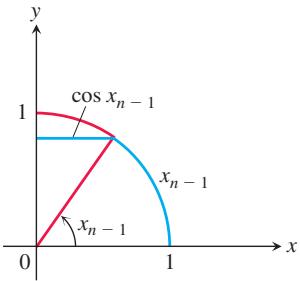
- A recursive definition of
𝜋 / 2 𝑥 1 = 1 { 𝑥 𝑛 } 𝑥 𝑛 = 𝑥 𝑛 − 1 + c o s 𝑥 𝑛 − 1 𝜋 / 2
COMPUTER EXPLORATIONS
Use a CAS to perform the following steps for the sequences in Exercises 147–158.
a. Calculate and then plot the first 25 terms of the sequence. Does the sequence appear to be bounded from above or below? Does it appear to converge or diverge? If it does converge, what is the limit L?
-
𝑎 𝑛 = 𝑛 √ 𝑛 -
𝑎 𝑛 = ( 1 + 0 . 5 𝑛 ) 𝑛 -
𝑎 1 = 1 , 𝑎 𝑛 + 1 = 𝑎 𝑛 + 1 5 𝑛 -
𝑎 1 = 1 𝑎 𝑛 + 1 = 𝑎 𝑛 + ( − 2 ) 𝑛 -
𝑎 𝑛 = s i n 𝑛 -
𝑎 𝑛 = 𝑛 s i n 1 𝑛
b. If the sequence converges, find an integer
-
𝑎 𝑛 = s i n 𝑛 𝑛 -
𝑎 𝑛 = l n 𝑛 𝑛 -
𝑎 𝑛 = ( 0 . 9 9 9 9 ) 𝑛 -
𝑎 𝑛 = ( 1 2 3 4 5 6 ) 1 / 𝑛 -
𝑎 𝑛 = 8 𝑛 𝑛 ! -
𝑎 𝑛 = 𝑛 4 1 1 9 𝑛
9.2 Infinite Series
An infinite series is the sum of an infinite sequence of numbers
The goal of this section is to understand the meaning of such an infinite sum and to develop methods to calculate it. Since there are infinitely many terms to add in an infinite series, we cannot just keep adding to see what comes out. Instead we look at the result of summing just the first n terms of the sequence. The sum of the first n terms
is an ordinary finite sum and can be calculated by normal addition. It is called the nth partial sum. As n gets larger, we expect the partial sums to get closer and closer to a limiting value in the same sense that the terms of a sequence approach a limit, as discussed in Section 9.1.
For example, to assign meaning to an expression like
we add the terms one at a time from the beginning and look for a pattern in how these partial sums grow.
| Partial sum | Value | Suggestive expression for partial sum | |
| First: | 1 | 2 - 1 | |
| Second: | |||
| Third: | |||
| ⋮ | ⋮ | ⋮ | ⋮ |
| nth: |
Indeed there is a pattern. The partial sums form a sequence whose nth term is
HISTORICAL BIOGRAPHY Blaise Pascal (1623–1662)
Pascal was born in France and was encouraged by his father to study science. He met Fermat and was inspired to work on applied science problems. As early as 1640, he wrote an essay on conic sections and earned praise for his work from Descartes. Despite his poor health, Pascal designed an “arithmetic machine” to perform computations for tax collecting. Pascal also contributed to the development of differential calculus.
To know more, visit the companion Website.
(a)
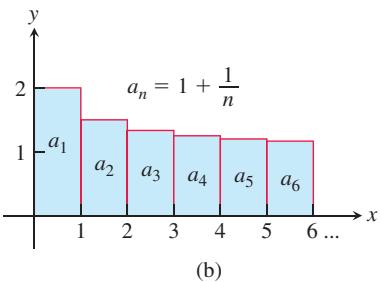
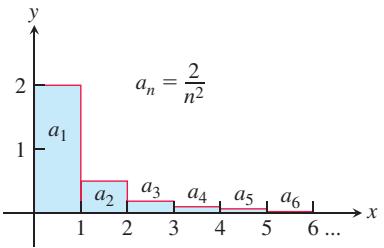
FIGURE 9.9 The sum of a series with positive terms can be interpreted as a total area of an infinite collection of rectangles. The series converges when the total area of the rectangles is finite (a) and diverges when the total area is unbounded (b). Note that the total area can be infinite even if the area of the rectangles is decreasing.
This sequence of partial sums converges to 2 because
“the sum of the infinite series
Is the sum of any finite number of terms in this series equal to 2? No. Can we actually add an infinite number of terms one by one? No. But we can still define their sum by defining it to be the limit of the sequence of partial sums as

FIGURE 9.8 As the lengths 1, 1/2, 1/4, 1/8, … are added one by one, the sum approaches 2.
DEFINITIONS Given a sequence of numbers
, an expression of the form { 𝑎 𝑛 } 𝑎 1 + 𝑎 2 + 𝑎 3 + ⋯ + 𝑎 𝑛 + … is an infinite series. The number
is the nth term of the series. The sequence 𝑎 𝑛 defined by { 𝑠 𝑛 } 𝑠 1 = 𝑎 1 𝑠 2 = 𝑎 1 + 𝑎 2 ⋮ 𝑠 𝑛 = 𝑎 1 + 𝑎 2 + ⋯ + 𝑎 𝑛 = ∑ 𝑛 𝑘 = 1 𝑎 𝑘 ⋮ is the sequence of partial sums of the series, the number
being the nth partial sum. If the sequence of partial sums converges to a limit L, we say that the series converges and that its sum is L. In this case, we also write 𝑠 𝑛 𝑎 1 + 𝑎 2 + ⋯ + 𝑎 𝑛 + ⋯ = ∞ ∑ 𝑛 = 1 𝑎 𝑛 = 𝐿 . If the sequence of partial sums of the series does not converge, we say that the series diverges.
If all the terms
When we begin to study a given series
Geometric Series
Geometric series are series of the form
in which a and r are fixed real numbers and
or negative, as in
If
and the series diverges because
If
Geometric Series
If
The formula
EXAMPLE 1 The geometric series with a = 1/9 and r = 1/3 is
(a)
(b)
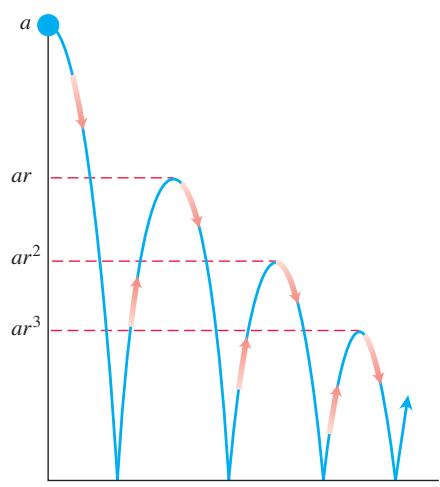
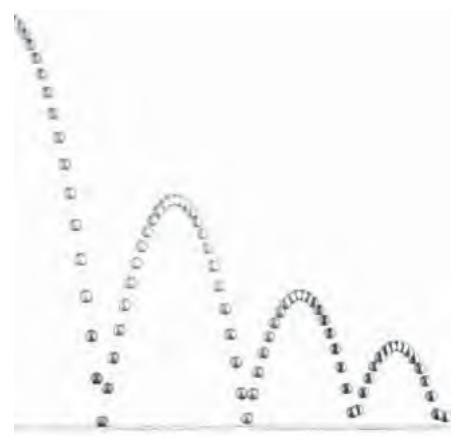
FIGURE 9.10 (a) Example 3 shows how to use a geometric series to calculate the total vertical distance traveled by a bouncing ball if the height of each rebound is reduced by the factor r. (b) A stroboscopic photo of a bouncing ball. (Source: Berenice Abbott/Science Source)
Since
EXAMPLE 2 The series
is a geometric series with
EXAMPLE 3 You drop a ball from a meters above a flat surface. Each time the ball hits the surface after falling a distance h, it rebounds a distance rh, where r is positive but less than 1. Find the total distance the ball travels up and down (Figure 9.10).
Solution The total distance is
If
EXAMPLE 4 Express the repeating decimal 5.232323 … as the ratio of two integers.
Solution From the definition of a decimal number, we get a geometric series.
Unfortunately, formulas like the one for the sum of a convergent geometric series are rare, and we usually have to settle for an estimate of a series’ sum (more about this later). The next example, however, is another case in which we can find the sum exactly.
Solution We look for a pattern in the sequence of partial sums that might lead to a formula for
SO
and
Removing parentheses and canceling adjacent terms of opposite sign collapse the sum to
We now see that
The nth-Term Test for a Divergent Series
One reason why a series may fail to converge is that its terms don’t become small.
EXAMPLE 6 The series
diverges because the partial sums eventually outgrow every preassigned number. Each term is greater than 1, so the sum of n terms is greater than n.
We now show that
This establishes the following theorem.
Caution
Theorem 7 does not say that
THEOREM 7 If
Theorem 7 leads to a test for detecting the kind of divergence that occurred in Example 6.
The nth-Term Test for Divergence
EXAMPLE 7 The following are all examples of divergent series.
(a)
(b)
(c)
(d)
EXAMPLE 8 The series
diverges because the terms can be grouped into infinitely many clusters each of which adds to 1, so the partial sums increase without bound. However, the terms of the series form a sequence that converges to 0. Example 1 of Section 9.3 shows that the harmonic series
Combining Series
Whenever we have two convergent series, we can add them term by term, subtract them term by term, or multiply them by constants to make new convergent series.
THEOREM 8 If
- Sum Rule:
- Difference Rule:
- Constant Multiple Rule:
Proof The three rules for series follow from the analogous rules for sequences in Theorem 1, Section 9.1. To prove the Sum Rule for series, let
Then the partial sums of
Since
To prove the Constant Multiple Rule for series, observe that the partial sums of
which converges to kA by the Constant Multiple Rule for sequences.
As corollaries of Theorem 8, we have the following results. We omit the proofs.
-
Every nonzero constant multiple of a divergent series diverges.
-
If
∑ 𝑎 𝑛 ∑ 𝑏 𝑛 ∑ ( 𝑎 𝑛 + 𝑏 𝑛 ) ∑ ( 𝑎 𝑛 − 𝑏 𝑛 )
Caution Remember that
EXAMPLE 9 Find the sums of the following series.
Adding or Deleting Terms
We can add a finite number of terms to a series or delete a finite number of terms without altering the series’ convergence or divergence, although in the case of convergence, this will usually change the sum. If
Conversely, if
and
HISTORICAL BIOGRAPHY Richard Dedekind (1831–1916)
Dedekind grew up in Germany and in 1850 entered the University of Gottingen. There he studied with Bernhard Riemann and Carl Gauss. Like Gauss, Dedekind preferred to study the theoretical aspects of number theory. His work on irrational numbers gave the subject a logical foundation.
To know more, visit the companion Website.
The convergence or divergence of a series is not affected by its first few terms. Only the “tail” of the series, the part that remains when we sum beyond some finite number of initial terms, influences whether it converges or diverges.
Reindexing
As long as we preserve the order of its terms, we can reindex any series without altering its convergence. To raise the starting value of the index h units, replace the n in the formula for
To lower the starting value of the index h units, replace the n in the formula for
We saw this reindexing in starting a geometric series with the index n = 0 instead of the index n = 1, but we can use any other starting index value as well. We usually give preference to indexings that lead to simple expressions.
EXAMPLE 10 We can write the geometric series
as
The partial sums remain the same no matter what indexing we choose to use.
EXERCISES 9.2
Finding nth Partial Sums
In Exercises 1–6, find a formula for the nth partial sum of each series and use it to find the series’ sum if the series converges.
Theory and Examples
Nondecreasing Partial Sums
Suppose that
Since the partial sums form a nondecreasing sequence, the Monotonic Sequence Theorem (Theorem 6, Section 9.1) gives the following result.
Corollary of Theorem 6 A series
EXAMPLE 1 As an application of the above corollary, consider the harmonic series
Although the nth term 1/n does go to zero, the series diverges because there is no upper bound for its partial sums. To see why, group the terms of the series in the following way:
The sum of the first two terms is 1.5. The sum of the next two terms is
The Integral Test
We introduce the Integral Test with a series that is related to the harmonic series, but whose nth term is
EXAMPLE 2 Does the following series converge?
Caution
The series and integral need not have the same value in the convergent case. You will see in Example 6 that
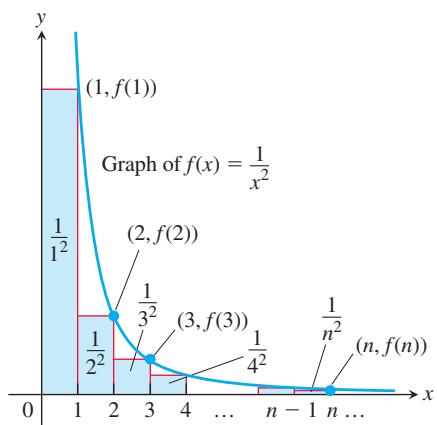
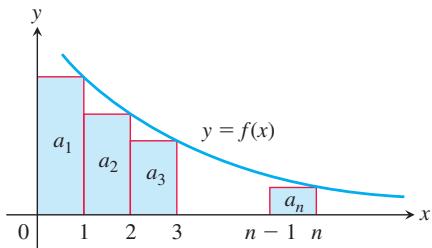
FIGURE 9.11 The sum of the areas of the rectangles under the graph of
(a)
(b)
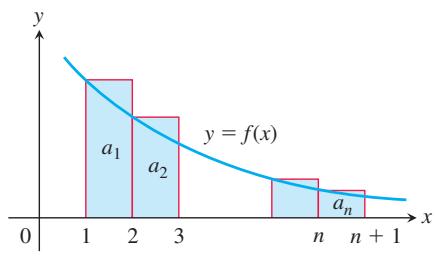
FIGURE 9.12 Subject to the conditions of the Integral Test, the series
Solution We determine the convergence of
As Figure 9.11 shows,
Thus the partial sums of
THEOREM 9—The Integral Test
Let
Proof We establish the test for the case
We start with the assumption that f is a decreasing function with
In Figure 9.12b the rectangles have been faced to the left instead of to the right. If we momentarily disregard the first rectangle of area
If we include
Combining these results gives
These inequalities hold for each n, and continue to hold as
If
The
EXAMPLE 3 Show that the p-series
converges if
(p a real constant) converges if p > 1 and diverges if
Solution If p > 1, then
the series converges by the Integral Test. We emphasize that the sum of the
If
Therefore, the series diverges by the Integral Test.
If
In summary, we have convergence for p > 1 but divergence for all other values of p.
The p-series with p = 1 is the harmonic series (Example 1). The p-Series Test shows that the harmonic series is just barely divergent; if we increase p to 1.000000001, for instance, the series converges!
The slowness with which the partial sums of the harmonic series approach infinity is impressive. For instance, it takes more than 178 million terms of the harmonic series to move the partial sums beyond 20. (See also Exercise 49b.)
EXAMPLE 4 The series
The Integral Test tells us that the series converges, but it does not say that
EXAMPLE 5 Determine the convergence or divergence of the series.
(a)
(b)
Solutions
(a) The function
is negative on that interval (since
Since the integral converges, the series also converges.
(b) The integrand
The improper integral diverges, so the series diverges also.
Error Estimation
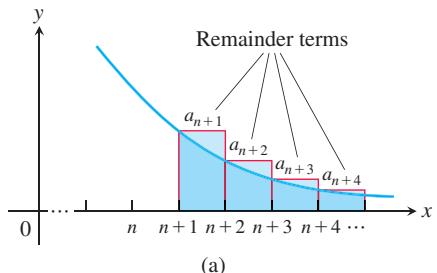
For some convergent series, such as the geometric series or the telescoping series in Example 5 of Section 9.2, we can actually find the total sum of the series. That is, we can find the limiting value S of the sequence of partial sums. For most convergent series, however, we cannot easily find the total sum. Nevertheless, we can estimate the sum by adding the first n terms to get
FIGURE 9.13 A geometric interpretation of Remainder Formula (1).
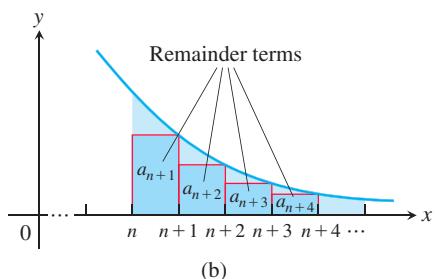
Suppose that a series
To get a lower bound for the remainder, we compare the sum of the areas of the rectangles with the area under the curve
Similarly, from Figure 9.13b, we find an upper bound with
These comparisons prove the following result, giving bounds on the size of the remainder.
Bounds for the Remainder in the Integral Test
Suppose
Since
The inequalities in (2) are useful for estimating the error in approximating the sum of a series known to converge by the Integral Test. The error can be no larger than the length of the interval containing S, with endpoints given by (2).
EXAMPLE 6 Estimate the sum of the series
Solution We have that
Using this result with the inequalities in (2) gives
Since
6 4 0 6 8 ≤ 𝑆 ≤ 1 . 6 4 9 7 7 .
If we approximate the sum
The
The error in this approximation is then less than half the length of the interval, so the error is less than 0.005. Using a trigonometric Fourier series, we prove in Section 19.4 that
-
1 − 1 2 + 1 4 − 1 8 + ⋯ + ( − 1 ) 𝑛 − 1 1 2 𝑛 − 1 + ⋯ -
1 − 2 + 4 − 8 + ⋯ + ( − 1 ) 𝑛 − 1 2 𝑛 − 1 + ⋯ -
1 2 ⋅ 3 + 1 3 ⋅ 4 + 1 4 ⋅ 5 + ⋯ + 1 ( 𝑛 + 1 ) ( 𝑛 + 2 ) + ⋯
Series with Geometric Terms
In Exercises 7–14, write out the first eight terms of each series to show how the series starts. Then find the sum of the series or show that it diverges.
-
∑ ∞ 𝑛 = 2 1 4 𝑛 -
∑ ∞ 𝑛 = 1 ( 1 − 7 4 𝑛 ) -
∑ ∞ 𝑛 = 0 ( − 1 ) 𝑛 5 4 𝑛 -
∑ ∞ 𝑛 = 0 ( 5 2 𝑛 + 1 3 𝑛 ) -
∑ ∞ 𝑛 = 0 ( 5 2 𝑛 − 1 3 𝑛 ) -
∑ ∞ 𝑛 = 0 ( 1 2 𝑛 + ( − 1 ) 𝑛 5 𝑛 ) -
∑ ∞ 𝑛 = 0 ( 2 𝑛 + 1 5 𝑛 )
In Exercises 15–22, determine whether the geometric series converges or diverges. If a series converges, find its sum.
-
1 + ( 2 5 ) + ( 2 5 ) 2 + ( 2 5 ) 3 + ( 2 5 ) 4 + ⋯ -
1 + ( − 3 ) + ( − 3 ) 2 + ( − 3 ) 3 + ( − 3 ) 4 + ⋯ -
( 1 8 ) + ( 1 8 ) 2 + ( 1 8 ) 3 + ( 1 8 ) 4 + ( 1 8 ) 5 + … -
( − 2 3 ) 2 + ( − 2 3 ) 3 + ( − 2 3 ) 4 + ( − 2 3 ) 5 + ( − 2 3 ) 6 + … -
1 − ( 2 𝑒 ) + ( 2 𝑒 ) 2 − ( 2 𝑒 ) 3 + ( 2 𝑒 ) 4 − … -
( 1 3 ) − 2 − ( 1 3 ) − 1 + 1 − ( 1 3 ) + ( 1 3 ) 2 − ⋯ -
1 + ( 1 0 9 ) 2 + ( 1 0 9 ) 4 + ( 1 0 9 ) 6 + ( 1 0 9 ) 8 + … -
9 4 − 2 7 8 + 8 1 1 6 − 2 4 3 3 2 + 7 2 9 6 4 − …
Repeating Decimals
Express each of the numbers in Exercises 23–30 as the ratio of two integers.
-
0 . ――― 2 3 = 0 . 2 3 2 3 2 3 … -
0 . ――― 2 3 4 = 0 . 2 3 4 2 3 4 2 3 4 … -
―― 7
-
0 . ―― 𝑑 = 0 . ――― 𝑑 𝑑 𝑑 … 𝑑 -
0 . 0 ―― 6 = 0 . 0 6 6 6 6 … -
1 . ――― 4 1 4 = 1 . 4 1 4 4 1 4 4 1 4 … -
1 . 2 4 ――― 1 2 3 = 1 . 2 4 1 2 3 1 2 3 1 2 3 … -
3 . ――――― 1 4 2 8 5 7 = 3 . 1 4 2 8 5 7 1 4 2 8 5 7
Using the nth-Term Test
In Exercises 31–38, use the nth-Term Test for divergence to show that the series is divergent, or state that the test is inconclusive.
-
∑ ∞ 𝑛 = 1 𝑛 𝑛 + 1 0 -
∑ ∞ 𝑛 = 1 𝑛 ( 𝑛 + 1 ) ( 𝑛 + 2 ) ( 𝑛 + 3 ) -
∑ ∞ 𝑛 = 0 1 𝑛 + 4 -
∑ ∞ 𝑛 = 1 𝑛 𝑛 2 + 3 -
∑ ∞ 𝑛 = 1 c o s 1 𝑛 -
∑ ∞ 𝑛 = 0 𝑒 𝑛 𝑒 𝑛 + 𝑛 -
∑ ∞ 𝑛 = 1 l n 1 𝑛
Telescoping Series
In Exercises 39–44, find a formula for the nth partial sum of the series and use it to determine whether the series converges or diverges. If a series converges, find its sum.
-
∑ ∞ 𝑛 = 1 ( 1 𝑛 − 1 𝑛 + 1 ) -
∑ ∞ 𝑛 = 1 ( 3 𝑛 2 − 3 ( 𝑛 + 1 ) 2 ) -
∑ ∞ 𝑛 = 1 ( l n √ 𝑛 + 1 − l n √ 𝑛 ) -
∑ ∞ 𝑛 = 1 ( t a n ( 𝑛 ) − t a n ( 𝑛 − 1 ) ) -
∑ ∞ 𝑛 = 1 ( a r c c o s ( 1 𝑛 + 1 ) − a r c c o s ( 1 𝑛 + 2 ) ) -
∑ ∞ 𝑛 = 1 ( √ 𝑛 + 4 − √ 𝑛 + 3 )
Find the sum of each series in Exercises 45-52.
-
∑ ∞ 𝑛 = 1 4 ( 4 𝑛 − 3 ) ( 4 𝑛 + 1 ) -
∑ ∞ 𝑛 = 1 6 ( 2 𝑛 − 1 ) ( 2 𝑛 + 1 ) -
∑ ∞ 𝑛 = 1 4 0 𝑛 ( 2 𝑛 − 1 ) 2 ( 2 𝑛 + 1 ) 2 -
∑ ∞ 𝑛 = 1 2 𝑛 + 1 𝑛 2 ( 𝑛 + 1 ) 2 -
∑ ∞ 𝑛 = 1 ( 1 √ 𝑛 − 1 √ 𝑛 + 1 ) -
∑ ∞ 𝑛 = 1 ( 1 2 1 / 𝑛 − 1 2 1 / ( 𝑛 + 1 ) ) -
∑ ∞ 𝑛 = 1 ( 1 l n ( 𝑛 + 2 ) − 1 l n ( 𝑛 + 1 ) ) -
∑ ∞ 𝑛 = 1 ( t a n − 1 ( 𝑛 ) − t a n − 1 ( 𝑛 + 1 ) )
Convergence or Divergence
Which series in Exercises 53–76 converge, and which diverge? Give reasons for your answers. If a series converges, find its sum.
-
∑ ∞ 𝑛 = 0 ( 1 √ 2 ) 𝑛 -
∑ ∞ 𝑛 = 0 ( √ 2 ) 𝑛 -
∑ ∞ 𝑛 = 1 ( − 1 ) 𝑛 + 1 3 2 𝑛 -
∑ ∞ 𝑛 = 1 ( − 1 ) 𝑛 + 1 𝑛 -
∑ ∞ 𝑛 = 0 c o s ( 𝑛 𝜋 2 ) -
∑ ∞ 𝑛 = 0 c o s 𝑛 𝜋 5 𝑛 -
∑ ∞ 𝑛 = 0 𝑒 − 2 𝑛 -
∑ ∞ 𝑛 = 1 l n 1 3 𝑛 -
∑ ∞ 𝑛 = 1 2 1 0 𝑛 -
∑ ∞ 𝑛 = 0 1 𝑥 𝑛 , | 𝑥 | > 1 -
∑ ∞ 𝑛 = 0 2 𝑛 − 1 3 𝑛 -
∑ ∞ 𝑛 = 1 ( 1 − 1 𝑛 ) 𝑛 -
∑ ∞ 𝑛 = 0 𝑛 ! 1 0 0 0 𝑛 -
∑ ∞ 𝑛 = 1 𝑛 𝑛 𝑛 ! -
∑ ∞ 𝑛 = 1 2 𝑛 + 3 𝑛 4 𝑛 -
∑ ∞ 𝑛 = 1 2 𝑛 + 4 𝑛 3 𝑛 + 4 𝑛 -
∑ ∞ 𝑛 = 1 l n ( 𝑛 𝑛 + 1 ) -
∑ ∞ 𝑛 = 1 l n ( 𝑛 2 𝑛 + 1 ) -
∑ ∞ 𝑛 = 0 ( 𝑒 𝜋 ) 𝑛 -
∑ ∞ 𝑛 = 0 𝑒 𝑛 𝜋 𝜋 𝑛 𝑒 -
∑ ∞ 𝑛 = 1 ( 𝑛 𝑛 + 1 − 𝑛 + 2 𝑛 + 3 ) -
∑ ∞ 𝑛 = 2 ( s i n ( 𝜋 𝑛 ) − s i n ( 𝜋 𝑛 − 1 ) ) -
∑ ∞ 𝑛 = 1 ( c o s ( 𝜋 𝑛 ) + s i n ( 𝜋 𝑛 ) ) -
∑ ∞ 𝑛 = 0 ( l n ( 4 𝑒 𝑛 − 1 ) − l n ( 2 𝑒 𝑛 + 1 ) )
Geometric Series with a Variable x
In each of the geometric series in Exercises 77–80, write out the first few terms of the series to find a and r, and find the sum of the series. Then express the inequality
-
∑ ∞ 𝑛 = 0 ( − 1 ) 𝑛 𝑥 𝑛 -
∑ ∞ 𝑛 = 0 ( − 1 ) 𝑛 𝑥 2 𝑛 -
∑ ∞ 𝑛 = 0 3 ( 𝑥 − 1 2 ) 𝑛 -
∑ ∞ 𝑛 = 0 ( − 1 ) 𝑛 2 ( 1 3 + s i n 𝑥 ) 𝑛
In Exercises 81–86, find the values of x for which the given geometric series converges. Also, find the sum of the series (as a function of x) for those values of x.
-
∑ ∞ 𝑛 = 0 2 𝑛 𝑥 𝑛 -
∑ ∞ 𝑛 = 0 ( − 1 ) 𝑛 𝑥 − 2 𝑛 -
∑ ∞ 𝑛 = 0 ( − 1 ) 𝑛 ( 𝑥 + 1 ) 𝑛 -
∑ ∞ 𝑛 = 0 ( − 1 2 ) 𝑛 ( 𝑥 − 3 ) 𝑛 -
∑ ∞ 𝑛 = 0 s i n 𝑛 𝑥 -
∑ ∞ 𝑛 = 0 ( l n 𝑥 ) 𝑛 -
The series in Exercise 5 can also be written as
Write this series as a sum beginning with (a)
- The series in Exercise 6 can also be written as
Write this series as a sum beginning with (a)
-
Make up an infinite series of nonzero terms whose sum is a. 1 b. -3 c. 0.
-
(Continuation of Exercise 89.) Can you make an infinite series of nonzero terms that converges to any number you want? Explain.
-
Show by example that
∑ ( 𝑎 𝑛 / 𝑏 𝑛 ) ∑ 𝑎 𝑛 ∑ 𝑏 𝑛 𝑏 𝑛 -
Find convergent geometric series
𝐴 = ∑ 𝑎 𝑛 𝐵 = ∑ 𝑏 𝑛 ∑ 𝑎 𝑛 𝑏 𝑛 𝐴 𝐵 -
Show by example that
∑ ( 𝑎 𝑛 / 𝑏 𝑛 ) 𝐴 = ∑ 𝑎 𝑛 , 𝐵 = ∑ 𝑏 𝑛 ≠ 0 𝑏 𝑛 -
If
∑ 𝑎 𝑛 𝑎 𝑛 > 0 𝑛 ∑ ( 1 / 𝑎 𝑛 ) -
What happens if you add a finite number of terms to a divergent series or delete a finite number of terms from a divergent series? Give reasons for your answer.
-
If
∑ 𝑎 𝑛 ∑ 𝑏 𝑛 ∑ ( 𝑎 𝑛 + 𝑏 𝑛 ) -
Make up a geometric series
∑ 𝑎 𝑟 𝑛 − 1
a.
converge? Find the sum of the series when it converges.
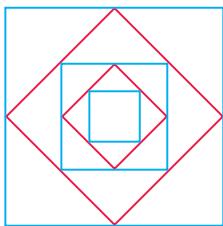
- The accompanying figure shows the first five of a sequence of squares. The outermost square has an area of
4 𝑚 2
- Drug dosage A patient takes a 300 mg tablet for the control of high blood pressure every morning at the same time. The concentration of the drug in the patient’s system decays exponentially at a constant hourly rate of k = 0.12.
a. How many milligrams of the drug are in the patient’s system just before the second tablet is taken? Just before the third tablet is taken?
b. After the patient has taken the medication for at least six months, what quantity of drug is in the patient’s body just before the next regularly scheduled morning tablet is taken?
-
Show that the error
( 𝐿 − 𝑠 𝑛 ) 𝑠 𝑛 𝑎 𝑟 𝑛 / ( 1 − 𝑟 ) -
The Cantor set To construct this set, we begin with the closed interval
[ 0 , 1 ] ( 1 / 3 , 2 / 3 ) [ 0 , 1 / 3 ] [ 2 / 3 , 1 ] [ 0 , 1 / 3 ] ( 1 / 9 , 2 / 9 ) [ 2 / 3 , 1 ] ( 7 / 9 , 8 / 9 ) [ 0 , 1 / 9 ] [ 2 / 9 , 1 / 3 ] [ 2 / 3 , 7 / 9 ] [ 8 / 9 , 1 ] ( 1 / 2 7 , 2 / 2 7 ) [ 0 , 1 / 9 ] [ 0 , 1 / 2 7 ] [ 2 / 2 7 , 1 / 9 ] ( 7 / 2 7 , 8 / 2 7 ) [ 2 / 9 , 1 / 3 ] [ 2 / 9 , 7 / 2 7 ] [ 8 / 2 7 , 1 / 3 ] [ 0 , 1 ]
a. The Cantor set contains infinitely many numbers in
b. Show, by summing an appropriate geometric series, that the total length of all the open middle third intervals that have been removed from
- Helge von Koch’s snowflake curve Helge von Koch’s snowflake is a curve of infinite length that encloses a region of finite area. To see why this is so, suppose the curve is generated by starting with an equilateral triangle whose sides have length 1.
a. Find the length
b. Find the area
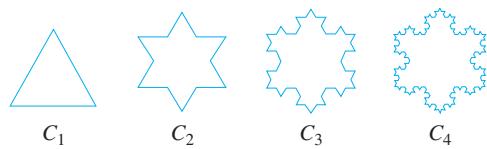
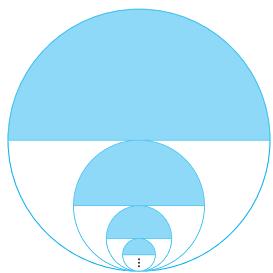
- The largest circle in the accompanying figure has radius 1. Consider the sequence of circles of maximum area inscribed in semicircles of diminishing size. What is the sum of the areas of all of the circles?
The most basic question we can ask about a series is whether it converges. In this section we begin to study this question, starting with series that have nonnegative terms. Such a series converges if its sequence of partial sums is bounded. If we establish that a given series does converge, we generally do not have a formula available for its sum. So to get an estimate for the sum of a convergent series, we investigate the error involved when using a partial sum to approximate the total sum.
Exercises 9.3
Applying the Integral Test
Use the Integral Test to determine whether the series in Exercises 1–12 converge or diverge. Be sure to check that the conditions of the Integral Test are satisfied.
-
∑ ∞ 𝑛 = 1 1 𝑛 2 -
∑ ∞ 𝑛 = 1 1 𝑛 0 . 2 -
∑ ∞ 𝑛 = 1 1 𝑛 + 4 -
∑ ∞ 𝑛 = 1 𝑒 − 2 𝑛 -
∑ ∞ 𝑛 = 2 1 𝑛 ( l n 𝑛 ) 2 -
∑ ∞ 𝑛 = 1 𝑛 𝑛 2 + 4 -
∑ ∞ 𝑛 = 2 l n ( 𝑛 2 ) 𝑛 -
∑ ∞ 𝑛 = 1 𝑛 2 𝑒 𝑛 / 3
-
∑ ∞ 𝑛 = 2 𝑛 − 4 𝑛 2 − 2 𝑛 + 1 -
∑ ∞ 𝑛 = 1 7 √ 𝑛 + 4 -
∑ ∞ 𝑛 = 2 1 5 𝑛 + 1 0 √ 𝑛
Determining Convergence or Divergence
Which of the series in Exercises 13–46 converge, and which diverge? Give reasons for your answers. (When you check an answer, remember that there may be more than one way to determine the series’ convergence or divergence.)
-
∑ ∞ 𝑛 = 1 1 1 0 𝑛 -
∑ ∞ 𝑛 = 1 𝑒 − 𝑛 -
∑ ∞ 𝑛 = 1 𝑛 𝑛 + 1 -
∑ ∞ 𝑛 = 1 5 𝑛 + 1 -
∑ ∞ 𝑛 = 1 3 √ 𝑛 -
∑ ∞ 𝑛 = 1 − 2 𝑛 √ 𝑛 -
∑ ∞ 𝑛 = 1 − 1 8 𝑛 -
∑ ∞ 𝑛 = 1 − 8 𝑛 -
∑ ∞ 𝑛 = 2 l n 𝑛 𝑛 -
∑ ∞ 𝑛 = 2 l n 𝑛 √ 𝑛 -
∑ ∞ 𝑛 = 1 2 𝑛 3 𝑛 -
∑ ∞ 𝑛 = 1 5 𝑛 4 𝑛 + 3 -
∑ ∞ 𝑛 = 0 − 2 𝑛 + 1 -
∑ ∞ 𝑛 = 1 1 2 𝑛 − 1 -
∑ ∞ 𝑛 = 1 2 𝑛 𝑛 + 1 -
∑ ∞ 𝑛 = 1 ( 1 + 1 𝑛 ) 𝑛 -
∑ ∞ 𝑛 = 2 √ 𝑛 l n 𝑛 -
∑ ∞ 𝑛 = 1 1 √ 𝑛 ( √ 𝑛 + 1 ) -
∑ ∞ 𝑛 = 1 1 ( l n 2 ) 𝑛 -
∑ ∞ 𝑛 = 1 1 ( l n 3 ) 𝑛 -
∑ ∞ 𝑛 = 3 ( 1 / 𝑛 ) ( l n 𝑛 ) √ l n 2 𝑛 − 1 -
∑ ∞ 𝑛 = 1 1 𝑛 ( 1 + l n 2 𝑛 ) -
∑ ∞ 𝑛 = 1 𝑛 s i n 1 𝑛 -
∑ ∞ 𝑛 = 1 𝑛 t a n 1 𝑛 -
∑ ∞ 𝑛 = 1 𝑒 𝑛 1 + 𝑒 2 𝑛 -
∑ ∞ 𝑛 = 1 2 1 + 𝑒 𝑛 -
∑ ∞ 𝑛 = 1 𝑒 𝑛 1 0 + 𝑒 𝑛 -
∑ ∞ 𝑛 = 1 𝑒 𝑛 ( 1 0 + 𝑒 𝑛 ) 2 -
∑ ∞ 𝑛 = 2 √ 𝑛 + 2 − √ 𝑛 + 1 √ 𝑛 + 1 √ 𝑛 + 2 -
∑ ∞ 𝑛 = 3 7 √ 𝑛 + 1 l n √ 𝑛 + 1 -
∑ ∞ 𝑛 = 1 8 t a n − 1 𝑛 1 + 𝑛 2 -
∑ ∞ 𝑛 = 1 𝑛 𝑛 2 + 1 -
∑ ∞ 𝑛 = 1 s e c h 𝑛 -
∑ ∞ 𝑛 = 1 s e c h 2 𝑛
Theory and Examples
For what values of
-
∑ ∞ 𝑛 = 1 ( 𝑎 𝑛 + 2 − 1 𝑛 + 4 ) -
∑ ∞ 𝑛 = 3 ( 1 𝑛 − 1 − 2 𝑎 𝑛 + 1 ) -
a. Draw illustrations like those in Figures 9.12a and 9.12b to show that the partial sums of the harmonic series satisfy the inequalities
T b. There is absolutely no empirical evidence for the divergence of the harmonic series even though we know it diverges.
The partial sums just grow too slowly. To see what we mean, suppose you had started with
-
Are there any values of
𝑥 ∑ ∞ 𝑛 = 1 ( 1 / 𝑛 𝑥 ) -
Is it true that if
∑ ∞ 𝑛 = 1 𝑎 𝑛 ∑ ∞ 𝑛 = 1 𝑏 𝑛 𝑏 𝑛 < 𝑎 𝑛 -
(Continuation of Exercise 51.) Is there a “largest” convergent series of positive numbers? Explain.
-
∑ ∞ 𝑛 = 1 ( 1 / √ 𝑛 + 1 )
a. Use the accompanying graph to show that the partial sum
Conclude that
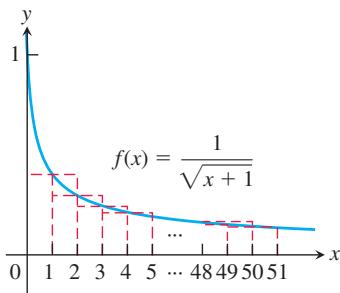
b. What should
∑ ∞ 𝑛 = 1 ( 1 / 𝑛 4 )
a. Use the accompanying graph to find an upper bound for the error if
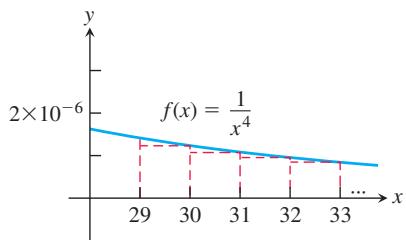
b. Find
-
Estimate the value of
∑ ∞ 𝑛 = 1 ( 1 / 𝑛 3 ) -
Estimate the value of
∑ ∞ 𝑛 = 2 ( 1 / ( 𝑛 2 + 4 ) ) -
How many terms of the convergent series
∑ ∞ 𝑛 = 1 ( 1 / 𝑛 1 . 1 ) -
How many terms of the convergent series
∑ ∞ 𝑛 = 4 1 / ( 𝑛 ( l n 𝑛 ) 3 ) -
The Cauchy condensation test The Cauchy condensation test says: Let
{ 𝑎 𝑛 } 𝑎 𝑛 ≥ 𝑎 𝑛 + 1 𝑛 ∑ 𝑎 𝑛 ∑ 2 𝑛 𝑎 2 𝑛 ∑ ( 1 / 𝑛 ) ∑ 2 𝑛 ⋅ ( 1 / 2 𝑛 ) = ∑ 1 -
Use the Cauchy condensation test from Exercise 59 to show that
a.
b.
- Logarithmic
𝑝
a. Show that the improper integral
converges if and only if p > 1.
b. What implications does the fact in part (a) have for the convergence of the series
Give reasons for your answer.
- (Continuation of Exercise 61.) Use the result in Exercise 61 to determine which of the following series converge and which diverge. Support your answer in each case.
d.
- Euler’s constant Graphs like those in Figure 9.12 suggest that as
𝑛
and the integral
To explore this idea, carry out the following steps.
9.4 Comparison Tests
a. By taking
or
Thus, the sequence
is bounded from below and from above.
b. Show that
and use this result to show that the sequence
Since a decreasing sequence that is bounded from below converges, the numbers
The number
- Use the Integral Test to show that the series
converges.
- a. For the series
∑ ( 1 / 𝑛 3 )
b. As in Example 5, use the midpoint of the interval found in part (a) to approximate the sum of the series. What is the maximum error for your approximation?
-
Repeat Exercise 65 using the series
∑ ( 1 / 𝑛 4 ) -
Area Consider the sequence
{ 1 / 𝑛 } ∞ 𝑛 = 1 ( 1 / ( 𝑛 + 1 ) , 1 / 𝑛 ) 𝑎 𝑛 ∑ 𝑎 𝑛 -
Area Repeat Exercise 67, using trapezoids instead of rectangles. That is, on the subinterval
( 1 / ( 𝑛 + 1 ) , 1 / 𝑛 ) 𝑎 𝑛 𝑦 = 1 / ( 𝑛 + 1 ) 𝑥 = 1 / ( 𝑛 + 1 ) 𝑦 = 1 / 𝑛 𝑥 = 1 / 𝑛
We have seen how to determine the convergence of geometric series, p-series, and a few others. We can test the convergence of many more series by comparing their terms to those of a series whose convergence is already known.
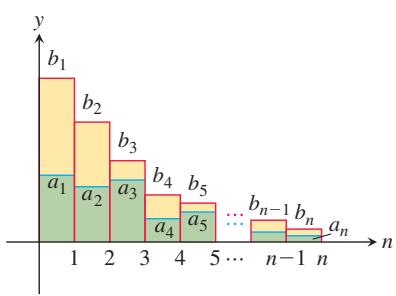
FIGURE 9.14 If the total area
HISTORICAL BIOGRAPHY
Albert of Saxony
(ca. 1316–1390)
Albert attended the University of Paris and gained recognition as a teacher at its faculty of arts. He wrote on squaring the circle and other geometric problems. He also published books on physics and mechanics, Tractatus proportionum being the most popular one.
To know more, visit the companion Website.
THEOREM 10—Direct Comparison Test
Let
- If
∑ 𝑏 𝑛 ∑ 𝑎 𝑛 - If
∑ 𝑎 𝑛 ∑ 𝑏 𝑛
Proof The series
In Part (1) we assume that
Since the partial sums of
In Part (2), where we assume that
and this would mean that
EXAMPLE 1 We apply Theorem 10 to several series.
(a) The series
diverges because its nth term
is positive and is greater than the nth term of the (positive) divergent harmonic series.
(b) The series
converges because its terms are all positive and less than or equal to the corresponding terms of
The geometric series on the left converges (since
The fact that 3 is an upper bound for the partial sums of
(c) The series
converges. To see this, we ignore the first three terms and compare the remaining terms with those of the convergent geometric series
So the truncated series and the original series converge by an application of the Direct Comparison Test.
The Limit Comparison Test
We now introduce a comparison test that is particularly useful for series in which
THEOREM 11—Limit Comparison Test
Suppose that
- If
l i m 𝑛 → ∞ 𝑎 𝑛 𝑏 𝑛 = 𝑐 𝑐 > 0 ∑ 𝑎 𝑛 ∑ 𝑏 𝑛 - If
l i m 𝑛 → ∞ 𝑎 𝑛 𝑏 𝑛 = 0 ∑ 𝑏 𝑛 ∑ 𝑎 𝑛 - If
l i m 𝑛 → ∞ 𝑎 𝑛 𝑏 𝑛 = ∞ ∑ 𝑏 𝑛 ∑ 𝑎 𝑛
Proof We will prove Part 1. Parts 2 and 3 are left as Exercises 57a and b.
We assume that
Thus, for
If
EXAMPLE 2 Which of the following series converge, and which diverge?
Solution We apply the Limit Comparison Test to each series.
(a) Let
and
so
(b) Let
and
so
(c) Let
and
so
EXAMPLE 3 Does
Solution First note that both
for
L’Hôpital’s Rule
Since
EXERCISES 9.4
Theory and Examples
𝑑 1 𝑑 2 𝑑 3 𝑑 4 ⋯ = 𝑑 1 1 0 + 𝑑 2 1 0 2 + 𝑑 3 1 0 3 + 𝑑 4 1 0 4 + … ,
where
Direct Comparison Test
In Exercises 1–8, use the Direct Comparison Test to determine whether each series converges or diverges.
-
∑ ∞ 𝑛 = 1 1 𝑛 2 + 3 0 -
∑ ∞ 𝑛 = 1 𝑛 − 1 𝑛 4 + 2 -
∑ ∞ 𝑛 = 2 1 √ 𝑛 − 1 -
∑ ∞ 𝑛 = 2 𝑛 + 2 𝑛 2 − 𝑛 -
∑ ∞ 𝑛 = 1 c o s 2 𝑛 𝑛 3 / 2 -
∑ ∞ 𝑛 = 1 1 𝑛 3 𝑛 -
∑ ∞ 𝑛 = 1 √ 𝑛 + 4 𝑛 4 + 4 -
∑ ∞ 𝑛 = 1 √ 𝑛 + 1 √ 𝑛 2 + 3
In Exercises 9–16, use the Limit Comparison Test to determine whether each series converges or diverges.
Limit Comparison Test
-
∑ ∞ 𝑛 = 1 𝑛 − 2 𝑛 3 − 𝑛 2 + 3 -
∑ ∞ 𝑛 = 1 √ 𝑛 + 1 𝑛 2 + 2 ∑ ∞ 𝑛 = 1 ( 1 / √ 𝑛 ) -
∑ ∞ 𝑛 = 2 𝑛 ( 𝑛 + 1 ) ( 𝑛 2 + 1 ) ( 𝑛 − 1 ) -
∑ ∞ 𝑛 = 1 2 𝑛 3 + 4 𝑛 -
∑ ∞ 𝑛 = 1 5 𝑛 √ 𝑛 4 𝑛 -
∑ ∞ 𝑛 = 1 ( 2 𝑛 + 3 5 𝑛 + 4 ) 𝑛 -
∑ ∞ 𝑛 = 2 1 l n 𝑛 ∑ ∞ 𝑛 = 2 ( 1 / 𝑛 ) -
∑ ∞ 𝑛 = 1 l n ( 1 + 1 𝑛 2 ) ∑ ∞ 𝑛 = 1 ( 1 / 𝑛 2 )
Determining Convergence or Divergence
Which of the series in Exercises 17–56 converge, and which diverge? Use any method, and give reasons for your answers.
17.
-
∑ ∞ 𝑛 = 1 3 𝑛 + √ 𝑛 -
∑ ∞ 𝑛 = 1 s i n 2 𝑛 2 𝑛 -
∑ ∞ 𝑛 = 1 1 + c o s 𝑛 𝑛 2 -
∑ ∞ 𝑛 = 1 2 𝑛 3 𝑛 − 1 -
∑ ∞ 𝑛 = 1 𝑛 + 1 𝑛 2 √ 𝑛 -
∑ ∞ 𝑛 = 1 1 0 𝑛 + 1 𝑛 ( 𝑛 + 1 ) ( 𝑛 + 2 ) -
∑ ∞ 𝑛 = 3 5 𝑛 3 − 3 𝑛 𝑛 2 ( 𝑛 − 2 ) ( 𝑛 2 + 5 ) -
∑ ∞ 𝑛 = 1 ( 𝑛 3 𝑛 + 1 ) 𝑛 -
∑ ∞ 𝑛 = 1 1 √ 𝑛 3 + 2 -
∑ ∞ 𝑛 = 3 1 l n ( l n 𝑛 ) -
∑ ∞ 𝑛 = 1 ( l n 𝑛 ) 2 𝑛 3 -
∑ ∞ 𝑛 = 2 1 √ 𝑛 l n 𝑛 -
∑ ∞ 𝑛 = 1 ( l n 𝑛 ) 2 𝑛 3 / 2 -
∑ ∞ 𝑛 = 1 1 1 + l n 𝑛 -
∑ ∞ 𝑛 = 2 l n ( 𝑛 + 1 ) 𝑛 + 1 -
∑ ∞ 𝑛 = 2 1 𝑛 √ 𝑛 2 − 1 -
∑ ∞ 𝑛 = 1 √ 𝑛 𝑛 2 + 1 -
∑ ∞ 𝑛 = 1 1 − 𝑛 𝑛 2 𝑛 -
∑ ∞ 𝑛 = 1 𝑛 + 2 𝑛 𝑛 2 2 𝑛 -
∑ ∞ 𝑛 = 1 1 3 𝑛 − 1 + 1 -
∑ ∞ 𝑛 = 1 3 𝑛 − 1 + 1 3 𝑛 -
∑ ∞ 𝑛 = 1 𝑛 + 1 𝑛 2 + 3 𝑛 ⋅ 1 5 𝑛 -
∑ ∞ 𝑛 = 1 2 𝑛 + 3 𝑛 3 𝑛 + 4 𝑛 -
∑ ∞ 𝑛 = 1 2 𝑛 − 𝑛 𝑛 2 𝑛 -
∑ ∞ 𝑛 = 1 l n 𝑛 √ 𝑛 𝑒 𝑛 -
∑ ∞ 𝑛 = 2 1 𝑛 ! ( 1 / 𝑛 ! ) ≤ ( 1 / 𝑛 ( 𝑛 − 1 ) ) 𝑛 ≥ 2 -
∑ ∞ 𝑛 = 1 ( 𝑛 − 1 ) ! ( 𝑛 + 2 ) ! -
∑ ∞ 𝑛 = 1 s i n 1 𝑛 -
∑ ∞ 𝑛 = 1 t a n 1 𝑛 -
∑ ∞ 𝑛 = 1 t a n − 1 𝑛 𝑛 1 . 1 -
∑ ∞ 𝑛 = 1 a r c s e c 𝑛 𝑛 1 . 3 -
∑ ∞ 𝑛 = 1 c o t h 𝑛 𝑛 2 -
∑ ∞ 𝑛 = 1 t a n h 𝑛 𝑛 2 -
∑ ∞ 𝑛 = 1 1 𝑛 𝑛 √ 𝑛 -
∑ ∞ 𝑛 = 1 𝑛 √ 𝑛 𝑛 2 -
∑ ∞ 𝑛 = 1 1 1 + 2 + 3 + ⋯ + 𝑛 -
∑ ∞ 𝑛 = 1 1 1 + 2 2 + 3 2 + ⋯ + 𝑛 2 -
∑ ∞ 𝑛 = 2 𝑛 ( l n 𝑛 ) 2 -
∑ ∞ 𝑛 = 2 ( l n 𝑛 ) 2 𝑛 -
Prove (a) Part 2 and (b) Part 3 of the Limit Comparison Test.
-
If
∑ ∞ 𝑛 = 1 𝑎 𝑛 ∑ ∞ 𝑛 = 1 ( 𝑎 𝑛 / 𝑛 ) -
Suppose that
𝑎 𝑛 > 0 𝑏 𝑛 > 0 𝑛 ≥ 𝑁 𝑁 l i m 𝑛 → ∞ ( 𝑎 𝑛 / 𝑏 𝑛 ) = ∞ ∑ 𝑎 𝑛 ∑ 𝑏 𝑛 -
Prove that if
∑ 𝑎 𝑛 ∑ 𝑎 2 𝑛 -
Suppose that
𝑎 𝑛 > 0 l i m 𝑛 → ∞ 𝑎 𝑛 = ∞ ∑ 𝑎 𝑛 -
Suppose that
𝑎 𝑛 > 0 l i m 𝑛 → ∞ 𝑛 2 𝑎 𝑛 = 0 ∑ 𝑎 𝑛 -
Show that
∑ ∞ 𝑛 = 2 ( ( l n 𝑛 ) 𝑞 / 𝑛 𝑝 ) − ∞ < 𝑞 < ∞ 𝑝 > 1
(Hint: Limit Comparison with
-
(Continuation of Exercise 63.) Show that
∑ ∞ 𝑛 = 2 ( ( l n 𝑛 ) 𝑞 / 𝑛 𝑝 ) − ∞ < 𝑞 < ∞ 0 < 𝑝 < 1 𝑝 -
Decimal numbers Any real number in the interval
[ 0 , 1 ] -
If
∑ 𝑎 𝑛 ∑ s i n ( 𝑎 𝑛 )
In Exercises 67–72, use the results of Exercises 63 and 64 to determine whether each series converges or diverges.
-
∑ ∞ 𝑛 = 2 ( l n 𝑛 ) 3 𝑛 4 -
∑ ∞ 𝑛 = 2 √ l n 𝑛 𝑛 -
∑ ∞ 𝑛 = 2 ( l n 𝑛 ) 1 0 0 0 𝑛 1 . 0 0 1 -
∑ ∞ 𝑛 = 2 ( l n 𝑛 ) 1 / 5 𝑛 0 . 9 9 -
∑ ∞ 𝑛 = 2 1 𝑛 1 . 1 ( l n 𝑛 ) 3 -
∑ ∞ 𝑛 = 2 1 √ 𝑛 ⋅ l n 𝑛
COMPUTER EXPLORATIONS
- It is not yet known whether the series
converges or diverges. Use a CAS to explore the behavior of the series by performing the following steps.
a. Define the sequence of partial sums
What happens when you try to find the limit of
b. Plot the first 100 points
c. Next plot the first 200 points
d. Plot the first 400 points
- a. Use Theorem 8 to show that
where
c. Explain why taking the first
d. We know the exact value of
gives a better approximation to S?
9.5 Absolute Convergence; The Ratio and Root Tests
When some of the terms of a series are positive and others are negative, the series may or may not converge. For example, the geometric series
converges (since
diverges (since
we see that it still converges. For a general series with both positive and negative terms, we can apply the tests for convergence that we studied before to the series of absolute values of its terms. In doing so, we are led naturally to the following concept.
DEFINITION A series
converges absolutely (is absolutely convergent) if the corresponding series of absolute values, ∑ 𝑎 𝑛 , converges. ∑ | 𝑎 𝑛 |
So the geometric series (1) is absolutely convergent. We observed, too, that it is also convergent. This situation is always true: An absolutely convergent series is convergent as well, which we now prove.
Caution
Be careful when using Theorem 12. A convergent series need not converge absolutely, as you will see in the next section.
THEOREM 12—The Absolute Convergence Test
If
Proof For each n,
If
Therefore,
EXAMPLE 1 This example gives two series that converge absolutely.
(a) For
The original series converges because it converges absolutely.
(b) For
terms, the corresponding series of absolute values is
which converges by comparison with
The Ratio Test
The Ratio Test measures the rate of growth (or decline) of a series by examining the ratio
THEOREM 13—The Ratio Test
Let
Then (a) the series converges absolutely if
Proof
(a)
Hence
Therefore,
The geometric series on the right-hand side converges because 0 < r < 1, so the series of absolute values
(b)
The terms of the series do not approach zero as
(c)
show that some other test for convergence must be used when
In both cases,
The Ratio Test is often effective when the terms of a series contain factorials of expressions involving n or expressions raised to a power involving n.
EXAMPLE 2 Investigate the convergence of the following series.
(a)
Solution We apply the Ratio Test to each series.
(a) For the series
The series converges absolutely (and thus converges) because
(b) If
The series diverges because
(c) If
Because the limit is
The Root Test
The convergence tests for
To investigate convergence we write out several terms of the series:
Clearly, this is not a geometric series. The nth term approaches zero as
As
THEOREM 14—The Root Test
Let
Proof
(a)
Then it is also true that
Now,
also converges. Therefore,
(b)
(c)
EXAMPLE 3 Consider again the series with terms
Solution We apply the Root Test, finding that
Therefore,
Since
EXAMPLE 4 Which of the following series converge, and which diverge?
(a)
Solution We apply the Root Test to each series, noting that each series has positive terms.
(a)
(b)
(c)
EXERCISES 9.5
Using the Ratio Test
In Exercises 1–8, use the Ratio Test to determine whether each series converges absolutely or diverges. Theory and Examples
Alternating Series and Conditional Convergence
A series in which the terms are alternately positive and negative is an alternating series. Here are three examples:
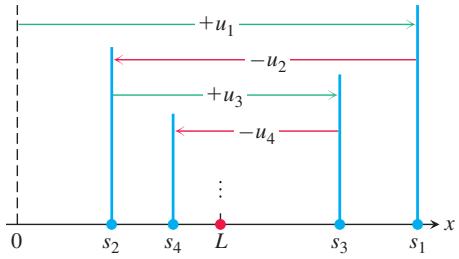
FIGURE 9.15 The partial sums of an alternating series that satisfies the hypotheses of Theorem 15 for N = 1 straddle the limit from the beginning.
We see from these examples that the
where
Series (1), called the alternating harmonic series, converges, as we will see in a moment. Series (2), which is a geometric series with ratio
converges if the following conditions are satisfied:
Conditional Convergence
If we replace all the negative terms in the alternating series in Example 3, changing them to positive terms instead, we obtain the geometric series
DEFINITION A series that is convergent but not absolutely convergent is called conditionally convergent.
The alternating harmonic series is conditionally convergent, or converges conditionally. The next example extends that result to the alternating
EXAMPLE 4 If p is a positive constant, the sequence
converges.
If p > 1, the series converges absolutely as an ordinary p-series. If
Absolute convergence
Conditional convergence
We need to be careful when using a conditionally convergent series. We have seen with the alternating harmonic series that altering the signs of infinitely many terms of a conditionally convergent series can change its convergence status. Even more, simply changing the order of occurrence of infinitely many of its terms can also have a significant effect, as we now discuss.
Rearranging Series
We can always rearrange the terms of a finite collection of numbers without changing their sum. The same result is true for an infinite series that is absolutely convergent (see Exercise 96 for an outline of the proof).
THEOREM 17—The Rearrangement Theorem for Absolutely Convergent Series
If
On the other hand, if we rearrange the terms of a conditionally convergent series, we can get different results. In fact, for any real number
EXAMPLE 5 We know that the alternating harmonic series
Now we change the order of this last sum by grouping each pair of terms with the same odd denominator, but leaving the negative terms with the even denominators as they are placed (so that the denominators are the positive integers in their natural order). This rearrangement gives
So when we rearrange the terms of the conditionally convergent series
Example 5 shows that we cannot rearrange the terms of a conditionally convergent series and expect the new series to be the same as the original one. When we use a conditionally convergent series, we must add the terms together in the order in which they are given to obtain a correct result. In contrast, Theorem 17 guarantees that the terms of an absolutely convergent series can be summed in any order without affecting the result.
Summary of Tests to Determine Convergence or Divergence
We have developed a variety of tests to determine convergence or divergence for an infinite series of constants. Other tests that we have not presented are sometimes given in more advanced courses. Here is a summary of the tests we have considered.
-
∑ ∞ 𝑛 = 1 2 𝑛 𝑛 ! -
∑ ∞ 𝑛 = 1 ( − 1 ) 𝑛 𝑛 + 2 3 𝑛 -
∑ ∞ 𝑛 = 1 ( 𝑛 − 1 ) ! ( 𝑛 + 1 ) 2 -
∑ ∞ 𝑛 = 1 2 𝑛 + 1 𝑛 3 𝑛 − 1 -
∑ ∞ 𝑛 = 1 𝑛 4 ( − 4 ) 𝑛 -
∑ ∞ 𝑛 = 2 3 𝑛 + 2 l n 𝑛 -
∑ ∞ 𝑛 = 1 ( − 1 ) 𝑛 𝑛 2 ( 𝑛 + 2 ) ! 𝑛 ! 3 2 𝑛 -
∑ ∞ 𝑛 = 1 𝑛 5 𝑛 ( 2 𝑛 + 3 ) l n ( 𝑛 + 1 ) -
The
𝑢 𝑛 -
The
𝑛 𝑎 𝑛 → 0 -
The
𝑢 𝑛 𝑢 𝑛 ≥ 𝑢 𝑛 + 1 𝑛 ≥ 𝑁 𝑁 -
Geometric series:
∑ 𝑎 𝑟 𝑛 | 𝑟 | < 1 -
𝑢 𝑛 → 0 .
Proof We look at the case N = 1, where we have nonincreasing terms
Written this way, we see that
This shows that
If
Therefore,
Combining the results of Equations (4) and (5) gives
EXAMPLE 1 The alternating harmonic series
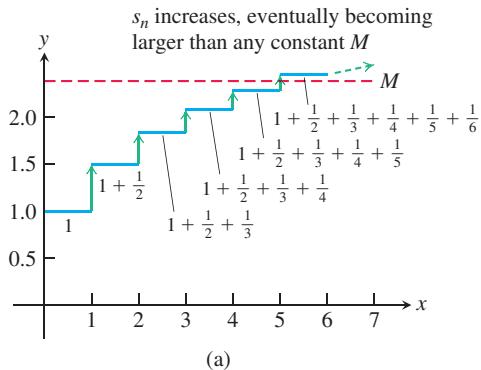
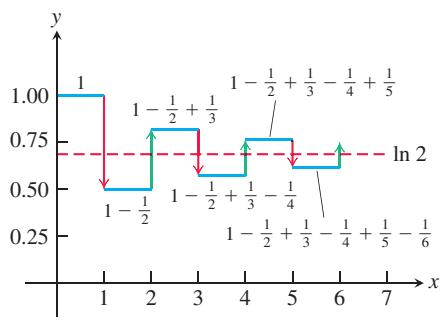
clearly satisfies the three requirements of Theorem 15 with N = 1; it therefore converges by the Alternating Series Test. Notice that the test gives no information about what the sum of the series might be. Figure 9.16 shows histograms of the partial sums of the divergent harmonic series and those of the convergent alternating harmonic series. It turns out that the alternating harmonic series converges to ln 2 (Exercise 61 in Section 9.7).
(b)
FIGURE 9.16 (a) The harmonic series diverges, with partial sums that eventually exceed any constant. (b) The alternating harmonic series converges to
Rather than directly verifying the definition
EXAMPLE 2 We show that the sequence
It follows that
A graphical interpretation of the partial sums (Figure 9.15) shows how an alternating series converges to its limit L when the three conditions of Theorem 15 are satisfied with N = 1. Starting from the origin of the x-axis, we lay off the positive distance
THEOREM 16—The Alternating Series Estimation Theorem
If the alternating series
and we can use this fact to make useful estimates of the sums of convergent alternating series.
We leave the verification of the sign of the remainder for Exercise 87.
EXAMPLE 3 We try Theorem 16 on a series whose sum we know:
The theorem says that if we truncate the series after the eighth term, we throw away a total that is positive and less than 1/256. The sum of the first eight terms is
and we note that 0.6640625 < (2/3) < 0.66796875. The difference,
is positive and is less than (1/256) = 0.00390625.
-
𝑝 ∑ 1 / 𝑛 𝑝 𝑝 > 1 -
Series with nonnegative terms: Try the Integral Test or try comparing to a known series with the Direct Comparison Test or the Limit Comparison Test. Try the Ratio or Root Test.
-
Series with some negative terms: Does
∑ | 𝑎 𝑛 | -
Alternating series:
∑ 𝑎 𝑛
Using the Root Test
In Exercises 9–16, use the Root Test to determine whether each series converges absolutely or diverges.
9.
-
∑ ∞ 𝑛 = 1 4 𝑛 ( 3 𝑛 ) 𝑛 -
∑ ∞ 𝑛 = 1 ( 4 𝑛 + 3 3 𝑛 − 5 ) 𝑛 -
∑ ∞ 𝑛 = 1 ( − l n ( 𝑒 2 + 1 𝑛 ) ) 𝑛 + 1 -
∑ ∞ 𝑛 = 1 − 8 ( 3 + ( 1 / 𝑛 ) ) 2 𝑛 -
∑ ∞ 𝑛 = 1 s i n 𝑛 ( 1 √ 𝑛 ) -
∑ ∞ 𝑛 = 1 ( − 1 ) 𝑛 ( 1 − 1 𝑛 ) 𝑛 2 l i m 𝑛 → ∞ ( 1 + 𝑥 / 𝑛 ) 𝑛 = 𝑒 𝑥 -
∑ ∞ 𝑛 = 2 ( − 1 ) 𝑛 𝑛 1 + 𝑛
Determining Convergence or Divergence
In Exercises 17–46, use any method to determine whether the series converges or diverges. Give reasons for your answer.
-
∑ ∞ 𝑛 = 1 𝑛 √ 2 2 𝑛 -
∑ ∞ 𝑛 = 1 ( − 1 ) 𝑛 𝑛 2 𝑒 − 𝑛 -
∑ ∞ 𝑛 = 1 𝑛 ! ( − 𝑒 ) − 𝑛 -
∑ ∞ 𝑛 = 1 𝑛 ! 1 0 𝑛 -
∑ ∞ 𝑛 = 1 𝑛 1 0 1 0 𝑛 -
∑ ∞ 𝑛 = 1 ( 𝑛 − 2 𝑛 ) 𝑛 -
∑ ∞ 𝑛 = 1 2 + ( − 1 ) 𝑛 1 . 2 5 𝑛 -
∑ ∞ 𝑛 = 1 ( − 2 ) 𝑛 3 𝑛 -
∑ ∞ 𝑛 = 1 ( − 1 ) 𝑛 ( 1 − 3 𝑛 ) 𝑛 -
∑ ∞ 𝑛 = 1 ( 1 − 1 3 𝑛 ) 𝑛 -
∑ ∞ 𝑛 = 1 l n 𝑛 𝑛 3 -
∑ ∞ 𝑛 = 1 ( − l n 𝑛 ) 𝑛 𝑛 𝑛 -
∑ ∞ 𝑛 = 1 ( 1 𝑛 − 1 𝑛 2 ) -
∑ ∞ 𝑛 = 1 ( 1 𝑛 − 1 𝑛 2 ) 𝑛 -
∑ ∞ 𝑛 = 1 𝑒 𝑛 𝑛 𝑒 -
∑ ∞ 𝑛 = 1 𝑛 l n 𝑛 ( − 2 ) 𝑛 -
∑ ∞ 𝑛 = 1 ( 𝑛 + 1 ) ( 𝑛 + 2 ) 𝑛 ! -
∑ ∞ 𝑛 = 1 𝑒 − 𝑛 ( 𝑛 3 ) -
∑ ∞ 𝑛 = 1 ( 𝑛 + 3 ) ! 3 ! 𝑛 ! 3 𝑛 -
∑ ∞ 𝑛 = 1 𝑛 2 𝑛 ( 𝑛 + 1 ) ! 3 𝑛 𝑛 ! -
∑ ∞ 𝑛 = 1 𝑛 ! ( 2 𝑛 + 1 ) ! -
∑ ∞ 𝑛 = 1 𝑛 ! ( − 𝑛 ) 𝑛 -
∑ ∞ 𝑛 = 2 − 𝑛 ( l n 𝑛 ) 𝑛 -
∑ ∞ 𝑛 = 2 𝑛 ( l n 𝑛 ) ( 𝑛 / 2 ) -
∑ ∞ 𝑛 = 1 𝑛 ! l n 𝑛 𝑛 ( 𝑛 + 2 ) ! -
∑ ∞ 𝑛 = 1 ( − 3 ) 𝑛 𝑛 3 2 𝑛 -
∑ ∞ 𝑛 = 1 ( 𝑛 ! ) 2 ( 2 𝑛 ) ! -
∑ ∞ 𝑛 = 1 ( 2 𝑛 + 3 ) ( 2 𝑛 + 3 ) 3 𝑛 + 2 -
∑ ∞ 𝑛 = 3 2 𝑛 𝑛 2 -
∑ ∞ 𝑛 = 3 2 𝑛 2 𝑛 2 𝑛
Recursively Defined Terms Which of the series ∑ ∞ 𝑛 = 1 𝑎 𝑛
-
𝑎 1 = 2 , 𝑎 𝑛 + 1 = 1 + s i n 𝑛 𝑛 𝑎 𝑛 -
𝑎 1 = 1 , 𝑎 𝑛 + 1 = 1 + t a n − 1 𝑛 𝑛 𝑎 𝑛 -
𝑎 1 = 1 3 , 𝑎 𝑛 + 1 = 3 𝑛 − 1 2 𝑛 + 5 𝑎 𝑛 -
𝑎 1 = 3 , 𝑎 𝑛 + 1 = 𝑛 𝑛 + 1 𝑎 𝑛 -
𝑎 1 = 2 , 𝑎 𝑛 + 1 = 2 𝑛 𝑎 𝑛 -
𝑎 1 = 5 , 𝑎 𝑛 + 1 = 𝑛 √ 𝑛 2 𝑎 𝑛 -
𝑎 1 = 1 , 𝑎 𝑛 + 1 = 1 + l n 𝑛 𝑛 𝑎 𝑛 -
𝑎 1 = 1 2 , 𝑎 𝑛 + 1 = 𝑛 + l n 𝑛 𝑛 + 1 0 𝑎 𝑛 -
𝑎 1 = 1 3 , 𝑎 𝑛 + 1 = 𝑛 √ 𝑎 𝑛 -
𝑎 1 = 1 2 , 𝑎 𝑛 + 1 = ( 𝑎 𝑛 ) 𝑛 + 1
Convergence or Divergence
Which of the series in Exercises 57–64 converge, and which diverge? Give reasons for your answers.
-
∑ ∞ 𝑛 = 1 2 𝑛 𝑛 ! 𝑛 ! ( 2 𝑛 ) ! -
∑ ∞ 𝑛 = 1 ( − 1 ) 𝑛 ( 3 𝑛 ) ! 𝑛 ! ( 𝑛 + 1 ) ! ( 𝑛 + 2 ) ! -
∑ ∞ 𝑛 = 1 ( 𝑛 ! ) 𝑛 ( 𝑛 𝑛 ) 2 -
∑ ∞ 𝑛 = 1 ( − 1 ) 𝑛 ( 𝑛 ! ) 𝑛 𝑛 ( 𝑛 2 ) -
∑ ∞ 𝑛 = 1 𝑛 𝑛 2 ( 𝑛 2 ) -
∑ ∞ 𝑛 = 1 𝑛 𝑛 ( 2 𝑛 ) 2 -
∑ ∞ 𝑛 = 1 1 ⋅ 3 ⋅ ⋯ ⋅ ( 2 𝑛 − 1 ) 4 𝑛 2 𝑛 𝑛 ! -
∑ ∞ 𝑛 = 1 1 ⋅ 3 ⋅ ⋯ ⋅ ( 2 𝑛 − 1 ) [ 2 ⋅ 4 ⋅ ⋯ ⋅ ( 2 𝑛 ) ] ( 3 𝑛 + 1 ) -
Assume that
𝑏 𝑛 ∑ ∞ 𝑛 = 1 ( 𝑏 𝑛 ) 1 / 𝑛 ∑ ∞ 𝑛 = 1 ( 5 4 ) 𝑛 ( 𝑏 𝑛 ) ∑ ∞ 𝑛 = 1 ( 𝑏 𝑛 ) 𝑛 ∑ ∞ 𝑛 = 1 1 0 0 0 𝑛 𝑛 ! + 𝑏 𝑛 -
Assume that
𝑏 𝑛 ∑ ∞ 𝑛 = 1 𝑏 𝑛 + 1 𝑏 𝑛 𝑛 4 𝑛 ∑ ∞ 𝑛 = 1 𝑛 𝑛 𝑛 ! 𝑏 2 1 𝑏 2 2 ⋯ 𝑏 2 𝑛 -
Neither the Ratio Test nor the Root Test helps with
𝑝 ∑ ∞ 𝑛 = 1 1 𝑛 𝑝
and show that both tests fail to provide information about convergence.
- Show that neither the Ratio Test nor the Root Test provides information about the convergence of
-
Let
𝑎 𝑛 = { 𝑛 / 2 𝑛 , i f 𝑛 i s a p r i m e n u m b e r 1 / 2 𝑛 , o t h e r w i s e . ∑ 𝑎 𝑛 -
Show that
∑ ∞ 𝑛 = 1 2 ( 𝑛 2 ) / 𝑛 ! 2 ( 𝑛 2 ) = ( 2 𝑛 ) 𝑛 -
Determine whether the series
∑ ∞ 𝑛 = 1 𝑐 𝑛
EXERCISES
Convergence of Alternating Series
In Exercises 1–14, determine whether the alternating series converges or diverges. Some of the series do not satisfy the conditions of the Alternating Series Test.
Theory and Examples
Power Series
Now that we can test many infinite series of numbers for convergence, we can study sums that look like “infinite polynomials.” We call these sums power series because they are defined as infinite series of powers of some variable, in our case x. Like polynomials, power series can be added, subtracted, multiplied, differentiated, and integrated to give new power series. With power series we can extend the methods of calculus to a vast array of functions, making the techniques of calculus applicable in an even wider setting.
Power Series and Convergence
We begin with the formal definition, which specifies the notation and terminology used for power series.
DEFINITIONS A power series about x = 0 is a series of the form
∞ ∑ 𝑛 = 0 𝑐 𝑛 𝑥 𝑛 = 𝑐 0 + 𝑐 1 𝑥 + 𝑐 2 𝑥 2 + ⋯ + 𝑐 𝑛 𝑥 𝑛 + … . ( 1 )
A power series about x = a is a series of the form
in which the center a and the coefficients
Equation (1) is the special case obtained by taking a = 0 in Equation (2). We will see that a power series defines a function
Power Series for
EXAMPLE 1 Taking all the coefficients to be 1 in Equation (1) gives the geometric power series
This is the geometric series with first term 1 and ratio
Up to now, we have used Equation (3) as a formula for the sum of the series on the right. We now change the focus: We think of the partial sums of the series on the right as polynomials
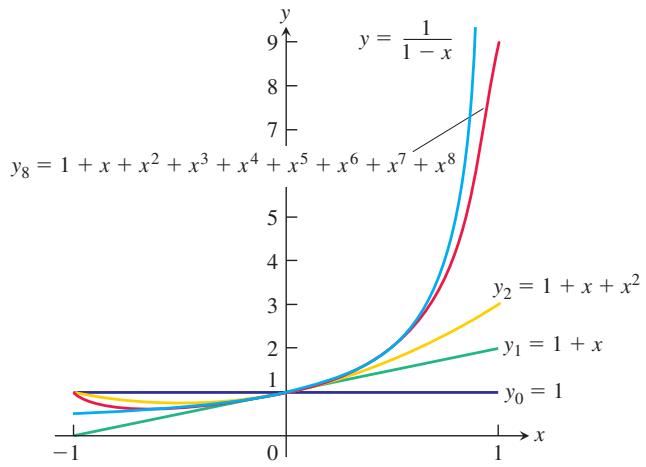
FIGURE 9.17 The graphs of
EXAMPLE 2 The power series
matches Equation (2) with
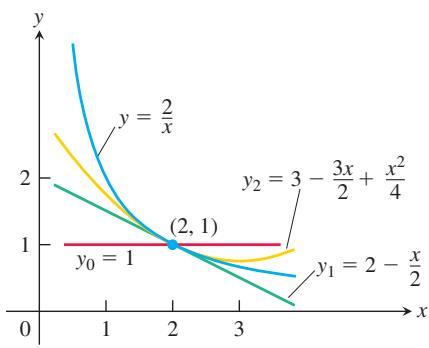
FIGURE 9.18 The graphs of
SO
Series (4) generates useful polynomial approximations of
and so on (Figure 9.18).
The following example illustrates how we test a power series for convergence by using the Ratio Test to see where it converges and where it diverges.
EXAMPLE 3 For what values of x do the following power series converge?
(c)
Solution Apply the Ratio Test to the series
By the Ratio Test, this series converges absolutely for
We will see in Example 6 that this series converges to the function
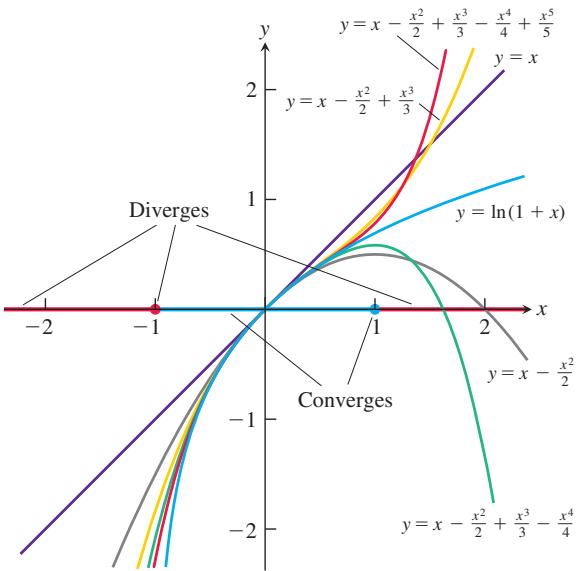
FIGURE 9.19 The power series
By the Ratio Test, the series converges absolutely for

The series converges absolutely for all x.
The previous example illustrated how a power series might converge. The next result shows that if a power series converges at a nonzero value, then it converges over an entire interval of values. The interval might be finite or infinite and might contain one, both, or none of its endpoints. We will see that each endpoint of a finite interval must be tested independently for convergence or divergence.
THEOREM 18—The Convergence Theorem for Power Series
If the power series
Proof The proof uses the Direct Comparison Test, with the given series compared to a converging geometric series.
Suppose the series
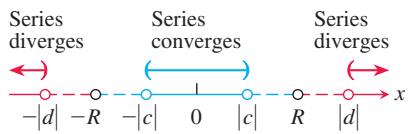
FIGURE 9.20 Convergence of
Now take any
Since
Now suppose that the series
To simplify the notation, Theorem 18 deals with the convergence of series of the form
The Radius of Convergence of a Power Series
The theorem we have just proved and the examples we have studied lead to the conclusion that a power series
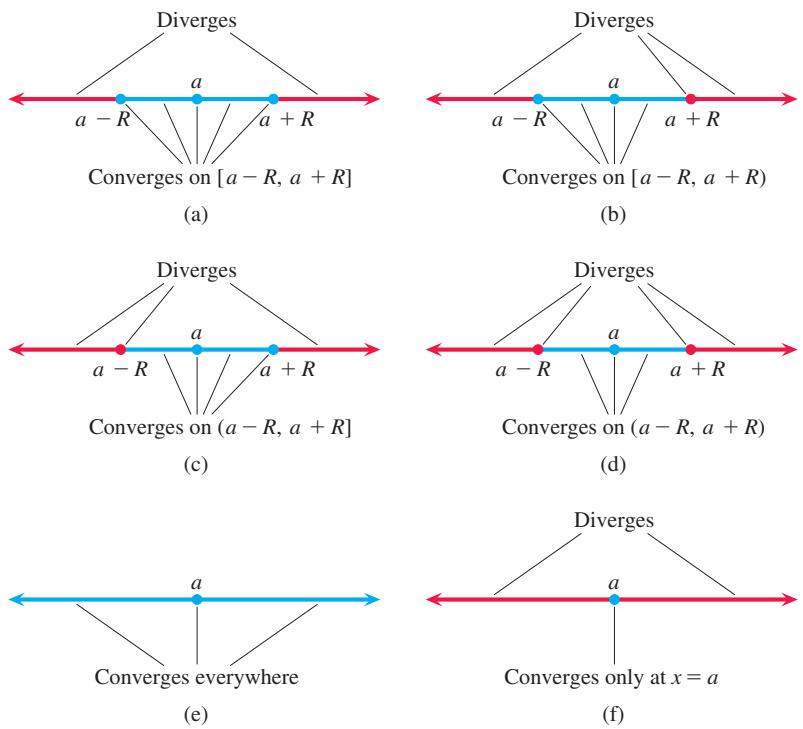
FIGURE 9.21 The six possibilities for an interval of convergence.
Corollary to Theorem 18
The convergence of the series
How to Test a Power Series for Convergence
∑ ∞ 𝑛 = 1 ( − 1 ) 𝑛 + 1 1 √ 𝑛
-
There is a positive number
𝑅 𝑥 | 𝑥 − 𝑎 | > 𝑅 𝑥 | 𝑥 − 𝑎 | < 𝑅 𝑥 = 𝑎 − 𝑅 𝑥 = 𝑎 + 𝑅 -
Use the Ratio Test or the Root Test to find the largest open interval where the series converges absolutely,
-
The series converges absolutely for every
𝑥 ( 𝑅 = ∞ ) -
If
𝑅 -
∑ ∞ 𝑛 = 1 ( − 1 ) 𝑛 + 1 1 𝑛 3 𝑛 -
The series converges at x = a and diverges elsewhere (R = 0).
Proof We first consider the case where a = 0, so that we have a power series
If
Now suppose
For a power series centered at an arbitrary point
R is called the radius of convergence of the power series, and the interval of radius R centered at x = a is called the interval of convergence. The interval of convergence may be open, closed, or half-open, depending on the particular series. At points x with
-
If
𝑅 | 𝑥 − 𝑎 | > 𝑅 -
∑ ∞ 𝑛 = 2 ( − 1 ) 𝑛 4 ( l n 𝑛 ) 2 -
∑ ∞ 𝑛 = 1 ( − 1 ) 𝑛 𝑛 𝑛 2 + 1 -
∑ ∞ 𝑛 = 1 ( − 1 ) 𝑛 + 1 𝑛 2 + 5 𝑛 2 + 4 -
∑ ∞ 𝑛 = 1 ( − 1 ) 𝑛 + 1 2 𝑛 𝑛 2 -
∑ ∞ 𝑛 = 1 ( − 1 ) 𝑛 1 0 𝑛 ( 𝑛 + 1 ) ! -
∑ ∞ 𝑛 = 1 ( − 1 ) 𝑛 + 1 ( 𝑛 1 0 ) 𝑛 -
∑ ∞ 𝑛 = 2 ( − 1 ) 𝑛 + 1 1 l n 𝑛 -
∑ ∞ 𝑛 = 1 ( − 1 ) 𝑛 + 1 l n 𝑛 𝑛 -
∑ ∞ 𝑛 = 1 ( − 1 ) 𝑛 l n ( 1 + 1 𝑛 ) -
∑ ∞ 𝑛 = 1 ( − 1 ) 𝑛 + 1 √ 𝑛 + 1 𝑛 + 1 -
∑ ∞ 𝑛 = 1 ( − 1 ) 𝑛 + 1 3 √ 𝑛 + 1 √ 𝑛 + 1
Absolute and Conditional Convergence
Which of the series in Exercises 15–48 converge absolutely, which converge conditionally, and which diverge? Give reasons for your answers.
-
∑ ∞ 𝑛 = 1 ( − 1 ) 𝑛 + 1 ( 0 . 1 ) 𝑛 -
∑ ∞ 𝑛 = 1 ( − 1 ) 𝑛 + 1 ( 0 . 1 ) 𝑛 𝑛 -
∑ ∞ 𝑛 = 1 ( − 1 ) 𝑛 1 √ 𝑛 -
∑ ∞ 𝑛 = 1 ( − 1 ) 𝑛 1 + √ 𝑛 -
∑ ∞ 𝑛 = 1 ( − 1 ) 𝑛 + 1 𝑛 𝑛 3 + 1 -
∑ ∞ 𝑛 = 1 ( − 1 ) 𝑛 + 1 𝑛 ! 2 𝑛 -
∑ ∞ 𝑛 = 1 ( − 1 ) 𝑛 1 𝑛 + 3 -
∑ ∞ 𝑛 = 1 ( − 1 ) 𝑛 s i n 𝑛 𝑛 2 -
∑ ∞ 𝑛 = 1 ( − 1 ) 𝑛 + 1 3 + 𝑛 5 + 𝑛 -
∑ ∞ 𝑛 = 1 ( − 2 ) 𝑛 + 1 𝑛 + 5 𝑛 -
∑ ∞ 𝑛 = 1 ( − 1 ) 𝑛 + 1 1 + 𝑛 𝑛 2 -
∑ ∞ 𝑛 = 1 ( − 1 ) 𝑛 + 1 ( 𝑛 √ 1 0 ) -
∑ ∞ 𝑛 = 1 ( − 1 ) 𝑛 𝑛 2 ( 2 / 3 ) 𝑛 -
∑ ∞ 𝑛 = 2 ( − 1 ) 𝑛 + 1 1 𝑛 l n 𝑛 -
∑ ∞ 𝑛 = 1 ( − 1 ) 𝑛 a r c t a n 𝑛 𝑛 2 + 1 -
∑ ∞ 𝑛 = 1 ( − 1 ) 𝑛 l n 𝑛 𝑛 − l n 𝑛 -
∑ ∞ 𝑛 = 1 ( − 1 ) 𝑛 𝑛 𝑛 + 1 -
∑ ∞ 𝑛 = 1 ( − 5 ) − 𝑛 -
∑ ∞ 𝑛 = 1 ( − 1 0 0 ) 𝑛 𝑛 ! -
∑ ∞ 𝑛 = 1 ( − 1 ) 𝑛 − 1 𝑛 2 + 2 𝑛 + 1 -
∑ ∞ 𝑛 = 1 c o s 𝑛 𝜋 𝑛 √ 𝑛 -
∑ ∞ 𝑛 = 1 c o s 𝑛 𝜋 𝑛 -
∑ ∞ 𝑛 = 1 ( − 1 ) 𝑛 ( 𝑛 + 1 ) 𝑛 ( 2 𝑛 ) 𝑛 -
∑ ∞ 𝑛 = 1 ( − 1 ) 𝑛 + 1 ( 𝑛 ! ) 2 ( 2 𝑛 ) ! -
∑ ∞ 𝑛 = 1 ( − 1 ) 𝑛 ( 2 𝑛 ) ! 2 𝑛 𝑛 ! 𝑛 -
∑ ∞ 𝑛 = 1 ( − 1 ) 𝑛 ( 𝑛 ! ) 2 3 𝑛 ( 2 𝑛 + 1 ) ! -
∑ ∞ 𝑛 = 1 ( − 1 ) 𝑛 ( √ 𝑛 + 1 − √ 𝑛 ) -
∑ ∞ 𝑛 = 1 ( − 1 ) 𝑛 ( √ 𝑛 2 + 𝑛 − 𝑛 ) -
∑ ∞ 𝑛 = 1 ( − 1 ) 𝑛 ( √ 𝑛 + √ 𝑛 − √ 𝑛 ) -
∑ ∞ 𝑛 = 1 ( − 1 ) 𝑛 √ 𝑛 + √ 𝑛 + 1 -
∑ ∞ 𝑛 = 1 ( − 1 ) 𝑛 s e c h 𝑛 -
∑ ∞ 𝑛 = 1 ( − 1 ) 𝑛 c s c h 𝑛 -
1 4 − 1 6 + 1 8 − 1 1 0 + 1 1 2 − 1 1 4 + … -
1 + 1 4 − 1 9 − 1 1 6 + 1 2 5 + 1 3 6 − 1 4 9 − 1 6 4 + …
Error Estimation
In Exercises 49–52, estimate the magnitude of the error involved in using the sum of the first four terms to approximate the sum of the entire series.
-
∑ ∞ 𝑛 = 1 ( − 1 ) 𝑛 + 1 1 𝑛 -
∑ ∞ 𝑛 = 1 ( − 1 ) 𝑛 + 1 1 1 0 𝑛 -
∑ ∞ 𝑛 = 1 ( − 1 ) 𝑛 + 1 ( 0 . 0 1 ) 𝑛 𝑛 -
1 1 + 𝑡 = ∑ ∞ 𝑛 = 0 ( − 1 ) 𝑛 𝑡 𝑛 , 0 < 𝑡 < 1
In Exercises 53–56, determine how many terms should be used to estimate the sum of the entire series with an error of less than 0.001.
-
∑ ∞ 𝑛 = 1 ( − 1 ) 𝑛 1 𝑛 2 + 3 -
∑ ∞ 𝑛 = 1 ( − 1 ) 𝑛 + 1 𝑛 𝑛 2 + 1 -
∑ ∞ 𝑛 = 1 ( − 1 ) 𝑛 + 1 1 ( 𝑛 + 3 √ 𝑛 ) 3 -
∑ ∞ 𝑛 = 1 ( − 1 ) 𝑛 1 l n ( l n ( 𝑛 + 2 ) )
Determining Convergence or Divergence
In Exercises 57–82, use any method to determine whether the series converges or diverges. Give reasons for your answer.
-
∑ ∞ 𝑛 = 1 3 𝑛 𝑛 𝑛 -
∑ ∞ 𝑛 = 1 3 𝑛 𝑛 3 -
∑ ∞ 𝑛 = 1 ( 1 𝑛 + 2 − 1 𝑛 + 3 ) -
∑ ∞ 𝑛 = 1 ( 1 2 𝑛 + 1 − 1 2 𝑛 + 2 ) -
∑ ∞ 𝑛 = 0 ( − 1 ) 𝑛 ( 𝑛 + 2 ) ! ( 2 𝑛 ) ! -
∑ ∞ 𝑛 = 2 ( 3 𝑛 ) ! ( 𝑛 ! ) 3 -
∑ ∞ 𝑛 = 1 𝑛 − 2 / √ 5 -
∑ ∞ 𝑛 = 2 3 1 0 + 𝑛 4 / 3 -
∑ ∞ 𝑛 = 1 ( 1 − 2 𝑛 ) 𝑛 2 -
∑ ∞ 𝑛 = 0 ( 𝑛 + 1 𝑛 + 2 ) 𝑛 -
∑ ∞ 𝑛 = 1 𝑛 − 2 𝑛 2 + 3 𝑛 ( − 2 3 ) 𝑛 -
∑ ∞ 𝑛 = 0 𝑛 + 1 ( 𝑛 + 2 ) ! ( 3 2 ) 𝑛 -
1 2 − 1 2 + 1 2 − 1 2 + 1 2 − 1 2 + … -
1 − 1 8 + 1 6 4 − 1 5 1 2 + 1 4 0 9 6 − … -
∑ ∞ 𝑛 = 3 s i n ( 1 √ 𝑛 ) -
∑ ∞ 𝑛 = 1 t a n ( 𝑛 1 / 𝑛 ) -
∑ ∞ 𝑛 = 2 𝑛 l n 𝑛 -
∑ ∞ 𝑛 = 2 1 𝑛 √ l n 𝑛 -
∑ ∞ 𝑛 = 2 l n ( 𝑛 + 2 𝑛 + 1 ) -
∑ ∞ 𝑛 = 2 ( l n 𝑛 𝑛 ) 3 -
∑ ∞ 𝑛 = 2 1 1 + 2 + 2 2 + ⋯ + 2 𝑛 -
∑ ∞ 𝑛 = 2 1 + 3 + 3 2 + ⋯ + 3 𝑛 − 1 1 + 2 + 3 + ⋯ + 𝑛 -
∑ ∞ 𝑛 = 0 ( − 1 ) 𝑛 𝑒 𝑛 𝑒 𝑛 + 𝑒 𝑛 2 -
∑ ∞ 𝑛 = 0 ( 2 𝑛 + 3 ) ( 2 𝑛 + 3 ) 3 𝑛 + 2 -
∑ ∞ 𝑛 = 1 𝑛 2 3 𝑛 3 ⋅ 5 ⋅ 7 ⋯ ( 2 𝑛 + 1 ) -
∑ ∞ 𝑛 = 1 4 ⋅ 6 ⋅ 8 ⋯ ( 2 𝑛 ) 5 𝑛 + 1 ( 𝑛 + 2 ) !
T Approximate the sums in Exercises 83 and 84 with an error of magnitude less than
-
∑ ∞ 𝑛 = 0 ( − 1 ) 𝑛 1 ( 2 𝑛 ) ! c o s 1 -
∑ ∞ 𝑛 = 0 ( − 1 ) 𝑛 1 𝑛 !
As you will see in Section 9.9 the sum is
- a. The series
does not meet one of the conditions of the Alternating Series Test. Which one?
b. Use the Sum Rule for series given in Section 9.2 to find the sum of the series in part (a).
- The limit L of an alternating series that satisfies the conditions of Theorem 15 lies between the values of any two consecutive partial sums. This suggests using the average
to estimate L. Compute
as an approximation to the sum of the alternating harmonic series. The exact sum is
-
The sign of the remainder of an alternating series that satisfies the conditions of Theorem 15 Prove the assertion in Theorem 16 that whenever an alternating series satisfying the conditions of Theorem 15 is approximated with one of its partial sums, the remainder (the sum of the unused terms) has the same sign as the first unused term. (Hint: Group the remainder’s terms in consecutive pairs.)
-
Show that the sum of the first
2 𝑛
is the same as the sum of the first n terms of the series
Do these series converge? What is the sum of the first
- Show that if
∑ ∞ 𝑛 = 1 𝑎 𝑛
c.
-
Show by example that
∑ ∞ 𝑛 = 1 𝑎 𝑛 𝑏 𝑛 ∑ ∞ 𝑛 = 1 𝑎 𝑛 ∑ ∞ 𝑛 = 1 𝑏 𝑛 -
Prove that if
∑ 𝑎 𝑛 ∑ 𝑎 2 𝑛 -
Does the series
converge or diverge? Justify your answer.
-
In the alternating harmonic series, suppose the goal is to arrange the terms to get a new series that converges to
− 1 / 2 − 1 / 2 − 1 / 2 − 1 / 2 − 1 / 2 𝑠 𝑛 𝑛 ( 𝑛 , 𝑠 𝑛 ) -
Outline of the proof of the Rearrangement Theorem (Theorem 17)
a. Let
Since all the terms
b. The argument in part (a) shows that if
Operations on Power Series
On the intersection of their intervals of convergence, two power series can be added and subtracted term by term just like series of constants (Theorem 8). They can be multiplied just as we multiply polynomials, but we often limit the computation of the product to the first few terms, which are the most important. The following result gives a formula for the coefficients in the product, but we omit the proof. (Power series can also be divided in a way similar to division of polynomials, but we do not give a formula for the general coefficient here.)
THEOREM 19—Series Multiplication for Power Series
If
then
Finding the general coefficient
We can also substitute a function
THEOREM 20 If
For example, since
Theorem 21 says that a power series can be differentiated term by term at each interior point of its interval of convergence. A proof of a restricted case of the theorem is outlined in Exercise 66.
THEOREM 21 — Term-by-Term Differentiation
If
This function f has derivatives of all orders inside the interval, and we obtain the derivatives by differentiating the original series term by term:
and so on. Each of these derived series converges at every point of the interval
EXAMPLE 4 Find series for
Solution We differentiate the power series on the right term by term:
Caution Term-by-term differentiation might not work for series that are not power series. For example, the trigonometric series
converges for all x. But if we differentiate term by term, we get the series
which diverges for all x. These are not power series since they are not sums of positive integer powers of x.
It is also true that a power series can be integrated term by term throughout its interval of convergence. The proof is outlined in Exercise 67.
THEOREM 22—Term-by-Term Integration
Suppose that
EXAMPLE 5 Identify the function
Solution We differentiate the original series term by term and get
This is a geometric series with first term 1 and ratio
We can now integrate
The Number
The series for
It can be shown that the series also converges to
Notice that the original series in Example 5 converges at both endpoints of the original interval of convergence, but Theorem 22 can guarantee only the convergence of the integrated series inside the interval.
EXAMPLE 6 The series
converges on the open interval -1 < t < 1. Therefore,
or
Alternating Harmonic Series Sum
It can also be shown that the series converges at x = 1 to the number ln 2, but that was not guaranteed by the theorem. A proof of this is outlined in Exercise 63.
EXERCISES 9.7
Intervals of Convergence
In Exercises 1–36, (a) find the series’ radius and interval of convergence. For what values of x does the series converge (b) absolutely, (c) conditionally?
-
∑ ∞ 𝑛 = 0 𝑥 𝑛 -
∑ ∞ 𝑛 = 0 ( 𝑥 + 5 ) 𝑛 -
∑ ∞ 𝑛 = 0 ( − 1 ) 𝑛 ( 4 𝑥 + 1 ) 𝑛 -
∑ ∞ 𝑛 = 1 ( 3 𝑥 − 2 ) 𝑛 𝑛 -
∑ ∞ 𝑛 = 0 ( 𝑥 − 2 ) 𝑛 1 0 𝑛 -
∑ ∞ 𝑛 = 0 ( 2 𝑥 ) 𝑛 -
∑ ∞ 𝑛 = 0 𝑛 𝑥 𝑛 𝑛 + 2 -
∑ ∞ 𝑛 = 1 ( − 1 ) 𝑛 ( 𝑥 + 2 ) 𝑛 𝑛 -
∑ ∞ 𝑛 = 1 𝑥 𝑛 𝑛 √ 𝑛 3 𝑛 -
∑ ∞ 𝑛 = 1 ( 𝑥 − 1 ) 𝑛 √ 𝑛 -
∑ ∞ 𝑛 = 0 ( − 1 ) 𝑛 𝑥 𝑛 𝑛 ! -
∑ ∞ 𝑛 = 0 3 𝑛 𝑥 𝑛 𝑛 ! -
∑ ∞ 𝑛 = 1 4 𝑛 𝑥 2 𝑛 𝑛 -
∑ ∞ 𝑛 = 1 ( 𝑥 − 1 ) 𝑛 𝑛 3 3 𝑛 -
∑ ∞ 𝑛 = 0 𝑥 𝑛 √ 𝑛 2 + 3 -
∑ ∞ 𝑛 = 0 ( − 1 ) 𝑛 𝑥 𝑛 + 1 √ 𝑛 + 3 -
∑ ∞ 𝑛 = 0 𝑛 ( 𝑥 + 3 ) 𝑛 5 𝑛 -
∑ ∞ 𝑛 = 0 𝑛 𝑥 𝑛 4 𝑛 ( 𝑛 2 + 1 ) -
∑ ∞ 𝑛 = 0 √ 𝑛 𝑥 𝑛 3 𝑛 -
∑ ∞ 𝑛 = 1 𝑛 √ 𝑛 ( 2 𝑥 + 5 ) 𝑛 -
∑ ∞ 𝑛 = 1 ( 2 + ( − 1 ) 𝑛 ) ⋅ ( 𝑥 + 1 ) 𝑛 − 1 -
∑ ∞ 𝑛 = 1 ( − 1 ) 𝑛 3 2 𝑛 ( 𝑥 − 2 ) 𝑛 3 𝑛 -
∑ ∞ 𝑛 = 1 ( 1 + 1 𝑛 ) 𝑛 𝑥 𝑛 -
∑ ∞ 𝑛 = 1 ( l n 𝑛 ) 𝑥 𝑛 -
∑ ∞ 𝑛 = 1 𝑛 𝑛 𝑥 𝑛 -
∑ ∞ 𝑛 = 0 𝑛 ! ( 𝑥 − 4 ) 𝑛 -
∑ ∞ 𝑛 = 1 ( − 1 ) 𝑛 + 1 ( 𝑥 + 2 ) 𝑛 𝑛 2 𝑛 -
∑ ∞ 𝑛 = 0 ( − 2 ) 𝑛 ( 𝑛 + 1 ) ( 𝑥 − 1 ) 𝑛 -
∑ ∞ 𝑛 = 2 𝑥 𝑛 𝑛 ( l n 𝑛 ) 2 ∑ 1 / ( 𝑛 ( l n 𝑛 ) 2 ) -
∑ ∞ 𝑛 = 2 𝑥 𝑛 𝑛 l n 𝑛 ∑ 1 / ( 𝑛 l n 𝑛 ) -
∑ ∞ 𝑛 = 1 ( 4 𝑥 − 5 ) 2 𝑛 + 1 𝑛 3 / 2 -
∑ ∞ 𝑛 = 1 ( 3 𝑥 + 1 ) 𝑛 + 1 2 𝑛 + 2 -
∑ ∞ 𝑛 = 1 1 2 ⋅ 4 ⋅ 6 ⋯ ( 2 𝑛 ) 𝑥 𝑛 -
∑ ∞ 𝑛 = 1 3 ⋅ 5 ⋅ 7 ⋯ ( 2 𝑛 + 1 ) 𝑛 2 ⋅ 2 𝑛 𝑥 𝑛 + 1 -
∑ ∞ 𝑛 = 1 1 + 2 + 3 + ⋯ + 𝑛 1 2 + 2 2 + 3 2 + ⋯ + 𝑛 2 𝑥 𝑛 -
∑ ∞ 𝑛 = 1 ( √ 𝑛 + 1 − √ 𝑛 ) ( 𝑥 − 3 ) 𝑛
In Exercises 37–42, find the series’ radius of convergence.
-
∑ ∞ 𝑛 = 1 𝑛 ! 3 ⋅ 6 ⋅ 9 ⋯ 3 𝑛 𝑥 𝑛 -
∑ ∞ 𝑛 = 1 ( 2 ⋅ 4 ⋅ 6 ⋯ ( 2 𝑛 ) 2 ⋅ 5 ⋅ 8 ⋯ ( 3 𝑛 − 1 ) ) 2 𝑥 𝑛 -
∑ ∞ 𝑛 = 1 ( 𝑛 ! ) 2 2 𝑛 ( 2 𝑛 ) ! 𝑥 𝑛 -
∑ ∞ 𝑛 = 1 𝑛 ! 𝑥 𝑛 𝑛 𝑛 -
∑ ∞ 𝑛 = 1 ( 𝑛 + 𝑎 ) ! 𝑛 ! ( 𝑛 + 𝑏 ) ! 𝑥 𝑛 𝑎 , 𝑏 -
∑ ∞ 𝑛 = 1 ( 𝑛 𝑛 + 1 ) 𝑛 2 𝑥 𝑛
(Hint: Apply the Root Test.)
In Exercises 43–50, use Theorem 20 to find the series’ interval of convergence and, within this interval, the sum of the series as a function of x.
-
∑ ∞ 𝑛 = 0 3 𝑛 𝑥 𝑛 -
∑ ∞ 𝑛 = 0 ( 𝑒 𝑥 − 4 ) 𝑛 -
∑ ∞ 𝑛 = 0 ( 𝑥 − 1 ) 2 𝑛 4 𝑛 -
∑ ∞ 𝑛 = 0 ( 𝑥 + 1 ) 2 𝑛 9 𝑛 -
∑ ∞ 𝑛 = 0 ( √ 𝑥 2 − 1 ) 𝑛 -
∑ ∞ 𝑛 = 0 ( l n 𝑥 ) 𝑛 -
∑ ∞ 𝑛 = 0 ( 𝑥 2 + 1 3 ) 𝑛 -
∑ ∞ 𝑛 = 0 ( 𝑥 2 − 1 2 ) 𝑛
Using the Geometric Series
-
In Example 2 we represented the function
𝑓 ( 𝑥 ) = 2 / 𝑥 𝑓 ( 𝑥 ) -
Use a geometric series to represent each of the given functions as a power series about
𝑥 = 0
a.𝑓 ( 𝑥 ) = 5 3 − 𝑥 𝑔 ( 𝑥 ) = 3 𝑥 − 2 -
Represent the function
𝑔 ( 𝑥 ) 𝑥 = 5 -
a. Find the interval of convergence of the power series
b. Represent the power series in part (a) as a power series about
Theory and Examples
- For what values of
𝑥
converge? What is its sum? What series do you get if you differentiate the given series term by term? For what values of x does the new series converge? What is its sum?
-
If you integrate the series in Exercise 55 term by term, what new series do you get? For what values of x does the new series converge, and what is another name for its sum?
-
The series
converges to
a. Find the first six terms of a series for
b. By replacing
c. Using the result in part (a) and series multiplication, calculate the first six terms of a series for
- The series
converges to
a. Find a series for
b. Find a series for
c. Replace x by -x in the series for
- The series
converges to
a. Find the first five terms of the series for
b. Find the first five terms of the series for
c. Check your result in part (b) by squaring the series given for sec x in Exercise 60.
- The series
converges to
a. Find the first five terms of a power series for the function
b. Find the first four terms of a series for
c. Check your result in part (b) by multiplying the series for
- Uniqueness of convergent power series
a. Show that if two power series
b. Show that if
-
The sum of the series
∑ ∞ 𝑛 = 0 ( 𝑛 2 / 2 𝑛 ) 1 / ( 1 − 𝑥 ) 𝑥 𝑥 𝑥 𝑥 1 / 2 -
The sum of the alternating harmonic series This exercise will show that
Let
a. Use mathematical induction or algebra to show that
b. Use the results in Exercise 63 in Section 9.3 to conclude that
and
where
c. Use these facts to show that
- Assume that the series
∑ 𝑎 𝑛 𝑥 𝑛
a. Converges absolutely for
b. Diverges for
c. Converges absolutely for
d. Converges for
e. Diverges for
f. Diverges for
g. Converges absolutely for
h. Converges absolutely for
- Assume that the series
∑ 𝑎 𝑛 ( 𝑥 − 2 ) 𝑛 𝑥 = − 1 𝑥 = 6
a. Converges absolutely for
b. Diverges for
c. Diverges for
d. Converges for
e. Converges absolutely for
f. Diverges for
g. Diverges for
h. Converges absolutely for
- Proof of a special case of Theorem 21 Assume that
𝑎 = 0 𝐿 = l i m 𝑛 → ∞ | 𝑐 𝑛 + 1 | | 𝑐 𝑛 | 𝐿 ≠ 0 𝑅 = 1 / 𝐿 𝐿 = 0 𝑅 = ∞ 𝑓 ( 𝑥 ) = ∑ ∞ 𝑛 = 0 𝑐 𝑛 𝑥 𝑛 − 𝑅 < 𝑥 < 𝑅 𝑔 ( 𝑥 ) = ∑ ∞ 𝑛 = 1 𝑛 𝑐 𝑛 𝑥 𝑛 − 1 𝑓 𝑓 ′ ( 𝑥 ) = 𝑔 ( 𝑥 ) l i m ℎ → 0 𝑓 ( 𝑥 + ℎ ) − 𝑓 ( 𝑥 ) ℎ = 𝑔 ( 𝑥 ) 𝑥 − 𝑅 < 𝑥 < 𝑅 − 𝑅 < 𝑥 < 𝑅 ℎ − 𝑅 < 𝑥 + ℎ < 𝑅
a. Use the Ratio Test to prove that the series defining
b. Apply the Mean Value Theorem to the function
for some
c. Show
d. Apply the Mean Value Theorem to the function
for some
e. Explain why
f. Show that
Hint: Multiply each term
g. Show that
h. Let
- Proof of Theorem 22 Assume that
𝑎 = 0 𝑓 ( 𝑥 ) = ∑ ∞ 𝑛 = 0 𝑐 𝑛 𝑥 𝑛 − 𝑅 < 𝑥 < 𝑅 𝑔 ( 𝑥 ) = ∑ ∞ 𝑛 = 0 𝑐 𝑛 𝑛 + 1 𝑥 𝑛 + 1 𝑔 ′ ( 𝑥 ) = 𝑓 ( 𝑥 )
a. Prove that the series defining
9.8 Taylor and Maclaurin Series
We have seen how geometric series can be used to generate a power series for functions such as
Series Representations
We know from Theorem 21 that within its interval of convergence I, the sum of a power series is a continuous function with derivatives of all orders. But what about the other way around? If a function
We can answer the last question readily if we assume that
with a positive radius of convergence. By repeated term-by-term differentiation within the interval of convergence I, we obtain
with the
Since these equations all hold at
and, in general,
HISTORICAL BIOGRAPHIES
Brook Taylor (1685–1731)
Taylor was an ingenious and productive British mathematician. Taylor published his book on calculus Methodus incrementorum directa et inversa in 1715 and his book on geometry Linear Perspective in the same year. To know more, visit the companion Website.
Colin Maclaurin
(1698-1746)
Maclaurin was elected a fellow of the Royal Society of London when he was only 21 years old. His Treatise of Fluxions (1742) has been described as the earliest logical and systematic publication of Newton’s methods.
To know more, visit the companion Website.
These formulas reveal a pattern in the coefficients of any power series
If
But if we start with an arbitrary function f that is infinitely differentiable on an interval containing x = a and use it to generate the series in Equation (1), does the series converge to
Taylor and Maclaurin Series
The series on the right-hand side of Equation (1) is the most important and useful series we will study in this chapter.
DEFINITIONS Let f be a function with derivatives of all orders throughout some interval containing a as an interior point. Then the Taylor series generated by f at x = a is
∑ ∞ 𝑘 = 0 𝑓 ( 𝑘 ) ( 𝑎 ) 𝑘 ! ( 𝑥 − 𝑎 ) 𝑘 = 𝑓 ( 𝑎 ) + 𝑓 ′ ( 𝑎 ) ( 𝑥 − 𝑎 ) + 𝑓 ′ ′ ( 𝑎 ) 2 ! ( 𝑥 − 𝑎 ) 2 + ⋯ + 𝑓 ( 𝑛 ) ( 𝑎 ) 𝑛 ! ( 𝑥 − 𝑎 ) 𝑛 + … . The Maclaurin series of f is the Taylor series generated by f at x = 0, or
∞ ∑ 𝑘 = 0 𝑓 ( 𝑘 ) ( 0 ) 𝑘 ! 𝑥 𝑘 = 𝑓 ( 0 ) + 𝑓 ′ ( 0 ) 𝑥 + 𝑓 ′ ′ ( 0 ) 2 ! 𝑥 2 + ⋯ + 𝑓 ( 𝑛 ) ( 0 ) 𝑛 ! 𝑥 𝑛 + … .
The Maclaurin series generated by f is often just called the Taylor series of f.
EXAMPLE 1 Find the Taylor series generated by
Solution We need to find
so that
The Taylor series is
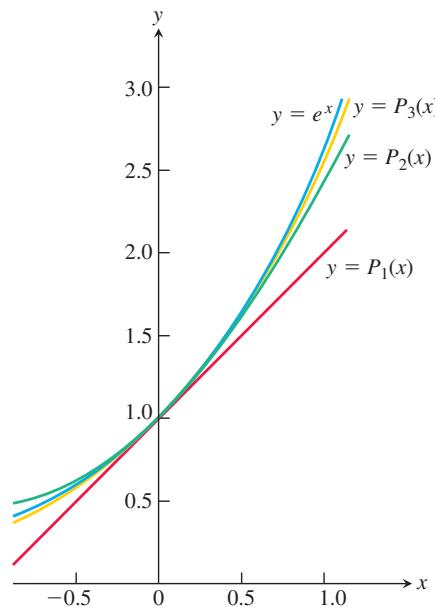
FIGURE 9.22 The graph of
Notice the very close agreement near the center
This is a geometric series with first term
In this example the Taylor series generated by
Taylor Polynomials
The linearization of a differentiable function
In Section 3.11 we used this linearization to approximate
DEFINITION Let
be a function with derivatives of order k for 𝑓 in some interval containing a as an interior point. Then, for any integer n from 0 through 𝑘 = 1 , 2 , … , 𝑁 the Taylor polynomial of order n generated by 𝑁 , at 𝑓 is the polynomial 𝑥 = 𝑎 𝑃 𝑛 ( 𝑥 ) = 𝑓 ( 𝑎 ) + 𝑓 ′ ( 𝑎 ) ( 𝑥 − 𝑎 ) + 𝑓 ′ ′ ( 𝑎 ) 2 ! ( 𝑥 − 𝑎 ) 2 + … + 𝑓 ( 𝑘 ) ( 𝑎 ) 𝑘 ! ( 𝑥 − 𝑎 ) 𝑘 + ⋯ + 𝑓 ( 𝑛 ) ( 𝑎 ) 𝑛 ! ( 𝑥 − 𝑎 ) 𝑛 .
We speak of a Taylor polynomial of order n rather than degree n because
Just as the linearization of
EXAMPLE 2 Find the Taylor series and the Taylor polynomials generated by
Solution Since
This is also the Maclaurin series for
The Taylor polynomial of order n at
EXAMPLE 3 Find the Taylor series and Taylor polynomials generated by
Solution The cosine and its derivatives are
The Taylor series generated by f at 0 is
This is also the Maclaurin series for cos x. Notice that only even powers of x occur in the Taylor series generated by the cosine function, which is consistent with the fact that it is an even function. In Section 9.9, we will see that the series converges to cos x at every x.
Because
Figure 9.23 shows how well these polynomials approximate
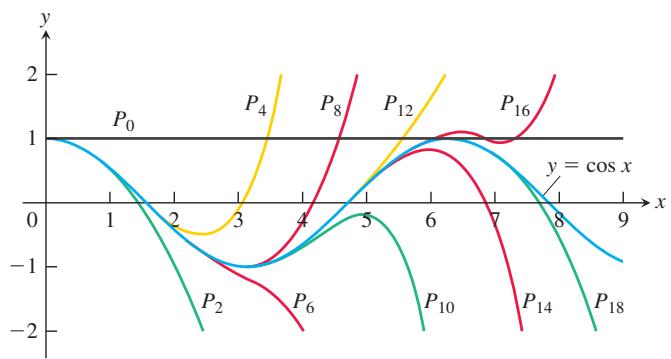
FIGURE 9.23 The polynomials
converge to cos x as
EXAMPLE 4 By using mathematical induction (see Exercise 51), it can be shown that
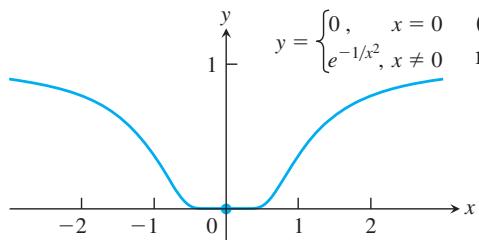
(Figure 9.24) has derivatives of all orders at
FIGURE 9.24 The graph of the continuous extension of
The series converges for every x (its sum is 0) but converges to
Two questions still remain.
-
For what values of x can we normally expect a Taylor series to converge to its generating function?
-
How accurately do a function’s Taylor polynomials approximate the function on a given interval?
The answers are provided by a theorem of Taylor in the next section.
EXERCISES 9.8
Finding Taylor Polynomials
In Exercises 1–10, find the Taylor polynomials of orders 0, 1, 2, and 3 generated by f at a.
-
𝑓 ( 𝑥 ) = 𝑒 2 𝑥 , 𝑎 = 0 -
⋅ 𝑓 ( 𝑥 ) = s i n 𝑥 , 𝑎 = 0 -
𝑓 ( 𝑥 ) = l n 𝑥 , 𝑎 = 1 -
f ( ) ln 1 , 0 x x a = + = ( )
-
𝑓 ( 𝑥 ) = 1 / 𝑥 , 𝑎 = 2 -
𝑓 ( 𝑥 ) = 1 / ( 𝑥 + 2 ) , 𝑎 = 0 -
𝑓 ( 𝑥 ) = s i n 𝑥 , 𝑎 = 𝜋 / 4 -
𝑓 ( 𝑥 ) = t a n 𝑥 , 𝑎 = 𝜋 / 4 -
𝑓 ( 𝑥 ) = √ 𝑥 , 𝑎 = 4 -
𝑓 ( 𝑥 ) = √ 1 − 𝑥 , 𝑎 = 0
Finding Taylor Series at 𝑥 = 0
Find the Maclaurin series for the functions in Exercises 11–24.
-
𝑒 − 𝑥 -
𝑥 𝑒 𝑥 -
1 1 + 𝑥 -
2 + 𝑥 1 − 𝑥 -
s i n 3 𝑥 -
s i n 𝑥 2 -
7 c o s ( − 𝑥 ) -
5 c o s 𝜋 𝑥 -
c o s h 𝑥 = 𝑒 𝑥 + 𝑒 − 𝑥 2 -
sinh
𝑥 = 𝑒 𝑥 − 𝑒 − 𝑥 2 -
𝑥 4 − 2 𝑥 3 − 5 𝑥 + 4 -
𝑥 2 𝑥 + 1 -
x sin x
-
( 𝑥 + 1 ) l n ( 𝑥 + 1 )
Finding Taylor and Maclaurin Series
In Exercises 25–34, find the Taylor series generated by
-
𝑓 ( 𝑥 ) = 𝑥 3 − 2 𝑥 + 4 , 𝑎 = 2 -
𝑓 ( 𝑥 ) = 2 𝑥 3 + 𝑥 2 + 3 𝑥 − 8 , 𝑎 = 1 -
𝑓 ( 𝑥 ) = 𝑥 4 + 𝑥 2 + 1 , 𝑎 = − 2 -
𝑓 ( 𝑥 ) = 3 𝑥 5 − 𝑥 4 + 2 𝑥 3 + 𝑥 2 − 2 , 𝑎 = − 1 -
𝑓 ( 𝑥 ) = 1 / 𝑥 2 , 𝑎 = 1 -
𝑓 ( 𝑥 ) = 1 / ( 1 − 𝑥 ) 3 , 𝑎 = 0 -
𝑓 ( 𝑥 ) = 𝑒 𝑥 , 𝑎 = 2 -
𝑓 ( 𝑥 ) = 2 𝑥 , 𝑎 = 1 -
𝑓 ( 𝑥 ) = c o s ( 2 𝑥 + ( 𝜋 / 2 ) ) , 𝑎 = 𝜋 / 4 -
𝑓 ( 𝑥 ) = √ 𝑥 + 1 , 𝑎 = 0
In Exercises 35–40, find the first three nonzero terms of the Maclaurin series for each function.
-
𝑓 ( 𝑥 ) = c o s 𝑥 − ( 2 / ( 1 − 𝑥 ) ) -
𝑓 ( 𝑥 ) = ( 1 − 𝑥 + 𝑥 2 ) 𝑒 𝑥 -
𝑓 ( 𝑥 ) = ( s i n 𝑥 ) l n ( 1 + 𝑥 ) -
𝑓 ( 𝑥 ) = 𝑥 s i n 2 𝑥 -
𝑓 ( 𝑥 ) = 𝑥 4 𝑒 𝑥 2
Quadratic Approximations The Taylor polynomial of order 2 generated by a twice-differentiable function
-
𝑓 ( 𝑥 ) = l n ( c o s 𝑥 ) -
𝑓 ( 𝑥 ) = 𝑒 s i n 𝑥 -
𝑓 ( 𝑥 ) = 1 / √ 1 − 𝑥 2 -
𝑓 ( 𝑥 ) = c o s h 𝑥 -
𝑓 ( 𝑥 ) = s i n 𝑥 -
𝑓 ( 𝑥 ) = t a n 𝑥 -
If m is a small positive number, then the graphs of
𝑦 = s i n 𝑥 𝑓 ( 𝑥 ) = s i n 𝑥 − 𝑚 𝑥 a t 𝑥 = 𝜋 , 𝜋 / ( 1 + 𝑚 )
Theory and Examples
- Use the Taylor series generated by
𝑒 𝑥 a t 𝑥 = 𝑎
-
(Continuation of Exercise 48.) Find the Taylor series generated by
𝑒 𝑥 𝑥 = 1 -
Let f( ) have derivatives through order x n at
𝑥 = 𝑎 . 𝑥 = 𝑎 . -
Approximation properties of Taylor polynomials Suppose that
𝑓 ( 𝑥 ) 𝑥 = 𝑎 𝑔 ( 𝑥 ) = 𝑏 0 + 𝑏 1 ( 𝑥 − 𝑎 ) + ⋯ + 𝑏 𝑛 ( 𝑥 − 𝑎 ) 𝑛 𝑏 0 , … , 𝑏 𝑛 𝐸 ( 𝑥 ) = 𝑓 ( 𝑥 ) − 𝑔 ( 𝑥 ) 𝑔
The approximation error is zero at
ii)
then
Thus, the Taylor polynomial
- Let f be the function from Example 4. Let
𝑝 1 ( 𝑡 ) = 2 𝑡 3 𝑝 2 ( 𝑡 ) = 4 𝑡 6 − 6 𝑡 4
a. Show that if
while for
b. Show that if
and
c. For
9.9 Convergence of Taylor Series
In the last section we asked when a Taylor series for a function can be expected to converge to the function that generates it. The finite-order Taylor polynomials that approximate the Taylor series provide estimates for the generating function. In order for these estimates to be useful, we need a way to control the possible errors we may encounter when approximating a function with its finite-order Taylor polynomials. How do we bound such possible errors? We answer the question in this section with the following theorem.
THEOREM 23—Taylor’s Theorem
If f and its first n derivatives
Taylor’s Theorem is a generalization of the Mean Value Theorem (Exercise 49), and we omit its proof here.
When we apply Taylor’s Theorem, we usually want to hold a fixed and treat b as an independent variable. Taylor’s formula is easier to use in circumstances like these if we change b to x. Here is a version of the theorem with this change.
Taylor’s Formula
If f has derivatives of all orders in an open interval I containing a, then for each positive integer n and for each x in I,
where
When we state Taylor’s theorem this way, it says that for each
The function
Equation (1) is called Taylor’s formula. The function
If
Often we can estimate
EXAMPLE 1 Show that the Taylor series generated by
Solution The function has derivatives of all orders throughout the interval
and
Since
and
Finally, because
we see that lim
The Number e as a Series
We can use the result of Example 1 with
where, for some c between 0 and 1,
Estimating the Remainder
It is often possible to estimate
THEOREM 24—The Remainder Estimation Theorem
If there is a positive constant M such that
If this inequality holds for every n, and the other conditions of Taylor’s Theorem are satisfied by
The next two examples use Theorem 24 to show that the Taylor series generated by the sine and cosine functions do in fact converge to the functions themselves.
EXAMPLE 2 Show that the Taylor series for sin x at
Solution The function and its derivatives are
so
The series has only odd-powered terms, and for
All the derivatives of sin x have absolute values less than or equal to 1, so we can apply the Remainder Estimation Theorem with
From Theorem 5, Rule 6, we have
EXAMPLE 3 Show that the Taylor series for cos x at
Solution We add the remainder term to the Taylor polynomial for cos x (Section 9.8, Example 3) to obtain Taylor’s formula for cos x with
Because the derivatives of the cosine have absolute value less than or equal to 1, the Remainder Estimation Theorem with
For every value of x,
Using Taylor Series
Since every Taylor series is a power series, the operations of adding, subtracting, and multiplying Taylor series are all valid on the intersection of their intervals of convergence.
EXAMPLE 4 Using known series, find the first few terms of the Taylor series for the given function by using power series operations.
Solution
By Theorem 20, if the Taylor series generated by
converges absolutely for
obtained by substituting
I
For instance, we can find the Taylor series for cos 2x by substituting 2x for x in the Taylor series for cos x:
By Theorem 20, this new Taylor series converges for all x.
EXAMPLE 5 For what values of x can we replace sin x by
Solution Here we can take advantage of the fact that the Taylor series for sin x is an alternating series for every nonzero value of x. According to the Alternating Series Estimation Theorem (Section 9.6), the error in truncating
after
Therefore, the error will be less than or equal to
The Alternating Series Estimation Theorem tells us something that the Remainder Estimation Theorem does not: The estimate
Figure 9.25 shows the graph of sin x, along with the graphs of a number of its approximating Taylor polynomials. The graph of
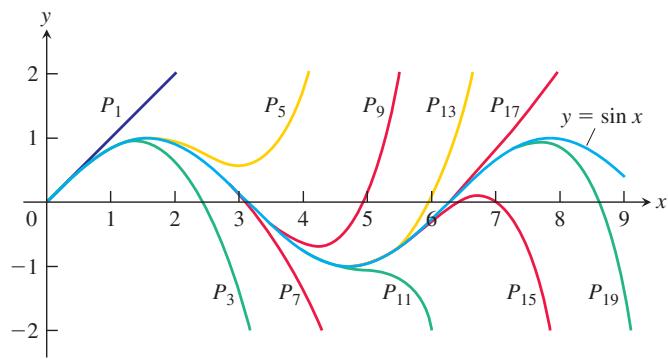
FIGURE 9.25 The polynomials
converge to sin x as
A Proof of Taylor’s Theorem
We prove Taylor’s theorem assuming
and its first n derivatives match the function f and its first n derivatives at
and its first n derivatives still agree with f and its first n derivatives at
We now choose the particular value of K that makes the curve
With K defined by Equation (8), the function
measures the difference between the original function f and the approximating function
We now use Rolle’s Theorem (Section 4.2). First, because
Next, because
Rolle’s Theorem, applied successively to
Finally, because
If we differentiate
Equations (9) and (10) together give
Equations (8) and (11) give
This concludes the proof.
EXERCISES 9.9
Finding Taylor Series
Use substitution (as in Formula (7)) to find the Taylor series at
Use power series operations to find the Taylor series at x = 0 for the functions in Exercises 13–30. 13.
-
sin
𝑥 − 𝑥 + 𝑥 3 3 ! -
x cos πx
-
𝑥 2 c o s ( 𝑥 2 ) -
c o s 2 𝑥 ( 𝐻 𝑖 𝑛 𝑡 : c o s 2 𝑥 = ( 1 + c o s 2 𝑥 ) / 2 . ) -
s i n 2 𝑥 -
𝑥 2 1 − 2 𝑥 -
𝑥 l n ( 1 + 2 𝑥 ) -
1 ( 1 − 𝑥 ) 2 -
2 ( 1 − 𝑥 ) 3 -
𝑥 a r c t a n 𝑥 2 -
sin
𝑥 ⋅ c o s 𝑥 -
𝑒 𝑥 + 1 1 + 𝑥 -
c o s 𝑥 − s i n 𝑥 -
𝑥 3 l n ( 1 + 𝑥 2 ) -
l n ( 1 + 𝑥 ) − l n ( 1 − 𝑥 )
Find the first four nonzero terms in the Maclaurin series for the functions in Exercises 31–38. 31.
-
c o s ( 𝑒 𝑥 − 1 ) -
c o s √ 𝑥 + l n ( c o s 𝑥 )
Error Estimates
-
Estimate the error if
𝑃 3 ( 𝑥 ) = 𝑥 − ( 𝑥 3 / 6 ) 𝑥 = 0 . 1 -
Estimate the error if
𝑃 4 ( 𝑥 ) = 1 + 𝑥 + ( 𝑥 2 / 2 ) + ( 𝑥 3 / 6 ) + ( 𝑥 4 / 2 4 ) 𝑒 𝑥 a t 𝑥 = 1 / 2 -
For approximately what values of x can you replace sin x by
𝑥 − ( 𝑥 3 / 6 ) 5 × 1 0 − 4 ? -
If cos x is replaced by
1 − ( 𝑥 2 / 2 ) | 𝑥 | < 0 . 5 1 − ( 𝑥 2 / 2 ) -
How close is the approximation sin
𝑥 = 𝑥 | 𝑥 | < 1 0 − 3 ? 𝑥 < -
The estimate
√ 1 + 𝑥 = 1 + ( 𝑥 / 2 ) | 𝑥 | < 0 . 0 1 -
The approximation
𝑒 𝑥 = 1 + 𝑥 + ( 𝑥 2 / 2 ) | 𝑥 | < 0 . 1 -
(Continuation of Exercise 45.) When
𝑥 < 0 . 𝑒 𝑥 𝑒 𝑥 1 + 𝑥 + ( 𝑥 2 / 2 ) − 0 . 1 < 𝑥 < 0
Theory and Examples
-
Use the identity sin
2 𝑥 = ( 1 − c o s 2 𝑥 ) / 2 -
(Continuation of Exercise 47.) Use the identity
c o s 2 𝑥 = c o s 2 𝑥 + s i n 2 . c o s 2 𝑥 . -
Taylor’s Theorem and the Mean Value Theorem Explain how the Mean Value Theorem (Section 4.2, Theorem 4) is a special case of Taylor’s Theorem.
-
Linearizations at inflection points Show that if the graph of a twice-differentiable function f( ) has an inflection point atx
𝑥 = 𝑎 , 𝑓 a t 𝑥 = 𝑎 𝑓 a t 𝑥 = 𝑎 . -
The (second) second derivative test Use the equation
to establish the following test.
Let f have continuous first and second derivatives and suppose that
a. f has a local maximum at a i
b. f has a local minimum at a if
-
A cubic approximation Use Taylor’s formula with
𝑎 = 0 𝑛 = 3 t o 𝑓 ( 𝑥 ) = 1 / ( 1 − 𝑥 ) 𝑥 = 0 | 𝑥 | ≤ 0 . 1 -
a. Use Taylor’s formula with
𝑛 = 2 𝑓 ( 𝑥 ) = ( 1 + 𝑥 ) 𝑘 a t 𝑥 = 0 𝑘 = 3 , [ 0 , 1 ] -
Improving approximations of π
a. Let P be an approximation of π accurate to n decimals. Show that P P+ sin gives an approximation correct to 3n decimals. (Hint: Let
b. Try it with a calculator.T
- The Taylor series generated by
𝑓 ( 𝑥 ) = ∑ ∞ 𝑛 = 0 𝑎 𝑛 𝑥 𝑛 ∑ ∞ 𝑛 = 0 𝑎 𝑛 𝑥 𝑛 ∑ ∞ 𝑛 = 0 𝑎 𝑛 𝑥 𝑛 𝑅 > 0 ( − 𝑅 , 𝑅 ) 𝑓 ( 𝑥 ) = ∑ ∞ 𝑛 = 0 𝑎 𝑛 𝑥 𝑛 ∑ ∞ 𝑛 = 0 𝑎 𝑛 𝑥 𝑛
An immediate consequence of this is that series like
and
obtained by multiplying Taylor series by powers of
- Taylor series for even functions and odd functions (Continuation of Section 9.7, Exercise 61.) Suppose that
𝑓 ( 𝑥 ) = ∑ ∞ 𝑛 = 0 𝑎 𝑛 𝑥 𝑛 ( − 𝑅 , 𝑅 )
a. If f is even, then
b. If f is odd, then
COMPUTER EXPLORATIONS
Taylor’s formula with
a. For what values of x can the function be replaced by each approximation with an error less than
b. What is the maximum error we can expect if we replace the function by each approximation over the specified interval?
Using a CAS, perform the following steps to aid in answering questions (a) and (b) for the functions and intervals in Exercises 57–62.
Step 1: Plot the function over the specified interval.
Step 2: Find the Taylor polynomials
Step 3: Calculate the
Step 4: Calculate the remainder
Step 5: Compare your estimated error with the actual error
Step
-
𝑓 ( 𝑥 ) = 𝑥 𝑥 2 + 1 , | 𝑥 | ≤ 2 -
𝑓 ( 𝑥 ) = ( c o s 𝑥 ) ( s i n 2 𝑥 ) , | 𝑥 | ≤ 2
9.10 Applications of Taylor Series
We can use Taylor series to solve problems that would otherwise be intractable. For example, many functions have antiderivatives that cannot be expressed using familiar functions. In this section we show how to evaluate integrals of such functions by giving them as Taylor series. We also show how to use Taylor series to evaluate limits that lead to indeterminate forms and how Taylor series can be used to extend the exponential function from real to complex numbers. We begin with a discussion of the binomial series, which comes from the Taylor series of the function
The Binomial Series for Powers and Roots
The Taylor series generated by
This series, called the binomial series, converges absolutely for
We then evaluate these at
If m is an integer greater than or equal to zero, the series stops after
If m is not a positive integer or zero, the series is infinite and converges for
Our derivation of the binomial series shows only that it is generated by
The Binomial Series
For -1 < x < 1,
EXAMPLE 1
and
With these coefficient values and with x replaced by −x, the binomial series formula gives the familiar geometric series
EXAMPLE 2 We know from Section 3.11, Example 1, that
Substitution for x gives still other approximations. For example,
Evaluating Nonelementary Integrals
Sometimes we can use a familiar Taylor series to find the sum of a given power series in terms of a known function. For example,
Additional examples are provided in Exercises 59–62.
Taylor series can be used to express nonelementary integrals in terms of series. Integrals like ∫ sin
EXAMPLE 3 Express
Solution From the series for sin x, we substitute
Therefore,
EXAMPLE 4 Estimate
Solution From the indefinite integral in Example 3, we easily find that
The series on the right-hand side alternates, and we find by numerical evaluations that
is the first term to be numerically less than 0.001. The sum of the preceding two terms gives
With two more terms, we could estimate
with an error of less than
with an error of about
Arctangents
In Section 9.7, Example 5, we found a series for arctan by differentiating to get x
and then integrating to get
However, we did not prove the term-by-term integration theorem on which this conclusion depended. We now derive the series again by integrating both sides of the finite formula
in which the last term comes from adding the remaining terms as a geometric series with first term
where
The denominator of the integrand is greater than or equal to
If
We take this route instead of finding the Taylor series directly because the formulas for the higher-order derivatives of arctan are unmanageable. When we putx
Because this series converges very slowly, it is not used in approximating π to many decimal places. The series for arctan converges most rapidly when x x is near zero. For that reason, people who use the series for arctan to compute x π use various trigonometric identities.
For example, if
then
and therefore,
Now Equation (3) may be used with
Evaluating Indeterminate Forms
We can sometimes evaluate indeterminate forms by expressing the functions involved as Taylor series.
EXAMPLE 5 Evaluate
Solution We represent ln x as a Taylor series in powers of
from which we find that
Of course, this particular limit can be evaluated just as well using l’Hôpital’s Rule. 一
EXAMPLE 6 Evaluate
Solution The Taylor series for sin x and tan x, to terms in
Subtracting the series term by term, it follows that
Division of both sides by
If we apply series to calculate lim
EXAMPLE 7 Find
Solution Using algebra and the Taylor series for sin
Therefore,
From the quotient on the right, we can see that if x is small, then
Euler’s Identity
A complex number is a number of the form
and so on to simplify the result, we obtain
This does not prove that
DEFINITION For any real number θ,
𝑒 𝑖 𝜃 = c o s 𝜃 + 𝑖 s i n 𝜃 . ( 4 )
Equation (4), called Euler’s identity, enables us to define
One consequence of this identity is the equation
When written in the form
TABLE 9.1 Frequently Used Taylor Series
EXERCISES 9.10
Taylor Series
Find the first four nonzero terms of the Taylor series for the functions in Exercises 1–10. 1.
Find the binomial series for the functions in Exercises 11–14. 11.
Approximations and Nonelementary Integrals
In Exercises 15–18, use series to estimate the integrals’ values withT an error of magnitude less than
Use series to approximate the values of the integrals in Exercises 19–22T with an error of magnitude less than
-
Estimate the error if cos t 2 is approximated by
1 − 𝑡 4 2 + 𝑡 8 4 ! ∫ 1 0 c o s 𝑡 2 𝑑 𝑡 -
Estimate the error if cos is approximated byt
1 − 𝑡 2 + 𝑡 2 4 ! − 𝑡 3 6 ! ∫ 1 0 c o s √ 𝑡 𝑑 𝑡
In Exercises 25–28, find a polynomial that will approximate F x( ) throughout the given interval with an error of magnitude less than − 10 .3
-
𝐹 ( 𝑥 ) = ∫ 𝑥 0 s i n 𝑡 2 𝑑 𝑡 , -
𝐹 ( 𝑥 ) = ∫ 𝑥 0 𝑡 2 𝑒 − 𝑡 2 𝑑 𝑡 . -
𝐹 ( 𝑥 ) = ∫ 𝑥 0 a r c t a n 𝑡 𝑑 𝑡 , -
𝐹 ( 𝑥 ) = ∫ 𝑥 0 l n ( 1 + 𝑡 ) 𝑡 𝑑 𝑡 ,
Indeterminate Forms
Use series to evaluate the limits in Exercises 29–40.
-
l i m 𝑥 → 0 𝑒 𝑥 − ( 1 + 𝑥 ) 𝑥 2 -
l i m 𝑥 → 0 𝑒 𝑥 − 𝑒 − 𝑥 𝑥 -
l i m 𝑡 → 0 1 − c o s 𝑡 − ( 𝑡 2 / 2 ) 𝑡 4 -
l i m 𝜃 → 0 s i n 𝜃 − 𝜃 + ( 𝜃 3 / 6 ) 𝜃 5 -
l i m 𝑦 → 0 𝑦 − a r c t a n 𝑦 𝑦 3 -
l i m 𝑦 → 0 t a n − 1 𝑦 − s i n 𝑦 𝑦 3 c o s 𝑦 -
l i m 𝑥 → ∞ 𝑥 2 ( 𝑒 − 1 / 𝑥 2 − 1 ) -
l i m 𝑥 → ∞ ( 𝑥 + 1 ) s i n 1 𝑥 + 1 -
l i m 𝑥 → 0 l n ( 1 + 𝑥 2 ) 1 − c o s 𝑥 -
l i m 𝑥 → 2 𝑥 2 − 4 l n ( 𝑥 − 1 ) -
l i m 𝑥 → 0 s i n 3 𝑥 2 1 − c o s 2 𝑥 -
l i m 𝑥 → 0 l n ( 1 + 𝑥 3 ) 𝑥 ⋅ s i n 𝑥 2
Using Table 9.1
In Exercises 41–52, use Table 9.1 to find the sum of each series.
-
1 + 1 + 1 2 ! + 1 3 ! + 1 4 ! + ⋯ -
( 1 4 ) 3 + ( 1 4 ) 4 + ( 1 4 ) 5 + ( 1 4 ) 6 + ⋯ -
1 − 3 2 4 2 ⋅ 2 ! + 3 4 4 4 ⋅ 4 ! − 3 6 4 6 ⋅ 6 ! + ⋯ -
1 2 − 1 2 ⋅ 2 2 + 1 3 ⋅ 2 3 − 1 4 ⋅ 2 4 + ⋯ -
𝜋 3 − 𝜋 3 3 3 ⋅ 3 ! + 𝜋 5 3 5 ⋅ 5 ! − 𝜋 7 3 7 ⋅ 7 ! + ⋯ -
2 3 − 2 3 3 3 ⋅ 3 + 2 5 3 5 ⋅ 5 − 2 7 3 7 ⋅ 7 + ⋯ -
𝑥 3 + 𝑥 4 + 𝑥 5 + 𝑥 6 + ⋯ -
1 − 3 2 𝑥 2 2 ! + 3 4 𝑥 4 4 ! − 3 6 𝑥 6 6 ! + ⋯ -
𝑥 3 − 𝑥 5 + 𝑥 7 − 𝑥 9 + 𝑥 1 1 − ⋯ -
𝑥 2 − 2 𝑥 3 + 2 2 𝑥 4 2 ! − 2 3 𝑥 5 3 ! + 2 4 𝑥 6 4 ! − ⋯ -
− 1 + 2 𝑥 − 3 𝑥 2 + 4 𝑥 3 − 5 𝑥 4 + ⋯ -
1 + 𝑥 2 + 𝑥 2 3 + 𝑥 3 4 + 𝑥 4 5 + ⋯
Theory and Examples
- Replace x by −x in the Taylor series for ln 1 to obtain a( ) + x series for ln 1 . Then subtract this from the Taylor series for( ) − x
l n ( 1 + 𝑥 )
-
How many terms of the Taylor series for ln 1 should you( ) + x add to be sure of calculating ln 1.1 with an error of magnitude( ) less than
1 0 − 8 ⋅ -
According to the Alternating Series Estimation Theorem, how many terms of the Taylor series for arctan 1 would you have to add to be sure of finding
𝜋 / 4 1 0 − 3 ? -
Show that the Taylor series for
𝑓 ( 𝑥 ) = a r c t a n 𝑥 > 1 -
Estimating pi About how many terms of the Taylor series forT arctan wx ould you have to use to evaluate each term on the righthand side of the equation
with an error of magnitude less than
- Use the following steps to prove that the binomial series in Equation (1) converges to
( 1 + 𝑥 ) 𝑚
a. Differentiate the series
to show that
b. Define
c. From part (b), show that
to generate the first four nonzero terms of the Taylor series for arcsin . What is the radius of convergence?x
b. Series for arccos x Use your result in part (a) to find the first five nonzero terms of the Taylor series for arccos .x
- a. Series for sinh
− 𝟏 \ b o l d s y m b o l 𝑥
b. Use the first three terms of the series in part (a) to estimateT − sinh 0.25. 1 Give an upper bound for the magnitude of the estimation error.
-
Obtain the Taylor series for
1 / ( 1 + 𝑥 ) 2 − 1 / ( 1 + 𝑥 ) -
Use the Taylor series for
1 / ( 1 − 𝑥 2 ) 2 𝑥 / ( 1 − 𝑥 2 ) ∙ -
Estimating pi The English mathematician Wallis discoveredT the formula
Find π to two decimal places with this formula.
- The complete elliptic integral of the first kind is the integral
where
a. Show that the first four terms of the binomial series for
b. From part (a) and the reduction integral Formula
by integrating the series
in the first case from x to ∞ and in the second case from −∞ to x.
Euler’s Identity
- Use Equation (4) to write the following powers of e in the form
𝑎 + 𝑏 𝑖 .
-
Establish the equations in Exercise 68 by combining the formal Taylor series for
𝑒 𝑖 𝜃 𝑒 − 𝑖 𝜃 . -
Show that
Use this fact to check your answer. For what values of x should the series for
- When a and b are real, we define
𝑒 ( 𝑎 + 𝑖 𝑏 ) 𝑥
Differentiate the right-hand side of this equation to show that
Thus the familiar rule
- Use the definition of
𝑒 𝑖 𝜃 𝜃 , 𝜃 1 , 𝜃 2 ,
a.
b.
- Two complex numbers
𝑎 + 𝑖 𝑏 𝑐 + 𝑖 𝑑
from
where
CHAPTER 9 Questions to Guide Your Review
-
What is an infinite sequence? What does it mean for such a sequence to converge? To diverge? Give examples.
-
What is a monotonic sequence? Under what circumstances does such a sequence have a limit? Give examples.
-
What theorems are available for calculating limits of sequences? Give examples.
-
What theorem sometimes enables us to use l’Hôpital’s Rule to calculate the limit of a sequence? Give an example.
-
What are the six commonly occurring limits in Theorem 5 that arise frequently when you work with sequences and series?
-
What is an infinite series? What does it mean for such a series to converge? To diverge? Give examples.
-
What is a geometric series? When does such a series converge? Diverge? When it does converge, what is its sum? Give examples.
-
Besides geometric series, what other convergent and divergent series do you know?
-
What is the nth-Term Test for Divergence? What is the idea behind the test?
-
What can be said about term-by-term sums and differences of convergent series? About constant multiples of convergent and divergent series?
-
What happens if you add a finite number of terms to a convergent series? A divergent series? What happens if you delete a finite number of terms from a convergent series? A divergent series?
-
How do you reindex a series? Why might you want to do this?
-
Under what circumstances will an infinite series of nonnegative terms converge? Diverge? Why study series of nonnegative terms?
-
What is the Integral Test? What is the reasoning behind it? Give an example of its use.
-
When do p-series converge? Diverge? How do you know? Give examples of convergent and divergent p-series.
-
What are the Direct Comparison Test and the Limit Comparison Test? What is the reasoning behind these tests? Give examples of their use.
-
What are the Ratio and Root Tests? Do they always give you the information you need to determine convergence or divergence? Give examples.
-
What is absolute convergence? Conditional convergence? How are the two related?
-
What is an alternating series? What theorem is available for determining the convergence of such a series?
-
How can you estimate the error involved in approximating the sum of an alternating series with one of the series’ partial sums? What is the reasoning behind the estimate?
-
What do you know about rearranging the terms of an absolutely convergent series? Of a conditionally convergent series?
-
What is a power series? How do you test a power series for convergence? What are the possible outcomes?
-
What are the basic facts about
a. sums, differences, and products of power series?
b. substitution of a function for x in a power series?
c. term-by-term differentiation of power series?
d. term-by-term integration of power series?
e. Give examples.
-
What is the Taylor series generated by a function f ( ) at a pointx
𝑥 = 𝑎 ? -
What is a Maclaurin series?
-
Does a Taylor series always converge to its generating function? Explain.
-
What are Taylor polynomials? Of what use are they?
-
What is Taylor’s formula? What does it say about the errors involved in using Taylor polynomials to approximate functions? In particular, what does Taylor’s formula say about the error in a linearization? A quadratic approximation?
-
What is the binomial series? On what interval does it converge? How is it used?
-
How can you sometimes use power series to estimate the values of nonelementary definite integrals? To find limits?
-
What are the Taylor series for
1 / ( 1 − 𝑥 ) , 1 / ( 1 + 𝑥 ) , 𝑒 𝑥
CHAPTER 9 Practice Exercises
Determining Convergence of Sequences
Which of the sequences whose nth terms appear in Exercises 1–18 converge, and which diverge? Find the limit of each convergent sequence.
-
𝑎 𝑛 = 1 + ( − 1 ) 𝑛 𝑛 -
𝑎 𝑛 = 1 − ( − 1 ) 𝑛 √ 𝑛 -
𝑎 𝑛 = 1 − 2 𝑛 2 𝑛 -
𝑎 𝑛 = 1 + ( 0 . 9 ) 𝑛 -
𝑎 𝑛 = s i n 𝑛 𝜋 2 -
𝑎 𝑛 = s i n 𝑛 𝜋 -
𝑎 𝑛 = l n ( 𝑛 2 ) 𝑛 -
𝑎 𝑛 = l n ( 2 𝑛 + 1 ) 𝑛 -
𝑎 𝑛 = 𝑛 + l n 𝑛 𝑛 -
𝑎 𝑛 = l n ( 2 𝑛 3 + 1 ) 𝑛 -
𝑎 𝑛 : = : ( 𝑛 − 5 𝑛 ) 𝑛 -
𝑎 𝑛 = ( 1 + 1 𝑛 ) − 𝑛 -
𝑎 𝑛 = 𝑛 √ 3 𝑛 𝑛 -
𝑎 𝑛 = ( 3 𝑛 ) 1 / 𝑛 -
𝑎 𝑛 = 𝑛 ( 2 1 / 𝑛 : − : 1 ) -
𝑎 𝑛 = 𝑛 √ 2 𝑛 + 1 -
𝑎 𝑛 = ( 𝑛 + 1 ) ! 𝑛 ! -
𝑎 𝑛 = ( − 4 ) 𝑛 𝑛 !
Convergent Series
Find the sums of the series in Exercises 19–24.
∑ ∞ 𝑛 = 3 1 ( 2 𝑛 − 3 ) ( 2 𝑛 − 1 )
-
∑ ∞ 𝑛 = 1 9 ( 3 𝑛 − 1 ) ( 3 𝑛 + 2 ) -
∑ ∞ 𝑛 = 3 − 8 ( 4 𝑛 − 3 ) ( 4 𝑛 + 1 ) -
∑ ∞ 𝑛 = 0 𝑒 − 𝑛 -
∑ ∞ 𝑛 = 1 ( − 1 ) 𝑛 3 4 𝑛
Determining Convergence of Series
Which of the series in Exercises 25–44 converge absolutely, which converge conditionally, and which diverge? Give reasons for your answers.
-
∑ ∞ 𝑛 = 1 1 √ 𝑛 -
∑ ∞ 𝑛 = 1 − 5 𝑛 -
∑ ∞ 𝑛 = 1 ( − 1 ) 𝑛 √ 𝑛 -
∑ ∞ 𝑛 = 1 1 2 𝑛 3 -
∑ ∞ 𝑛 = 1 ( − 1 ) 𝑛 l n ( 𝑛 + 1 ) -
∑ ∞ 𝑛 = 2 1 𝑛 ( l n 𝑛 ) 2 -
∑ ∞ 𝑛 = 1 l n 𝑛 𝑛 3 -
∑ ∞ 𝑛 = 3 l n 𝑛 l n ( l n 𝑛 ) -
∑ ∞ 𝑛 = 1 ( − 1 ) 𝑛 𝑛 √ 𝑛 2 + 1 -
∑ ∞ 𝑛 = 1 ( − 1 ) 𝑛 3 𝑛 2 𝑛 3 + 1 -
∑ ∞ 𝑛 = 1 𝑛 + 1 𝑛 ! -
∑ ∞ 𝑛 = 1 ( − 1 ) 𝑛 ( 𝑛 2 + 1 ) 2 𝑛 2 + 𝑛 − 1 -
∑ ∞ 𝑛 = 1 ( − 3 ) 𝑛 𝑛 ! -
∑ ∞ 𝑛 = 1 2 𝑛 3 𝑛 𝑛 𝑛 -
∑ ∞ 𝑛 = 1 1 √ 𝑛 ( 𝑛 + 1 ) ( 𝑛 + 2 ) -
∑ ∞ 𝑛 = 2 1 𝑛 √ 𝑛 2 − 1 -
1 − ( 1 √ 3 ) 2 + ( 1 √ 3 ) 4 − ( 1 √ 3 ) 6 + ( 1 √ 3 ) 8 − ⋯ -
∑ ∞ 𝑛 = 0 ( − 1 ) 𝑛 𝑒 − 𝑛 + 1 -
∑ ∞ 𝑛 = 0 1 1 + 𝑟 + 𝑟 2 + ⋯ + 𝑟 𝑛 f o r − 1 < 𝑟 < 1 -
∑ ∞ 𝑛 = 1 ( − 1 ) 𝑛 √ 𝑛 + 1 0 0 − √ 𝑛 -
P r o v e t h a t ∑ ∞ 𝑛 = 3 1 𝑛 ( l n 𝑛 ) ( l n ( l n 𝑛 ) ) 𝑝 i f 𝑝 > 1 -
Prove that
∑ ∞ 𝑛 = 1 l n 𝑛 𝑛 𝑝 𝑝 > 1
Power Series
In Exercises 47–56, (a) find the series’ radius and interval of convergence. Then identify the values of x for which the series converges (b) absolutely and (c) conditionally.
-
∑ ∞ 𝑛 = 1 ( 𝑥 + 4 ) 𝑛 𝑛 3 𝑛 -
∑ ∞ 𝑛 = 1 ( 𝑥 − 1 ) 2 𝑛 − 2 ( 2 𝑛 − 1 ) ! -
∑ ∞ 𝑛 = 1 ( − 1 ) 𝑛 − 1 ( 3 𝑥 − 1 ) 𝑛 𝑛 2 -
∑ ∞ 𝑛 = 0 ( 𝑛 + 1 ) ( 2 𝑥 + 1 ) 𝑛 ( 2 𝑛 + 1 ) 2 𝑛 -
∑ ∞ 𝑛 = 1 𝑥 𝑛 𝑛 𝑛 -
∑ ∞ 𝑛 = 1 𝑥 𝑛 √ 𝑛 -
∑ ∞ 𝑛 = 0 ( 𝑛 + 1 ) 𝑥 2 𝑛 − 1 3 𝑛 -
∑ ∞ 𝑛 = 0 ( − 1 ) 𝑛 ( 𝑥 − 1 ) 2 𝑛 + 1 2 𝑛 + 1 -
∑ ∞ 𝑛 = 1 ( c s c h 𝑛 ) 𝑥 𝑛 -
∑ ∞ 𝑛 = 1 ( c o t h 𝑛 ) 𝑥 𝑛
Maclaurin Series
Each of the series in Exercises 57–62 is the value of the Taylor series at x = 0 of a function f ( ) at a particular point. What function andx what point? What is the sum of the series?
-
1 − 1 4 + 1 1 6 − ⋯ + ( − 1 ) 𝑛 1 4 𝑛 + ⋯ -
2 3 − 4 1 8 + 8 8 1 − ⋯ + ( − 1 ) 𝑛 − 1 2 𝑛 𝑛 3 𝑛 + ⋯ -
𝜋 − 𝜋 3 3 ! + 𝜋 5 5 ! − ⋯ + ( − 1 ) 𝑛 𝜋 2 𝑛 + 1 ( 2 𝑛 + 1 ) ! + ⋯ -
1 − 𝜋 2 9 ⋅ 2 ! + 𝜋 4 8 1 ⋅ 4 ! − ⋯ + ( − 1 ) 𝑛 𝜋 2 𝑛 3 2 𝑛 ( 2 𝑛 ) ! + ⋯ -
1 + l n 2 + ( l n 2 ) 2 2 ! + ⋯ + ( l n 2 ) 𝑛 𝑛 ! + ⋯ -
1 √ 3 − 1 9 √ 3 + 1 4 5 √ 3 − ⋯ + ( − 1 ) 𝑛 − 1 1 ( 2 𝑛 − 1 ) ( √ 3 ) 2 𝑛 − 1 + ⋯
Find Taylor series at
-
1 1 − 2 𝑥 -
1 1 + 𝑥 3 -
sin πx
-
s i n 2 𝑥 3 -
c o s ( 𝑥 5 / 3 ) -
c o s 𝑥 3 √ 5 -
𝑒 ( 𝜋 𝑥 / 2 ) -
𝑒 − 𝑥 2
Taylor Series
In Exercises 71–74, find the first four nonzero terms of the Taylor series generated by
-
𝑓 ( 𝑥 ) = √ 3 + 𝑥 2 a t 𝑥 = − 1 -
𝑓 ( 𝑥 ) = 1 / ( 1 − 𝑥 ) a t 𝑥 = 2 -
𝑓 ( 𝑥 ) = 1 / ( 𝑥 + 1 ) a t 𝑥 = 3 -
𝑓 ( 𝑥 ) = 1 / 𝑥 a t 𝑥 = 𝑎 > 0
Nonelementary Integrals
Use series to approximate the values of the integrals in Exercises 75–78 with an error of magnitude less than
-
∫ 1 / 2 0 𝑒 − 𝑥 3 𝑑 𝑥 -
∫ 1 0 𝑥 s i n ( 𝑥 3 ) 𝑑 𝑥 -
∫ 1 / 2 0 t a n − 1 𝑥 𝑥 𝑑 𝑥 -
∫ 1 / 6 4 0 a r c t a n 𝑥 √ 𝑥 𝑑 𝑥
Using Series to Find Limits
In Exercises 79–84:
a. Use power series to evaluate the limit.
b. Then use a grapher to support your calculation.T
x7 sin 79. lim → −e x 1x 0 2
-
l i m 𝜃 → 0 𝑒 𝜃 − 𝑒 − 𝜃 − 2 𝜃 𝜃 − s i n 𝜃 -
l i m 𝑡 → 0 ( 1 2 − 2 c o s 𝑡 − 1 𝑡 2 ) -
l i m ℎ → 0 ( s i n ℎ ) / ℎ − c o s ℎ ℎ 2 -
l i m 𝑧 → 0 1 − c o s 2 𝑧 l n ( 1 − 𝑧 ) + s i n 𝑧 -
l i m 𝑦 → 0 𝑦 2 c o s 𝑦 − c o s h 𝑦
Theory and Examples
- Use a series representation of sin 3x to find values of r and s for which
-
Compare the accuracies of the approximations sin x x ≈T and sin x ≈
6 𝑥 / ( 6 + 𝑥 2 ) 𝑔 ( 𝑥 ) = s i n 𝑥 − ( 6 𝑥 / ( 6 + 𝑥 2 ) ) -
Find the radius of convergence of the series
- Find the radius of convergence of the series
-
Find a closed-form formula for the nth partial sum of the series
𝑒 𝑡 ∞ 𝑛 = 2 l n ( 1 − ( 1 / 𝑛 2 ) ) -
Evaluate
∑ ∞ 𝑘 = 2 ( 1 / ( 𝑘 2 − 1 ) ) 𝑛 ∞ -
a. Find the interval of convergence of the series
b. Show that the function defined by the series satisfies a differential equation of the form
and find the values of the constants a and b.
- a. Find the Maclaurin series for the function
𝑥 2 / ( 1 + 𝑥 )
b. Does the series converge at
-
If
∑ ∞ 𝑎 𝑛 ∑ \ s p ∞ 𝑏 𝑛 ∑ ∞ 𝑛 = 1 𝑎 𝑛 𝑏 𝑛 ? -
If
∑ ∞ 𝑎 𝑛 ∑ ∞ 𝑛 = 1 𝑏 𝑛 ∑ ∞ 𝑛 = 1 𝑎 𝑛 𝑏 𝑛 ? -
Prove that the sequence
{ 𝑥 𝑛 } ∑ ∞ 𝑘 = 1 ( 𝑥 𝑘 + 1 − 𝑥 𝑘 ) -
Prove that
∑ ∞ 𝑛 = 1 ( 𝑎 𝑛 / ( 1 + 𝑎 𝑛 ) ) 𝑎 𝑛 > 0 ∑ ∞ 𝑎 𝑛 -
Suppose that
𝑎 1 , 𝑎 2 , 𝑎 3 , … , 𝑎 𝑛
ii) the series
Show that the series
diverges.
- Use the result in Exercise 97 to show that
diverges.
-
Show that if
𝑎 𝑛 > 0 a n d ∑ ∞ 𝑛 = 1 𝑎 𝑛 ∑ ∞ 𝑛 = 1 √ 𝑎 𝑛 𝑛 -
Determine whether
⋅ ∑ ∞ 𝑛 = 1 𝑏 𝑛
- Assume that
𝑏 𝑛 > 0 ∑ ∞ 𝑛 = 1 𝑏 𝑛
-
Consider the convergent series
∑ ∞ 𝑛 = 1 ( − 1 ) 𝑛 𝑒 𝑛 + 𝑒 𝑐 𝑛 -
Assume that the following sequence has a limit L. Find the value of L.
- Consider the infinite sequence of shaded right triangles in the accompanying diagram. Compute the total area of the triangles.
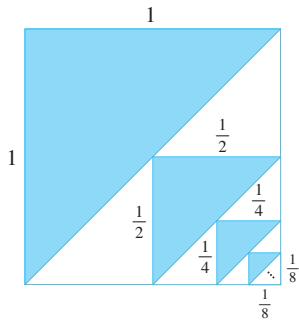
CHAPTER 9 Additional and Advanced Exercises
Determining Convergence of Series
Which of the series
∑ ∞ 𝑛 = 1 ( − 1 ) 𝑛 t a n h 𝑛
Which of the series
𝑎 1 = 1 , 𝑎 𝑛 + 1 = 𝑛 ( 𝑛 + 1 ) ( 𝑛 + 2 ) ( 𝑛 + 3 ) 𝑎 𝑛
(Hint: Write out several terms, see which factors cancel, and then generalize.)
-
𝑎 1 = 𝑎 2 = 7 , 𝑎 𝑛 + 1 = 𝑛 ( 𝑛 − 1 ) ( 𝑛 + 1 ) 𝑎 𝑛 i f 𝑛 ≥ 2 -
= = = a a a + 1, n 1 2 1 + a 1 1 ≥ n if 2
-
𝑎 𝑛 = 1 / 3 𝑛 𝑎 𝑛 = 𝑛 / 3 𝑛
Choosing Centers for Taylor Series
Taylor’s formula
expresses the value of f at x in terms of the values of f and its derivatives at
In Exercises 9–14, what Taylor series would you choose to represent the function near the given value of x? (There may be more than one good answer.) Write out the first four nonzero terms of the series you choose.
-
sin nearx
𝑥 = 6 . 3 -
e x near 0.4 x =
-
ln near 1.3 x x =
-
cos nearx
𝑥 = 6 9
Theory and Examples
-
Let a and b be constants with
0 < 𝑎 < 𝑏 . { ( 𝑎 𝑛 + 𝑏 𝑛 ) 1 / 𝑛 } -
Find the sum of the infinite series
- Evaluate
- Find all values of x for which
converges absolutely.

- a. Does the value of
appear to depend on the value of a? If so, how?
b. Does the value of
appear to depend on the value of b? If so, how?
c. Use calculus to confirm your findings in parts (a) and (b). 20. Show that if
converges.
- Find a value for the constant b that will make the radius of convergence of the power series
equal to 5.
-
How do you know that the functions sin x, ln x, and
𝑒 𝑥 -
Find the value of a for which the limit
is finite, and evaluate the limit.
- Find values of a and b for which
- Raabe’s (or Gauss’s) Test The following test, which we state without proof, is an extension of the Ratio Test.
Raabe’s Test: If
where
Show that the results of Raabe’s Test agree with what you know about the series
- (Continuation of Exercise 25.) Suppose that the terms of
∑ ∞ 𝑛 = 1 𝑢 𝑛
Apply Raabe’s Test to determine whether the series converges.
- Suppose that
∑ ∞ 𝑛 = 1 𝑎 𝑛 𝑎 𝑛 ≠ 1 , 𝑎 𝑛 > 0 ∑ ∞ 𝑛 = 1 𝑎 2 𝑛
b. Does
-
(Continuation of Exercise 27.) If
∑ ∞ 𝑛 = 1 𝑎 𝑛 0 < 𝑎 𝑛 < 1 ∑ ∞ 𝑛 = 1 l n ( 1 − 𝑎 𝑛 ) ( 1 − 𝑎 𝑛 ) | ≤ 𝑎 𝑛 / ( 1 − 𝑎 𝑛 ) . ) -
Nicole Oresme’s Theorem Prove Nicole Oresme’s Theorem:
(Hint: Differentiate both sides of the equation
- a. Find a power series representation of
𝑒 𝑥 − 1 𝑥 .
b. By differentiating the series in part (a) term by term, show that
- a. Find a power series representation of
𝑒 − 𝑥 2
b. By differentiating the series in part (a) twice term-by-term, show that
- a. Show that
for
twice, multiplying the result by x, and then replacing x by
b. Use part (a) to find the real solution greater than 1 of the equation
33. Quality control
a. Differentiate the series
to obtain a series for
b. In one throw of two dice, the probability of getting a roll of 7 is
c. As an engineer applying statistical control to an industrial operation, you inspect items taken at random from the assembly line. You classify each sampled item as either “good” or “bad.” If the probability of an item’s being good is p and of an item’s being bad is
- Expected value Suppose that a random variable X may assume the values 1, 2, 3, … , with probabilities
𝑝 1 , 𝑝 2 , 𝑝 3 , … 𝑝 𝑘 𝑘 ( 𝑘 = 1 , 2 , 3 , . . . ) 𝑝 𝑘 ≥ 0 ∑ ∞ 𝑘 = 1 𝑝 𝑘 = 1 𝑋 , ∑ ∞ 𝑘 = 1 𝑘 𝑝 𝑘 ∑ ∞ 𝑘 = 1 𝑝 𝑘 = 1

- Safe and effective dosage The concentration in the bloodT resulting from a single dose of a drug normally decreases with time as the drug is eliminated from the body. Doses may therefore need to be repeated periodically to keep the concentration from dropping below some particular level. One model for the effect of repeated doses gives the residual concentration just before the
( 𝑛 + 1
where
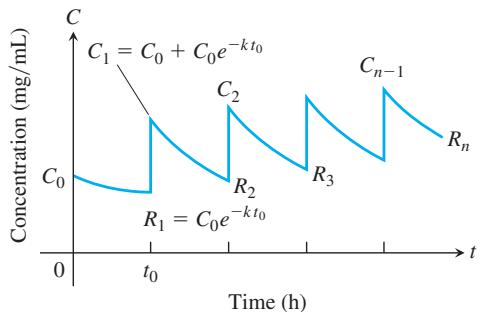
a. Write
b. Calculate
c. If
(Source: Prescribing Safe and Effective Dosage, B. Horelick and S. Koont, COMAP, Inc., Lexington, MA.)
- Time between drug doses (Continuation of Exercise 35.) If a drug is known to be ineffective below a concentration
𝐶 𝐿 𝐶 𝐻 𝐶 0 𝑡 0 𝐶 𝐻 ) 𝐶 𝐿 ) 𝐶 0 𝑡 0
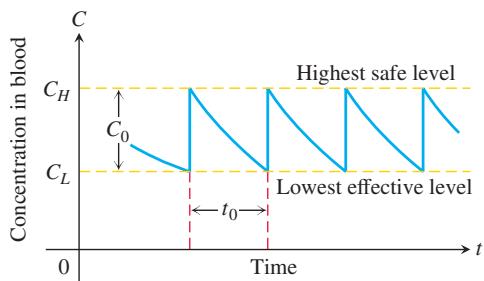
Thus
To reach an effective level rapidly, one might administer a “loading” dose that would produce a concentration of
a. Verify the preceding equation for
b. If
c. Given
d. Suppose that
CHAPTER 9 Technology Application Projects
Mathematica/Maple Projects
Projects can be found within MyLab Math.
• Bouncing Ball
The model predicts the height of a bouncing ball, and the time until it stops bouncing.
• Taylor Polynomial Approximations of a Function A graphical animation shows the convergence of the Taylor polynomials to functions having derivatives of all orders over an interval in their domains.